





Let the Mangroves Whisper to You
— Discover the Sundarban Tour

There are destinations that dazzle with grandeur, and then there are those that speak in hushed tones—drawing travellers not with spectacle, but with a quiet, ancient power. The Sundarban, the world’s largest contiguous mangrove forest, belongs to the latter. To step here is to enter a realm where nature never raises its voice, yet commands absolute reverence. Mangrove roots rise like scripts carved by time, the tidal creeks wind like liquid myths, and the forest itself whispers stories that only the patient ear can decode. A Sundarban tour is not merely a holiday; it is a slow awakening to the intelligence of the wild, an invitation to let the mangroves speak to your senses, your memory, and your understanding of the fragile equilibrium that sustains life.
The Mangrove Whisper — A Forest That Communicates in Silence
Mangroves are among the most adaptive species on earth. At first glance, their tangled architecture appears chaotic, but the more one observes, the more a profound natural order reveals itself. Every prop root is a strategic response to shifting tides; every pneumatophore is an instrument of survival; every leaf shows an ecological negotiation between land and sea. Nowhere is this elegant complexity more visible than in the Sundarban Delta, where more than 80 mangrove species collectively shape a forest that breathes with the rhythm of the tides.
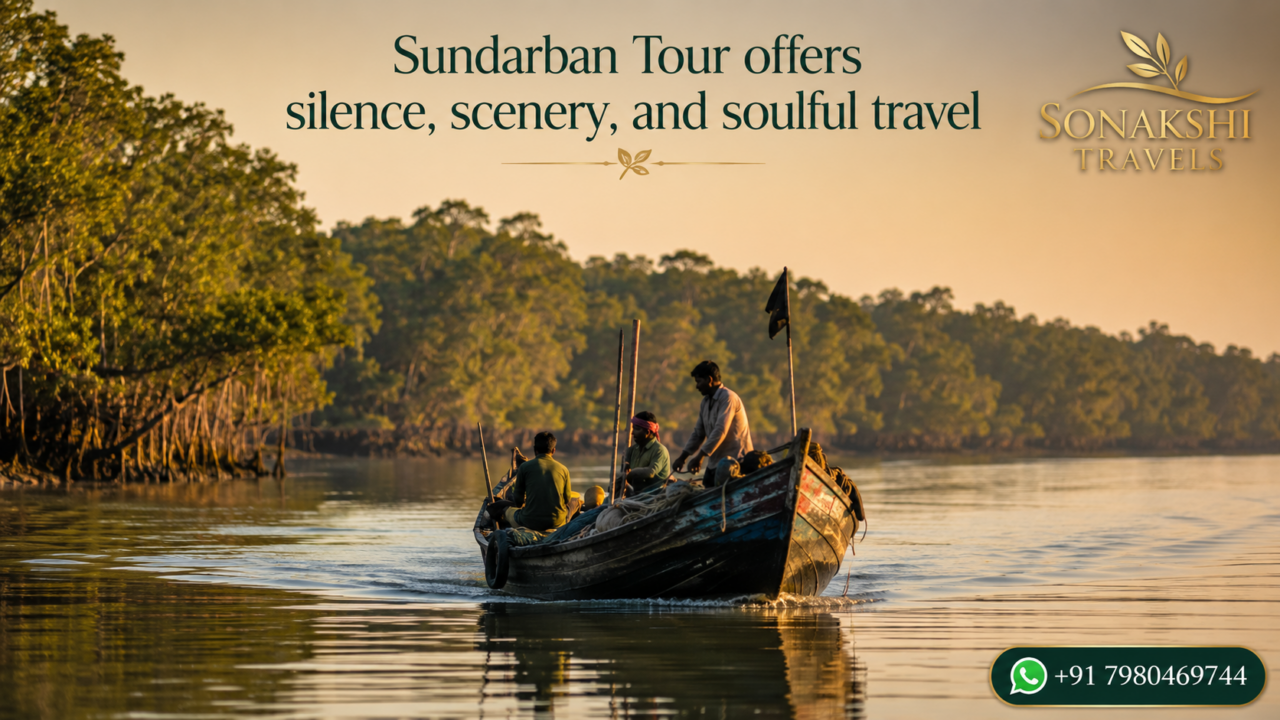
As boats glide through the emerald corridors, travellers often feel the subtle atmospheric change—the air becomes denser yet purer, carrying a signature blend of saline moisture, silt, and quiet. The “whisper of the mangroves” is not poetic exaggeration; it is the sensory resonance created by wind brushing past layered leaves, birds shifting on branches, and waterways rearranging themselves throughout the day. To hear it is to understand why this forest inspired myths, rituals, poetry, and fierce devotion among the communities living on its edge.
For those planning a well-structured journey, curated platforms such as Sundarban Travel serve as reliable gateways to understand routes, accommodation categories, and responsible forest navigation. When exploring deeper insights into the region, the authoritative reference from Wikipedia offers valuable scientific context.
Tides that Shape a Living Landscape
The Sundarban is not a static forest; it is a living, pulsating organism built by the eternal dance between freshwater from the Ganga-Brahmaputra-Meghna basin and saline water from the Bay of Bengal. The twice-daily tides do more than flood or drain land—they redraw borders, nourish vegetation, disperse nutrients, and sculpt natural channels used by both humans and wildlife.
During high tide, the forest appears to float, with only the upper canopies visible above the rising water. During low tide, mudflats reveal themselves along with prints of deer, wild boars, and even the elusive Bengal tiger. This alternation of concealment and revelation is central to the forest’s mystique. It is this tidal dynamism that makes every journey unique; no traveller can witness the exact same Sundarban twice.
The Royal Bengal Tiger — A Presence That Is Felt More Than Seen
The Sundarban is home to the world’s largest population of mangrove-dwelling tigers. Their behavioural patterns differ from their inland counterparts: they swim adeptly across creeks, camouflage within mangrove shadows, and move silently through narrow forest corridors. While sightings remain rare, what visitors feel is the forest’s palpable tension—subtle indicators that apex life exists nearby. Scratch marks on trees, pugmarks on fresh mud, a sudden alarm cry from deer, or complete silence descending over water bodies can signal the tiger’s hidden presence.
This rare ecosystem is protected under strict forest regulations, ensuring ethical tourism. To navigate these guidelines and select safe, permitted routes, travellers often choose structured packages such as those listed on Sundarban Tour, which promote sustainability and trained naturalist guidance.
A Symphony of Biodiversity Beyond the Tiger
Although the tiger captures global imagination, the Sundarban’s ecological richness extends far beyond this apex predator. Each creek harbours a hidden world where aquatic life thrives in brackish harmony. Estuarine crocodiles bask along muddy banks, Gangetic dolphins create silver arcs in the water, and fishing cats prowl silently at dusk. The region shelters numerous species of kingfishers, herons, owls, eagles, and migratory birds that treat the delta as a seasonal refuge.
The forest also supports unique flora—salt-excreting trees like Avicennia, stilt-rooted species like Rhizophora, and the famed Sundari tree that gives the forest its name. Every plant species participates in preventing coastal erosion, filtering water, nurturing biodiversity, and stabilizing the delicate freshwater-saltwater balance. The Sundarban’s ecological intelligence operates constantly, silently, and precisely—a natural engineering marvel that humbles even the most seasoned environmental scholars.
Villages on the Edge — Lives Intertwined with the Forest’s Rhythm
Life in the Sundarban’s fringe villages is defined by coexistence. Here, the forest is not just a destination; it is a neighbour that must be respected, feared, and cherished simultaneously. Families depend on fishing, honey collection, crab harvesting, and small-scale agriculture, all of which demand acute awareness of tides, seasons, and wildlife movement.
Honey collectors, known locally as Moulay, undertake dangerous expeditions into the deep forest each year. Their rituals of seeking the forest goddess Bonbibi’s blessings reveal the cultural spine of the region—a belief system shaped through generations of living amidst uncertainty and wild beauty. Their stories, myths, and songs offer travellers profound insight into human resilience and devotion.
The Experience of a Sundarban Tour — A Journey of Awareness
The Approach from Kolkata
A typical journey begins with a road transfer from Kolkata to gateways like Godkhali, Sonakhali, or Canning. The transition is striking—the city’s architectural geometry gradually dissolves into open paddy fields, narrow village roads, and networks of tidal canals. By the time you step onto the boat, urban time no longer applies; the pace of the river becomes the only clock that matters.
Entering the Creeks
Once the boat enters the protected forest area, travellers encounter landscapes that appear untouched for centuries. The creeks narrow gradually, their edges thick with mudskippers, crabs, and the characteristic knee-roots of mangroves. Naturalists explain how these roots filter salt, manage tides, and help trees breathe—turning each sighting into a small ecology lesson.
Watchtowers and Forest Islands
Watchtowers like Sajnekhali, Dobanki, and Sudhanyakhali offer elevated perspectives of the delta. From these vantage points, one sees the mosaic of waterways, forest islands, and distant fishing settlements. The canopy walk at Dobanki—suspended above the forest floor—reveals the mangrove world from a rare height, making visitors conscious of the delicate balance between wildlife and human presence.
Evening Halts on Riverbanks
As dusk approaches, the Sundarban undergoes a dramatic tonal shift. Water darkens into ink, the sky burns briefly in shades of amber and rose, and birds return to their nesting islands in orchestrated flocks. Many travellers describe this moment as the highlight of their journey. The silence becomes textured, and the forest’s whisper becomes deeper, almost meditative. Nights spent on anchored boats or riverside resorts often include local cultural performances—folk dances, Bonbibi pala, or ritual songs that narrate the forest’s mythology.
Understanding the Science Behind the Mystique
What makes the Sundarban scientifically extraordinary is not merely its size but its functionality. It acts as a natural shield protecting millions of people from cyclones, dissipating wind energy and storm surges through its dense vegetation. Research indicates that mangroves reduce wave velocity by up to 66% over short distances, effectively absorbing the ocean’s fury.
The forest also stores immense carbon reserves in its thick sediment layers, making it a critical component in global climate-change mitigation. Its tidal channels act as natural filtration systems, maintaining water quality and supporting fisheries that are central to regional livelihoods. In essence, the Sundarban is not just a wilderness; it is a hydrological guardian, ecological engineer, and climate stabiliser.
A Call for Responsible Exploration
The Sundarban’s fragility demands a responsible approach from travellers. Respecting forest guidelines, avoiding plastic, maintaining silent observation during wildlife spotting, and choosing licensed operators are essential aspects of ethical tourism. The benefit is twofold: the forest remains protected, and travellers experience a more authentic, undisturbed wilderness.
For carefully designed itineraries, safety protocols, and curated naturalist-led experiences, travellers often rely on structured platforms such as those offering detailed Sundarban Tour Package insights, ensuring both comfort and conservation-aligned exploration.
When the Forest Finally Speaks to You
A journey through the Sundarban is ultimately a journey inward. The forest does not reveal itself immediately. It waits, watches, and unveils its layers slowly—through shifting light, rippling creeks, unseen movements, and distant calls. Eventually, there comes a moment when the landscape feels alive in a way that defies scientific explanation. This is when the mangroves truly whisper to you—when the forest, tides, breeze, and silence merge into one seamless language. To experience this is to understand why the Sundarban is not merely visited but felt, remembered, and cherished long after the journey concludes.