





Kolakham – At the Edge of Neora Valley Forest:
A Detailed Travel Narrative
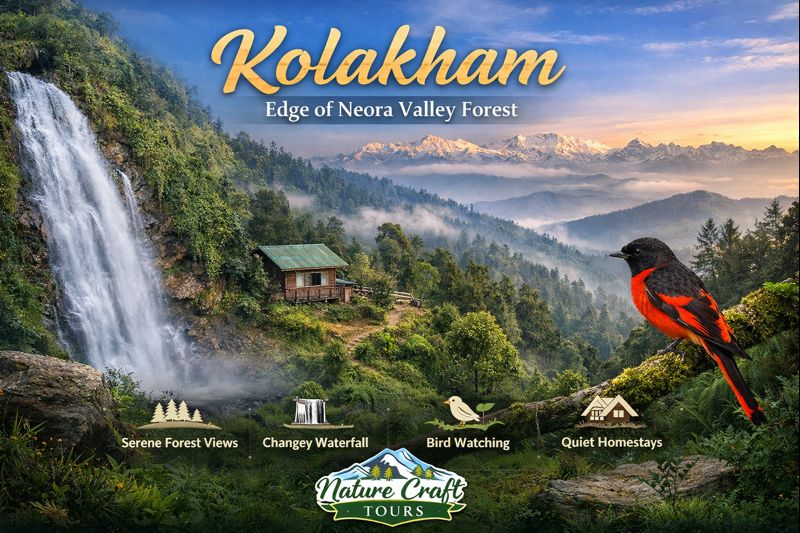
Tucked quietly on the eastern fringes of the Eastern Himalayas, Kolakham stands as a pristine forest-side settlement overlooking the deep green wilderness of the Neora Valley National Park. Unlike mainstream hill destinations of North Bengal, Kolakham does not announce itself loudly. Instead, it invites travelers through silence, mist, birdsong, and an overwhelming sense of untouched natural order. This small hamlet, located at an altitude of approximately 6,100 feet, serves as a natural balcony facing one of India’s most biodiverse forest reserves.
Kolakham’s identity is inseparably linked with Neora Valley forest. The village exists not as a tourist center, but as a gentle human presence at the very threshold of a protected ecosystem. It is this delicate balance between habitation and wilderness that gives Kolakham its rare charm. Travelers who seek immersive forest experiences, slow travel, and authentic Himalayan village life find Kolakham deeply rewarding.
Geographical Setting and Environmental Importance
Kolakham is situated in the Kalimpong district of West Bengal, bordering the Neora Valley National Park, which stretches across elevations ranging from 183 meters to over 3,200 meters. The forest is internationally recognized as an ecological transition zone between tropical, subtropical, and temperate ecosystems. Kolakham lies precisely where dense broadleaf forests begin to merge with higher-altitude conifer zones.
The terrain around Kolakham is rugged yet deeply forested. Steep slopes descend sharply into valleys layered with ferns, mosses, orchids, and towering oak trees. From several points in the village, uninterrupted views of forested ridges are visible, often disappearing into low-hanging clouds. On clear mornings, the distant Himalayan ranges glow faintly, creating an ethereal landscape.
The ecological significance of this region is immense. Neora Valley is home to rare species such as the Red Panda, Clouded Leopard, Himalayan Black Bear, and more than 300 species of birds. Kolakham, being a fringe settlement, acts as a buffer zone where sustainable tourism and conservation coexist.
Key Attractions and Experiences in Kolakham
Neora Valley Forest Views
The primary attraction of Kolakham is the uninterrupted visual access to Neora Valley forest. Unlike destinations where forests are accessed via gates and tickets, Kolakham offers an organic experience where the forest forms the backdrop of daily life. Early mornings often reveal rolling mist drifting through tree canopies, while evenings are marked by sudden silence broken only by cicadas and distant bird calls.
Changey Waterfall
Located a short distance from Kolakham, Changey Waterfall is a seasonal cascade fed by forest streams. During monsoon and post-monsoon months, the waterfall flows with dramatic intensity, creating a refreshing microclimate around it. The approach trail passes through thick forest growth, offering a brief yet immersive nature walk.
Birdwatching and Wildlife Observation
Kolakham is regarded as one of the finest birdwatching locations in North Bengal. Species such as Scarlet Minivet, Himalayan Woodpecker, Blue-fronted Redstart, Verditer Flycatcher, and various species of Laughingthrush are frequently spotted. Early morning walks along village trails provide exceptional opportunities for observation without disturbing wildlife.
Forest Walks and Nature Trails
Guided forest-edge walks around Kolakham introduce travelers to medicinal plants, wild orchids, and ancient trees. These trails do not involve aggressive trekking but rather contemplative exploration. The forest floor, layered with decomposed leaves, supports a complex web of fungi and insects that reflect the ecological health of the region.
Cultural Landscape and Village Life
Kolakham is inhabited primarily by local Nepali-speaking communities who have lived alongside the forest for generations. Their relationship with the forest is governed by respect and restraint rather than exploitation. Agriculture here is limited and sustainable, often consisting of small vegetable plots and seasonal crops.
Daily life follows natural rhythms. Sunrise dictates work schedules, and evenings conclude early. Visitors often find themselves adapting unconsciously to this slower pace. Cultural interactions remain subtle—shared conversations, locally prepared meals, and quiet hospitality form the core of the experience.
Major Distances from Kolakham
Understanding distances is essential for planning travel to Kolakham, as road conditions and terrain significantly influence travel time.
- Kolakham to Lava: approximately 10 kilometers
- Kolakham to Loleygaon: approximately 15 kilometers
- Kolakham to Kalimpong: approximately 45 kilometers
- Kolakham to Siliguri: approximately 95 kilometers
- Kolakham to NJP Railway Station: approximately 100 kilometers
- Kolakham to Bagdogra Airport: approximately 105 kilometers
How to Reach Kolakham
By Air
The nearest airport is Bagdogra, well connected to major Indian cities. From Bagdogra, travelers must undertake a road journey via Kalimpong or Lava. The final stretch beyond Lava involves narrow mountain roads, making daylight travel advisable.
By Train
New Jalpaiguri (NJP) Railway Station serves as the primary railhead. From NJP, shared or reserved vehicles are available up to Kalimpong or Lava, followed by a smaller vehicle transfer to Kolakham.
By Road
Road travel is the most immersive way to reach Kolakham. Routes from Siliguri pass through Teesta Valley before ascending toward Kalimpong and Lava. The final approach offers forest-lined roads with minimal traffic, enhancing the sense of remoteness.
Staying Options in Kolakham
Accommodation in Kolakham remains intentionally limited to preserve ecological balance. The village primarily offers eco-friendly homestays, forest lodges, and small nature resorts designed using local materials. These properties focus on warmth, simplicity, and integration with surroundings rather than luxury.
Most stays provide forest-facing rooms, home-cooked meals using seasonal ingredients, and guided nature activities. Electricity availability may vary during adverse weather conditions, reinforcing the off-grid experience that Kolakham represents.
Travelers accustomed to curated eco-tourism experiences in destinations like Sundarbans often appreciate this model of low-impact hospitality. For those interested in exploring nature-based travel across India, curated experiences are also discussed on platforms such as
Sundarban Travel, where forest-centric tourism philosophies align closely with Kolakham’s ethos.
Best Time to Visit Kolakham
Spring (March to May)
Spring brings blooming rhododendrons and clear forest views. Temperatures remain moderate, making it ideal for nature walks and photography.
Monsoon (June to September)
Monsoon transforms Kolakham into a lush green sanctuary. While landslides and roadblocks are possible, the forest reaches peak vibrancy. This season suits travelers seeking solitude and dramatic landscapes.
Autumn (October to November)
Post-monsoon months offer the clearest skies and optimal birdwatching conditions. Forest trails become accessible, and long-range views occasionally include Himalayan peaks.
Winter (December to February)
Winters are cold, with temperatures often dropping near freezing. While snowfall is rare, frost is common. This season is best for travelers seeking quiet retreats and misty forest mornings.
Responsible Travel and Conservation Awareness
Kolakham’s proximity to a protected forest demands responsible behavior. Plastic usage should be minimized, noise levels kept low, and wildlife left undisturbed. Travelers are encouraged to respect local customs and forest regulations.
Sustainable tourism initiatives across India highlight similar principles, whether in Himalayan forests or mangrove ecosystems. Comparative insights into responsible forest tourism can be explored through resources like
Sundarban Tour, where conservation-led travel models are increasingly emphasized.
Why Kolakham Appeals to the Thoughtful Traveler
Kolakham does not cater to hurried itineraries or checklist tourism. Its appeal lies in presence—being present in a forested landscape that operates on ecological time rather than human schedules. The village allows travelers to witness how life unfolds at the margins of wilderness without intrusion.
For photographers, naturalists, writers, and those seeking digital detox, Kolakham provides rare clarity. It represents a form of travel where silence is not empty but full of meaning, and where landscapes are not consumed but contemplated.
Kolakham stands quietly at the edge of Neora Valley forest, offering one of North Bengal’s most authentic forest-side travel experiences. Its restrained development, ecological sensitivity, and immersive natural surroundings distinguish it from more commercial hill destinations. Travelers who choose Kolakham do not merely visit a place—they step into a living forest narrative shaped by mist, birdsong, and centuries-old natural processes.
As interest in offbeat and sustainable destinations grows, Kolakham remains a reminder that true travel value often lies not in what is offered, but in what is preserved.