




Lower Tindharia
– Where Mist, Machines, and Mountains Whisper Together
Nestled quietly along the lower slopes of the Darjeeling Himalayas, Lower Tindharia remains one of those rare hill settlements that still breathe at their own pace. Overshadowed by its more frequented neighbors yet rich in layered history, forested contours, and colonial-era engineering legacies, Lower Tindharia offers a deeply immersive travel experience for those who seek authenticity rather than attraction lists. This tranquil pocket near the historic Hill Cart Road is not a destination of spectacle; it is a destination of silence, memory, and slow discovery.
Unlike mainstream hill towns shaped by tourism infrastructure, Lower Tindharia continues to exist as a lived-in landscape—where moss-covered stone walls, old railway quarters, mist-laden pine slopes, and distant whistles of mountain winds form the everyday rhythm. For travelers exploring offbeat Darjeeling circuits, Lower Tindharia functions as a reflective pause between destinations, quietly revealing the emotional geography of the Eastern Himalayas.
Understanding the Geographic Setting of Lower Tindharia
Lower Tindharia is situated in the Darjeeling district of West Bengal, positioned below the more elevated Tindharia settlement and closely aligned with the historic Hill Cart Road corridor. Geographically, it rests at a transitional altitude—where the plains begin to dissolve into foothills, and subtropical vegetation slowly gives way to temperate forests. This unique positioning grants Lower Tindharia a layered ecological profile, featuring sal forests at lower stretches and pine, oak, and fern-rich growth as elevation increases.
The area forms part of the broader Kurseong subdivision and remains historically connected to colonial railway development, forest management zones, and tea logistics routes. Its terrain undulates gently rather than dramatically, making it ideal for slow walks, nature observation, and immersive stays.
Altitude, Climate, and Natural Environment
Lower Tindharia lies approximately between 1,800 and 2,500 feet above sea level. This moderate altitude results in a pleasant climate throughout much of the year. Summers remain mild, monsoons transform the region into a lush green sanctuary, and winters bring cool air without the harshness of higher Himalayan zones.
Morning mists frequently roll through the valley, creating ethereal scenes where forest canopies appear suspended in clouds. Birdlife thrives here, and the silence is often punctuated only by cicadas, distant road echoes, or rustling leaves.
Historical Layers That Shaped Lower Tindharia
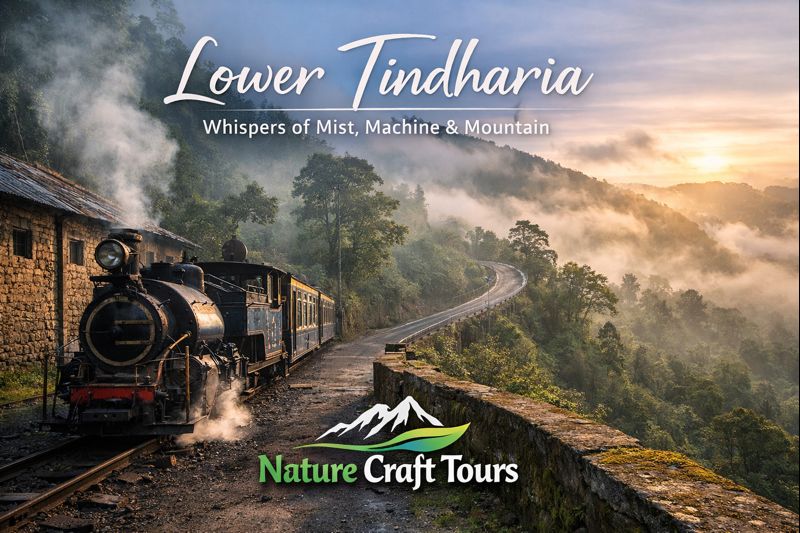
Lower Tindharia owes much of its early development to British-era infrastructural planning. The construction of the Hill Cart Road and the Darjeeling Himalayan Railway transformed this region into a strategic transit and maintenance zone. Old railway quarters, abandoned stone structures, and remnants of workshops still dot the landscape, offering subtle glimpses into a time when steam locomotives defined mountain mobility.
Unlike curated heritage towns, Lower Tindharia’s history remains embedded in everyday life rather than preserved behind plaques. Locals continue to inhabit colonial-built homes, often blending traditional Nepali architectural elements with British-era layouts.
Cultural Continuity and Local Life
The population of Lower Tindharia primarily comprises Nepali-speaking hill communities whose lives remain closely tied to forest rhythms, small-scale agriculture, and seasonal labor. Cultural expressions are understated yet deeply rooted—manifested in food habits, festivals, and oral traditions rather than performances for visitors.
Visitors willing to engage respectfully often find conversations here richer than itineraries. Stories flow slowly, like the mountain paths themselves.
Important Places and Experiences Around Lower Tindharia
Lower Tindharia does not offer landmark-style sightseeing. Instead, its charm lies in experiential exploration—walking, observing, and absorbing.
Hill Cart Road Forest Stretches
One of the most rewarding experiences in Lower Tindharia is walking along quieter stretches of Hill Cart Road. Framed by towering trees and old stone embankments, these sections allow travelers to witness how nature has gradually reclaimed colonial infrastructure. Early mornings often reveal mist curling along the road, creating cinematic perspectives.
Old Railway Quarters and Heritage Remnants
Scattered through the lower slopes are remnants of railway-era residences and maintenance zones. Though not formally preserved, these structures speak volumes through peeling paint, moss-laden walls, and silent verandas overlooking valleys.
Forest Trails and Nature Walks
Lower Tindharia offers several informal forest paths used by locals for daily movement. These trails pass through mixed vegetation zones and occasionally open into clearings with valley views. Nature enthusiasts and slow travelers find these walks deeply grounding.
Major Distances from Lower Tindharia
Understanding distances helps travelers integrate Lower Tindharia into broader Darjeeling travel plans.
- Lower Tindharia to Kurseong: approximately 14 kilometers
- Lower Tindharia to Darjeeling town: approximately 38 kilometers
- Lower Tindharia to Siliguri: approximately 45 kilometers
- Lower Tindharia to NJP Railway Station: approximately 50 kilometers
- Lower Tindharia to Bagdogra Airport: approximately 55 kilometers
These distances make Lower Tindharia an excellent midway retreat between plains and higher hill destinations.
How to Reach Lower Tindharia
By Road
Lower Tindharia is best accessed via road from Siliguri or Kurseong. Private vehicles and hired taxis follow Hill Cart Road or alternative hill routes depending on traffic and weather conditions. The drive itself is scenic, transitioning gradually from tea estates to dense forest corridors.
By Rail
The nearest major railway access point is New Jalpaiguri (NJP). From NJP, road transport is the most practical option. While the Darjeeling Himalayan Railway passes through nearby zones, its services are irregular for daily connectivity.
By Air
Bagdogra Airport serves as the nearest airport. From Bagdogra, the journey to Lower Tindharia takes approximately two to two-and-a-half hours by road, depending on traffic and weather.
Staying Options in and Around Lower Tindharia
Accommodation in Lower Tindharia is limited and intentionally understated. This is not a resort-centric destination, and that is precisely its appeal.
Homestays and Heritage Homes
A few family-run homestays operate within and around Lower Tindharia. These stays typically offer simple rooms, home-cooked meals, and a close connection to local life. Many are located in older houses with valley-facing verandas and forest surroundings.
Nearby Stay Alternatives
Travelers seeking more options may choose to stay in Kurseong or nearby forest-fringe settlements and visit Lower Tindharia as a day exploration or short retreat. This approach works well for those following a larger offbeat Darjeeling itinerary similar to routes including Tinchuley village trails or other quiet Himalayan hamlets.
Best Time to Visit Lower Tindharia
The most suitable period to explore Lower Tindharia is from October to early April. During these months, the weather remains stable, skies clearer, and walking conditions comfortable.
Monsoon months from June to September transform the region into a vivid green sanctuary, but landslides and slippery paths may restrict movement. However, for experienced travelers seeking solitude and dramatic landscapes, monsoon visits can be deeply rewarding.
Lower Tindharia in the Context of Offbeat Himalayan Travel
Lower Tindharia fits naturally into thematic travel routes focused on silence, heritage, and slow exploration. It pairs well with lesser-known settlements and experiential destinations promoted through curated travel platforms such as Sundarban Travel and broader immersive circuits developed by responsible tourism planners.
Travelers combining forested hills with deltaic wilderness often explore mountain retreats before heading toward mangrove ecosystems through journeys curated under Sundarban Tour experiences, allowing for a holistic understanding of Eastern India’s ecological diversity.
Within offbeat Darjeeling explorations, Lower Tindharia complements destinations like Tinchuley, where human settlements and natural rhythms remain in quiet equilibrium.
A Poem for Lower Tindharia
Between the road and the forest’s breath,
Lower Tindharia waits without a name.
Mist settles softly on forgotten walls,
Time walks slower, unafraid of clocks.
Old stones remember footsteps now gone,
Pines listen where engines once roared.
Silence speaks in drifting cloud and leaf,
Morning arrives without announcement.
Here, travel becomes a gentle pause,
And the hills keep what the world forgets.
Why Lower Tindharia Deserves a Place in Your Journey
Lower Tindharia is not a destination to be consumed; it is a place to be experienced quietly. It offers no grand viewpoints or curated attractions, yet it provides something rarer—a sense of continuity between past and present, nature and memory. For travelers seeking to step outside commercial tourism narratives and engage with landscapes that still breathe freely, Lower Tindharia stands as a meaningful pause along the Himalayan road.
In choosing Lower Tindharia, one chooses stillness over spectacle, depth over display, and presence over pace.