





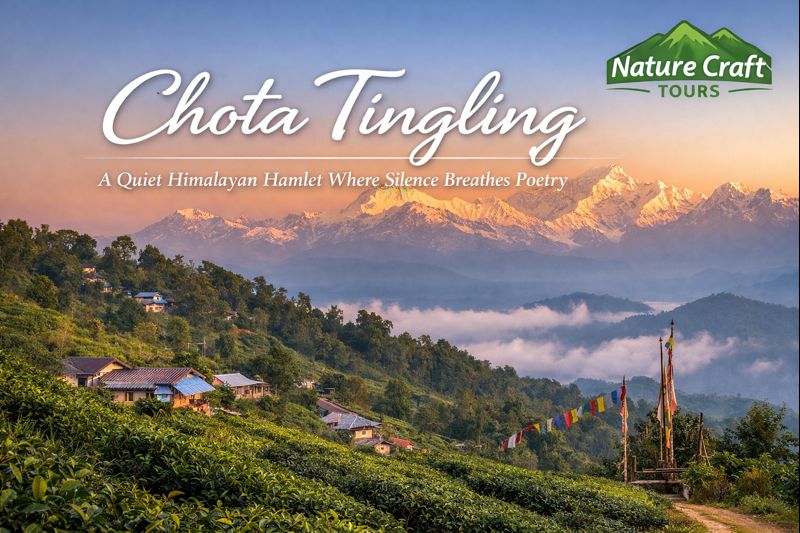
Chota Tingling
– A Quiet Himalayan Hamlet Where Silence Breathes Poetry
Nestled quietly between the lesser-known folds of the Eastern Himalayas, Chota Tingling stands as a subtle yet deeply evocative destination for travellers seeking authenticity beyond mainstream hill tourism. Unlike crowded hill towns that echo with constant movement, Chota Tingling unfolds slowly—through whispering pine forests, mist-laden tea slopes, scattered hamlets, and a lifestyle still guided by seasons rather than schedules. This offbeat settlement, located close to the Darjeeling–Kalimpong transitional belt, offers a contemplative travel experience rooted in nature, culture, and silence.
Chota Tingling is not a place that announces itself loudly. Instead, it invites travellers to observe, to listen, and to remain still. The beauty here lies in subtle shifts of light across terraced fields, the sound of wind brushing against bamboo groves, and the gentle hospitality of local households who continue to live in harmony with their surroundings. For researchers, slow travellers, writers, photographers, and nature lovers, this village becomes more than a destination—it becomes a pause.
Geographical Setting and Landscape Character
Chota Tingling is situated at a moderate altitude within the Darjeeling district of West Bengal, positioned between the better-known rural corridors connecting. The landscape here is defined by rolling hills rather than sharp peaks, making it visually soothing and ecologically diverse. Mixed forests of pine, alder, oak, and seasonal flowering shrubs dominate the terrain, while small agricultural plots follow the contours of the land.
Tea gardens in nearby belts influence the ecology and economy of the area, although Chota Tingling itself remains largely agrarian. The soil composition, rainfall pattern, and elevation collectively support crops such as maize, ginger, cardamom, seasonal vegetables, and traditional millet varieties. These elements together create a rural Himalayan micro-region that has remained relatively untouched by rapid commercialization.
Climate and Natural Rhythm
The climate of Chota Tingling is temperate throughout the year, marked by cool mornings, mild afternoons, and refreshing evenings. Summer months remain pleasant, with temperatures rarely becoming oppressive. Monsoons bring heavy rainfall that rejuvenates forests and farmlands, while winter introduces crisp air and misty mornings that lend the village a dreamlike quality. The natural rhythm here is slow, seasonal, and deeply connected to agricultural cycles.
Cultural Landscape and Village Life
The social fabric of Chota Tingling reflects a blend of Nepali, Lepcha, and hill Bengali influences. Daily life revolves around farming, livestock rearing, forest resource management, and community-based celebrations. Houses are modest, often built with stone, wood, and corrugated roofing, designed to withstand the climatic conditions of the hills.
Local traditions are preserved through festivals, oral storytelling, and food practices. Seasonal festivals linked to harvest cycles are observed with simplicity rather than spectacle. Visitors often find themselves drawn into conversations around hearth fires, listening to stories of weather patterns, forest spirits, and changing times. This cultural intimacy is one of the most defining aspects of Chota Tingling.
Cuisine and Local Produce
Food in Chota Tingling is primarily organic and seasonal. Meals are prepared using vegetables grown in backyard gardens, complemented by locally sourced grains and herbs. Traditional preparations emphasize simplicity, nutrition, and warmth. For travellers, sharing a meal here becomes an immersive cultural experience rather than a culinary indulgence.
Important Places and Experiences to See
Chota Tingling does not offer conventional tourist attractions. Instead, its appeal lies in experiential travel. Forest walks along narrow trails reveal rich birdlife and seasonal flora. Sunrise viewpoints, often known only to locals, provide expansive views of layered hills disappearing into morning mist.
Village pathways connect small clusters of homes, prayer flags, and agricultural fields, offering ideal settings for photography and reflective walks. Interaction with local families, participation in daily routines, and observation of farming practices form the core experiences here. Travellers looking for authenticity rather than activity-based tourism find deep satisfaction in these understated encounters.
Nature Trails and Quiet Exploration
Short forest trails around Chota Tingling are suitable for all age groups and do not require technical trekking skills. These paths are often used by villagers and pass through bamboo groves, shaded ridges, and open clearings. Early mornings and late afternoons are particularly rewarding for nature observation.
Major Distances and Connectivity
Chota Tingling is reasonably accessible while still maintaining its offbeat character. The village lies approximately 35–40 kilometers from Darjeeling town and about 30 kilometers from Kalimpong. From Siliguri, the primary gateway to North Bengal hills, the distance is roughly 75–80 kilometers depending on the chosen route.
Despite these manageable distances, travel time can be longer due to winding mountain roads. This gradual approach, however, allows travellers to transition slowly from urban settings into rural Himalayan landscapes, enhancing the overall travel experience.
How to Reach Chota Tingling
The nearest major transport hub is Siliguri, which is well connected by rail, road, and air. From Siliguri, travellers typically proceed towards Teesta Valley routes before branching off towards the interior village roads leading to Chota Tingling. Shared or private vehicles are commonly used for the final stretch, as public transport connectivity becomes limited closer to the village.
Travellers coming from Darjeeling or Kalimpong can reach Chota Tingling via connecting rural roads that pass through tea garden belts and forested sections. The journey itself is scenic, marked by changing vegetation zones and expansive valley views.
Travel Advisory
Due to narrow roads and occasional landslides during monsoon months, it is advisable to plan travel during daylight hours and consult local guidance when navigating interior routes. This ensures both safety and comfort.
Staying Options and Accommodation Style
Accommodation in Chota Tingling is primarily homestay-based, offering travellers an opportunity to live within the village ecosystem. These properties are usually family-run and designed to provide clean, comfortable, and culturally immersive stays. Rooms are simple yet well-maintained, often featuring views of surrounding hills or fields.
Some eco-lodges and village guesthouses are gradually emerging in nearby areas, focusing on sustainable practices and low-impact tourism. These properties prioritize local employment, traditional architecture, and minimal environmental footprint. Visitors are encouraged to choose accommodations that respect the village’s ecological and cultural balance.
Best Time to Visit Chota Tingling
The most favorable time to visit Chota Tingling is between October and May. Post-monsoon months offer clear skies, lush greenery, and comfortable temperatures. Winter months, though cooler, provide crisp air and tranquil surroundings ideal for introspective travel.
Monsoon season, from June to September, transforms the landscape into a vivid green expanse but also brings challenges related to road conditions. While visually stunning, travel during this period is recommended only for experienced hill travellers.
Chota Tingling
Where hills speak softly to wandering clouds,
Where silence carries the weight of time,
Chota Tingling rests without asking to be found.
Morning mist folds gently into green valleys,
And footsteps dissolve into forest breath.
Here, life flows like an unhurried stream,
Measured not by clocks, but by seasons.
Lantern light warms wooden rooms at dusk,
Stories linger longer than footsteps depart,
And peace remains, long after the traveller leaves.
Responsible Travel and Regional Context
Travelling to Chota Tingling carries a responsibility to preserve its fragile environment and cultural integrity. Visitors are encouraged to minimize waste, respect local customs, and support community-led tourism initiatives. Such mindful travel ensures that the village remains sustainable for future generations.
Those exploring offbeat Himalayan regions often extend their journeys to nearby hamlets such as Tinchuley village trails, which share similar ecological and cultural characteristics. Understanding these interconnected landscapes helps travellers appreciate the broader rural Himalayan system.
For travellers interested in combining hill experiences with riverine and forest ecosystems, curated itineraries such as Sundarban Tour or Sundarban Travel provide complementary journeys across eastern India’s diverse natural zones.
Chota Tingling remains a destination for those who seek meaning beyond movement—a place where the Himalayas are not a backdrop, but a quiet companion.