




Major Tourist Places in Darjeeling
Darjeeling – An Explorer’s Comprehensive Guide to the Queen of the Eastern Himalaya
Perched along the southern slopes of the Eastern Himalaya, Darjeeling is not merely a hill station; it is a living cultural and ecological corridor between the Indian plains and the Himalayan highlands. From colonial-era legacies and globally celebrated tea estates to sacred viewpoints and forested ridges, Darjeeling presents a layered travel experience that unfolds gradually. This article approaches Darjeeling as an explorer would—observing its geography, heritage, and rhythms—while offering a structured, research-based travel guide suitable for informed travelers and planners.
Understanding Darjeeling: Geographic & Cultural Context
Darjeeling town is located at an average altitude of approximately 6,700 feet above sea level, within the Darjeeling district of West Bengal. The region forms part of the lesser Himalaya and is characterized by steep ridge lines, temperate forests, and tea-clad slopes. Its cultural fabric is deeply influenced by Nepali, Tibetan, Lepcha, Bhutia, and colonial British traditions, making Darjeeling a rare confluence of ethnic histories and Himalayan lifestyles.
Major Tourist Places in Darjeeling
1. Tiger Hill
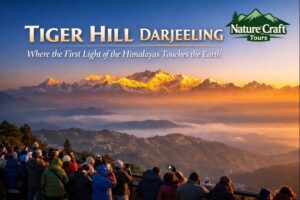
Tiger Hill is internationally renowned for its sunrise view over the Himalayan range, where Mount Kanchenjunga emerges in hues of gold and rose. On exceptionally clear mornings, even Mount Everest can be sighted in the distant western horizon.
- Key highlights: Sunrise over Kanchenjunga, Himalayan panoramic views
- Distance: Approximately 11 km from Darjeeling town
- How to reach: Early morning shared or reserved vehicles from town
- Best time to visit: October to December and March to April
2. Batasia Loop
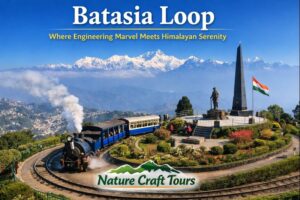
The Batasia Loop is a marvel of railway engineering where the Darjeeling Himalayan Railway negotiates a dramatic spiral turn. The landscaped garden here offers unobstructed views of snow peaks and houses a memorial dedicated to Gorkha soldiers.
- Key highlights: Toy train loop, war memorial, mountain views
- Distance: 5 km from Darjeeling town
- How to reach: Taxi or toy train excursion
- Best time to visit: Throughout the year, clear mornings preferred
3. Darjeeling Himalayan Railway (Toy Train)
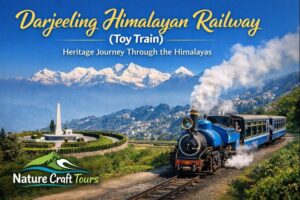
A UNESCO World Heritage Site, the Darjeeling Himalayan Railway is not simply transport but a historical journey through time. Running from New Jalpaiguri to Darjeeling, it passes through towns, forests, markets, and tea gardens at a leisurely pace.
- Key highlights: Heritage steam locomotives, mountain engineering
- Distance: NJP to Darjeeling approx. 88 km (full route)
- How to reach: Joy rides or full-route journeys from NJP
- Best time to visit: March–May and October–November
4. Himalayan Mountaineering Institute (HMI) & Padmaja Naidu Himalayan Zoological Park

Situated together, these two institutions reflect Darjeeling’s role in Himalayan exploration and conservation. The Mountaineering Institute preserves expedition history, while the zoological park focuses on high-altitude species conservation.
- Key highlights: Mountaineering museum, red panda, snow leopard
- Distance: 2 km from town center
- How to reach: Local taxi or walking trails
- Best time to visit: Morning hours year-round
5. Peace Pagoda
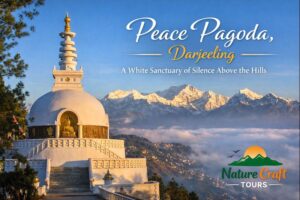
The Peace Pagoda stands as a symbol of harmony, constructed under the guidance of Japanese Buddhist monks. Overlooking the town, it offers spiritual calm along with panoramic Himalayan views.
- Key highlights: Buddhist architecture, quiet ambiance
- Distance: 4 km from town
- How to reach: Taxi or short forest walks
- Best time to visit: Sunrise and late afternoon
6. Happy Valley Tea Estate
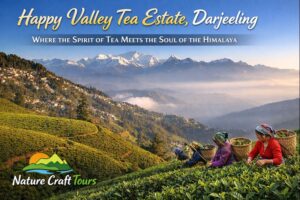
Among the oldest tea estates in Darjeeling, Happy Valley Tea Estate allows visitors to understand the heritage of Darjeeling tea through guided factory visits and plantation walks.
- Key highlights: Tea processing, colonial plantation legacy
- Distance: 3 km from town
- How to reach: Taxi or walking trail
- Best time to visit: March to November
7. Rock Garden & Ganga Maya Park
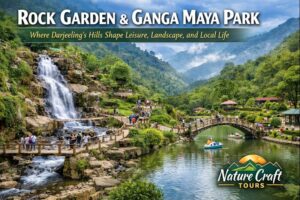
These landscaped areas lie along natural streams cascading through sculpted rock formations. They represent Darjeeling’s recreational spaces, blending nature with gentle human design.
- Key highlights: Waterfalls, terraced gardens
- Distance: Around 10 km from town
- How to reach: Half-day taxi excursion
- Best time to visit: Post-monsoon and summer
8. Observatory Hill & Mahakal Temple
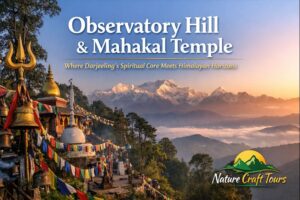
This sacred hill is a spiritual convergence where Hindu and Buddhist traditions coexist. The Mahakal Temple draws pilgrims and explorers alike for its cultural significance and hilltop views.
- Key highlights: Spiritual heritage, town viewpoints
- Distance: Within walking distance of Mall Road
- How to reach: Short uphill walk
- Best time to visit: Early morning or evening
How to Reach Darjeeling
Darjeeling is accessed primarily through the plains of North Bengal. The nearest major railhead is New Jalpaiguri (NJP), approximately 75 km away. Bagdogra Airport, about 70 km from Darjeeling, connects the region with major Indian cities. From both points, travelers ascend via scenic mountain roads through Kurseong or Mirik routes.
Staying Options in Darjeeling
Accommodation in Darjeeling ranges from heritage hotels and boutique hillside properties to modern comfort stays and family-run lodges. Areas around Mall Road, Observatory Hill, Lebong Cart Road, and Ghoom offer varied elevation-based experiences. Tea estate stays on the outskirts provide quieter, immersive alternatives.
Best Time to Visit Darjeeling
The most favorable seasons to visit Darjeeling are spring (March to May) and autumn (October to November), when skies are clear and mountain views are sharp. Summers remain cool and pleasant, while monsoons (June to September) bring mist, greenery, and occasional travel disruptions. Winters offer crisp air and occasional snowfall at higher elevations.
Darjeeling as an Explorer’s Destination
Darjeeling rewards those who approach it patiently. Beyond popular viewpoints lie forest trails, monasteries, tea hamlets, and colonial pathways that speak quietly of time and terrain. To explore Darjeeling fully is to engage with its climate, its people, and its layered Himalayan identity—an experience that remains long after the journey concludes.