




Batasia Loop
Batasia Loop:
Where Engineering Genius Meets the Soul of the Eastern Himalaya
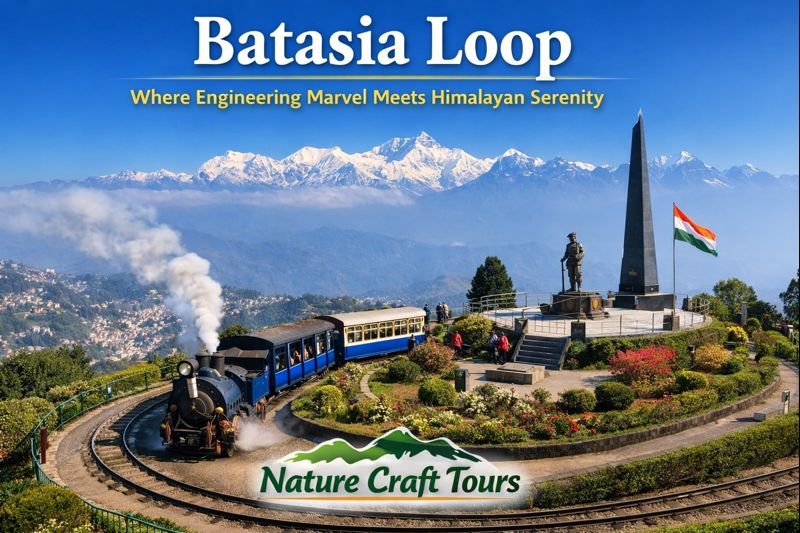
Perched quietly above the bustling hill town of Darjeeling, is far more than a scenic railway curve. It is an extraordinary synthesis of geography, colonial-era engineering, military remembrance, and Himalayan aesthetics. To an explorer’s eye, Batasia Loop is not simply a stop on a tourist itinerary—it is a living landscape where history turns gracefully, much like the iconic loop itself.
Situated on the legendary Darjeeling Himalayan Railway, this location allows travelers to observe how human ingenuity adapted to one of the world’s most challenging mountain terrains. At the same time, it offers uninterrupted views of the eastern Himalayan ranges, including the ethereal presence of Mount Kanchenjunga on clear mornings.
Geographical Setting and Natural Orientation
Batasia Loop lies approximately 5 kilometers below the town center of Darjeeling, at an elevation of nearly 7,000 feet above sea level. The loop is located between Darjeeling, the highest railway station in India. The surrounding terrain is characterized by rolling hills, manicured tea gardens, and distant forested ridges that fade into Nepal on the western horizon.
From a geographical perspective, the loop was constructed to address a steep gradient that the toy train could not otherwise navigate. The circular design enables the train to gain altitude gradually while remaining within a compact spatial footprint—an ingenious response to the constraints imposed by the Himalayas.
Historical Background and Engineering Significance
The Darjeeling Himalayan Railway, declared a UNESCO World Heritage Site, represents one of the finest examples of late 19th-century mountain railway engineering. Batasia Loop was developed as part of this broader railway vision during the British colonial period, when Darjeeling was emerging as a summer capital and strategic military outpost.
The loop itself is an engineering marvel. Unlike tunnels or zigzag tracks used elsewhere, the loop allows the train to spiral around a landscaped garden before continuing its ascent. Observing the train from the center of the loop provides a rare visual spectacle: the engine appears both above and below the observer at different moments, illustrating the elegant efficiency of the design.
The War Memorial: A Space of Reflection
Commemoration Amidst Mountains
At the heart of Batasia Loop stands a dignified war memorial dedicated to the Gorkha soldiers who laid down their lives in various conflicts after India’s independence. This memorial is not merely symbolic; it reflects the deep-rooted military tradition of the Gorkha community, whose history is inseparable from the hills of Darjeeling and surrounding regions.
The memorial’s placement is intentional. Encircled by the railway loop and open skies, it invites visitors to pause, reflect, and understand the human cost of history against the timeless backdrop of the Himalayas.
Cultural and Emotional Resonance
For many visitors, the memorial introduces a solemn dimension to the otherwise scenic environment. The silence here—occasionally broken by the whistle of the toy train—creates an atmosphere where remembrance and natural beauty coexist harmoniously.
Panoramic Himalayan Views
On clear days, Batasia Loop offers one of the most accessible panoramic viewpoints in the Darjeeling region. The snow-clad peaks of the eastern Himalayas, particularly Mount Kanchenjunga, dominate the northern skyline. Early mornings are especially rewarding, when soft sunlight paints the mountains in hues of gold and rose.
Unlike crowded viewpoints, Batasia Loop allows a 360-degree visual experience. The curvature of the land, combined with carefully maintained gardens, ensures unobstructed sightlines in multiple directions.
Major Points to See at Batasia Loop
The Circular Railway Track
The defining feature of Batasia Loop is, of course, the circular railway track. Watching the toy train negotiate the loop is both educational and mesmerizing, especially for those interested in heritage transport systems.
Landscaped Gardens
The central garden within the loop is meticulously maintained, featuring seasonal flowers, trimmed lawns, and walking paths. These gardens enhance the visual appeal while offering comfortable spaces for slow exploration.
Observation Areas
Several designated observation points allow visitors to appreciate the loop from different elevations. These spots are ideal for photography, sketching, or simply absorbing the environment.
Distances from Key Locations
Understanding distances is essential for planning a relaxed visit:
- Darjeeling Mall Road: approximately 5 km
- Ghum Railway Station: approximately 2 km
- New Jalpaiguri (NJP) Railway Station: approximately 75 km
- Bagdogra Airport: approximately 70 km
These distances make Batasia Loop an easy inclusion in most Darjeeling sightseeing circuits, often combined with nearby attractions such as Ghum Monastery and local tea estates.
How to Reach Batasia Loop
By Road
Batasia Loop is well-connected by hill roads from Darjeeling town. Local taxis and private vehicles can reach the site comfortably, and the road journey itself offers scenic glimpses of tea gardens and hillside settlements.
By Toy Train
One of the most memorable ways to reach Batasia Loop is aboard the Darjeeling Himalayan Railway toy train. Several short-ride joy trains include a stop here, allowing passengers to disembark and explore before continuing the journey.
On Foot
For explorers who enjoy walking, the area can also be accessed via short hikes from nearby localities. These walks provide deeper engagement with the landscape and local life.
Staying Options Around Batasia Loop
While there are no accommodations directly within the loop area, several staying options are available in nearby Darjeeling and Ghum. These range from heritage-style hill hotels and boutique lodges to family-run homestays overlooking tea gardens.
Travelers seeking tranquility often prefer properties on the outskirts of Darjeeling, where mornings are quieter and views more expansive. Staying slightly away from the town center also allows easier access to sites like Batasia Loop during early hours.
Best Time to Visit Batasia Loop
Spring (March to May)
Spring is among the finest seasons to visit Batasia Loop. Clear skies, blooming flowers, and comfortable temperatures make this period ideal for photography and leisurely exploration.
Autumn (October to November)
Post-monsoon autumn offers crisp air and exceptional mountain visibility. This season is particularly favored by travelers interested in panoramic Himalayan views.
Winter (December to February)
Winter brings a quiet charm to Batasia Loop. While temperatures drop significantly, the reduced tourist presence and occasional frost add a distinctive character to the landscape.
Monsoon (June to September)
During monsoon months, the region receives heavy rainfall. Although the gardens appear lush, frequent fog and slippery paths may limit visibility and comfort.
Experiencing Batasia Loop as an Explorer
To truly experience Batasia Loop, one must slow down. Observe how clouds drift across the tracks, listen to the distant sounds of prayer flags fluttering near Ghum, and watch how the train becomes momentarily silent as it curves around the memorial.
Unlike many viewpoints that demand brief visits, Batasia Loop rewards time. It is a place where history, nature, and movement converge, offering insights into how landscapes shape human endeavor.
Why Batasia Loop Remains Timeless
In an era of rapid travel and crowded destinations, Batasia Loop stands as a reminder that journeys are as important as destinations. Its enduring appeal lies not only in what it shows, but in what it teaches—about patience, adaptation, and harmony with nature.
For travelers exploring Darjeeling beyond conventional checklists, Batasia Loop is not merely a stop; it is an experience that encapsulates the spirit of the Eastern Himalaya.