
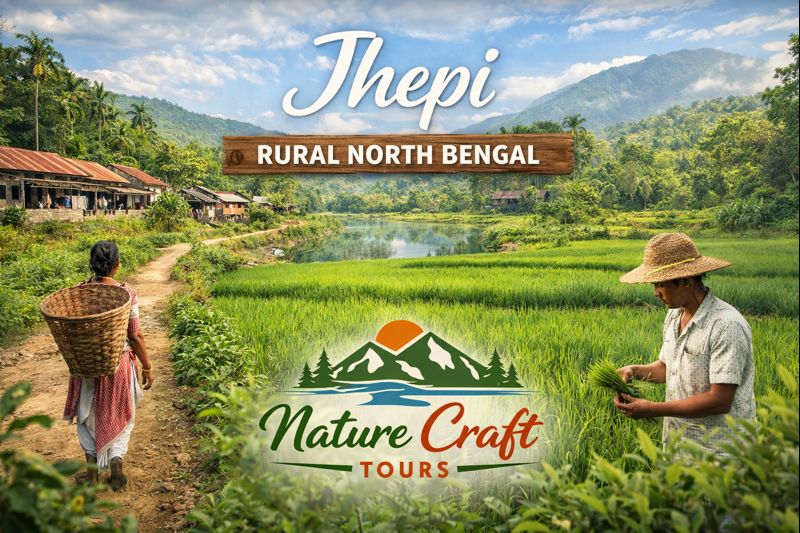
For the conscious traveler, researcher, or cultural observer, Jhepi offers an authentic window into the lesser-known rural ecosystems of the region. Its significance lies in what it preserves: silence, spatial openness, and a way of life still closely aligned with land and water. In an era of rapid tourism-driven transformation, Jhepi stands as a reminder that meaningful travel does not always require altitude or spectacle.
Geographical Location and Landscape Character
Jhepi is situated in the plains-to-foothills belt of North Bengal, within a landscape shaped by alluvial soil systems and seasonal river networks. The terrain here is largely flat to gently undulating, marked by agricultural fields, scattered tree groves, and narrow village roads bordered by drainage canals and small streams. This geography places Jhepi within an environmentally productive zone, historically favorable for farming and settlement.
The area lies close to forest fringes that form part of larger ecological corridors connecting the Himalayan foothills to the Dooars region. These transitional zones are studied by environmental planners for their role in biodiversity movement, groundwater recharge, and climate moderation. Jhepi’s natural setting thus holds ecological importance beyond its modest scale.
Agricultural Landscape and Soil Profile
The fields surrounding Jhepi are dominated by paddy cultivation, seasonal vegetables, mustard, and jute. The soil, enriched by river-borne sediments, supports intensive yet traditional farming practices. Agricultural cycles dictate village life, influencing festivals, labor patterns, and daily routines. During harvest seasons, the countryside transforms visually, with golden fields stretching uninterrupted toward distant tree lines.
Historical and Cultural Background
Historically, settlements like Jhepi developed along old rural trade and migration routes linking the plains of Bengal with the lower Himalayan markets. While not recorded prominently in colonial gazetteers, oral histories suggest that the village evolved as a farming and service settlement supporting nearby forest and tea-estate economies.
Culturally, Jhepi reflects a composite rural identity. Bengali traditions dominate daily language and customs, while influences from Rajbanshi, Nepali, and tribal communities are visible in food habits, agricultural tools, and folk practices. This cultural layering is subtle, integrated into everyday life rather than showcased through performance.
Important Points to See in and Around Jhepi
Village Life and Rural Walks
One of the most meaningful experiences in Jhepi is simply walking through its village paths. These walks reveal ponds used for irrigation and fishing, courtyards shaded by fruit trees, and communal spaces where elders gather in the evenings. Such environments offer valuable insight into rural spatial organization and social interaction.
Seasonal Water Bodies
Small rivers, canals, and rain-fed ponds form the hydrological backbone of the region. During monsoon months, these water bodies expand, nourishing fields and attracting migratory birds. In winter, they become calm reflective surfaces, ideal for quiet observation and photography.
Forest Fringe Zones
The outskirts of Jhepi gradually transition into semi-wooded zones. These areas are often used by locals for collecting firewood, fodder, and forest produce. For visitors, these edges offer opportunities to understand human–forest coexistence, an increasingly important subject in sustainable land-use studies.
Local Community and Daily Life
Life in Jhepi is structured around cooperation and familiarity. Households are interconnected through kinship, shared labor, and seasonal rituals. Education, small-scale trade, and agriculture form the primary livelihoods. Despite modernization pressures, traditional knowledge—particularly related to farming, water management, and food preservation—remains actively practiced.
Markets in nearby towns serve as economic anchors, while Jhepi itself functions as a residential and agricultural hub. Visitors often note the unhurried pace of life, a characteristic increasingly rare in rapidly urbanizing regions.
Major Distances from Jhepi
- Siliguri to Jhepi: approximately 35–40 km
- Bagdogra Airport to Jhepi: approximately 45 km
- New Jalpaiguri Railway Station to Jhepi: approximately 40 km
- Kalimpong to Jhepi: approximately 70 km
- Jalpaiguri town to Jhepi: approximately 30 km
Travel time may vary depending on road conditions and seasonal weather patterns, particularly during the monsoon.
How to Reach Jhepi
By Air
Bagdogra Airport is the nearest airport, offering connections to major Indian cities. From Bagdogra, travelers must continue by road, passing through Siliguri and adjoining rural highways before reaching Jhepi.
By Rail
New Jalpaiguri Railway Station is the closest major railhead. It is well-connected to Kolkata, Delhi, Guwahati, and other metropolitan centers. Road transport from NJP completes the journey to Jhepi.
By Road
Jhepi is accessible via state highways and rural roads branching off from Siliguri and Jalpaiguri. The final stretches often pass through farmland and village clusters, offering a gradual immersion into the rural landscape.
Travelers who appreciate slow, nature-aligned journeys often combine such destinations with river- and forest-based circuits similar in philosophy to experiential itineraries promoted under Sundarban Tour planning, where the journey itself becomes an essential part of the experience.
Staying Options Near Jhepi
Accommodation options in Jhepi are limited and intentionally low-impact. Visitors typically stay in nearby towns or opt for locally managed homestays in surrounding villages. These stays emphasize basic comfort, local food, and cultural exchange rather than luxury amenities.
Such arrangements allow travelers to engage closely with local communities while minimizing environmental footprint. Properties are generally small-scale, integrated into existing residential structures, and reflective of regional architectural styles.
Best Time to Visit Jhepi
Winter (November to February)
Winter is the most comfortable season to visit Jhepi. Temperatures remain moderate, skies are clear, and agricultural landscapes are visually striking. This period is ideal for village walks, photography, and cultural observation.
Spring (March to April)
Spring brings flowering trees and renewed agricultural activity. The countryside appears vibrant, and daytime temperatures are pleasant, making it suitable for exploratory travel.
Monsoon (June to September)
Monsoon months transform the region into a lush green expanse. However, heavy rainfall can affect road conditions and accessibility. Travel during this time is best suited for those comfortable with rural travel uncertainties.
Summer (May)
Summer can be warm and humid, but early mornings and evenings remain agreeable. This season offers insight into irrigation practices and water management in agrarian communities.
Why Jhepi Appeals to Thoughtful Travelers
Jhepi does not offer dramatic viewpoints or curated attractions. Its value lies in continuity—of land use, community life, and environmental balance. For travelers interested in rural studies, slow travel, or cultural documentation, Jhepi provides a meaningful counterpoint to destination-centric tourism.
Much like carefully designed eco-cultural journeys—whether in delta regions through Sundarban Travel initiatives or in Himalayan foothill villages—Jhepi demonstrates how travel can be observational, respectful, and deeply enriching without altering the character of the place itself.
To visit Jhepi is to engage with a living landscape where the ordinary becomes significant, and where travel returns to its original purpose: understanding place, people, and the quiet stories written into the soil.