
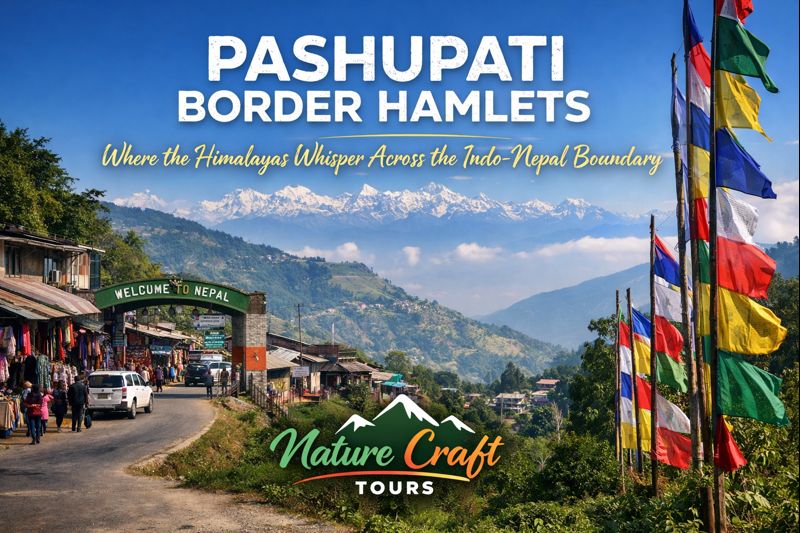
Pashupati Border Hamlets:
Where the Himalayas Whisper Across the Indo–Nepal Boundary
The Pashupati border hamlets occupy a quiet yet culturally vibrant stretch of the eastern Darjeeling hills, resting gently along the Indo–Nepal frontier near the historic Pashupati Phatak. Far removed from crowded tourist circuits, these settlements represent a living borderland—one shaped not by rigid lines on a map, but by centuries of shared geography, faith, and everyday coexistence. The landscape here speaks softly, through forested ridges, winding footpaths, and distant prayer bells echoing across two nations.
For travellers who seek meaning beyond scenic beauty, the Pashupati border hamlets offer a deeply immersive experience. This region is less about landmarks and more about atmospheres: the early morning mist drifting across tea gardens, the rhythmic sound of footsteps along border roads, and the subtle harmony between cultures that have learned to live together across political boundaries.
Geographical Setting and Regional Importance
The Pashupati border hamlets are situated on the eastern periphery of Darjeeling town, close to the Indo–Nepal boundary. The altitude ranges approximately between 6,000 and 7,000 feet above sea level, ensuring a cool, temperate climate throughout most of the year. The terrain is characterised by rolling hills, forested slopes, and narrow ridgelines that offer uninterrupted views into Nepal’s eastern hills.
Geographically, this region functions as a natural corridor between Darjeeling and Nepal’s Ilam district. The border is lightly regulated, designed primarily for local movement rather than large-scale trade. This gentle approach to border management has allowed traditional lifestyles to continue with minimal disruption.
Landscape Character and Natural Surroundings
The natural environment of the Pashupati border hamlets is defined by dense temperate forests, patches of cultivated land, and small streams that descend towards lower valleys. Pine, oak, and rhododendron trees dominate the upper slopes, while seasonal wildflowers add colour to the landscape during spring. Birdlife is abundant, making the region especially appealing to nature observers and slow travellers.
Cultural Fabric of the Border Hamlets
The cultural identity of the Pashupati border hamlets is layered and deeply interconnected. Nepali language and traditions form the backbone of daily life, yet influences from Bengal, Tibet, and eastern Nepal are clearly visible. Religious practices blend Hindu and Buddhist elements, with small shrines, monasteries, and prayer flags dotting the landscape.
Festivals such as Dashain, Tihar, and local village fairs are celebrated collectively, often without regard to the political border. These events offer visitors rare insight into a border culture that values continuity over division.
Architecture and Settlement Patterns
Homes in the Pashupati border hamlets are typically modest, constructed from wood, stone, and corrugated metal. Many houses feature sloping roofs to withstand monsoon rains and winter mist. The settlements are loosely clustered, allowing residents easy access to fields, forests, and border pathways.
Important Places and Experiences
Rather than conventional sightseeing spots, the Pashupati border hamlets offer experiential highlights. Walking along the border road itself is a memorable activity, where one can observe daily cross-border movement, local markets, and changing landscapes within a few kilometres.
Nearby viewpoints provide panoramic vistas of the Nepalese hills and, on clear days, distant Himalayan peaks. Quiet forest trails invite reflective walks, while village interactions reveal stories of shared heritage and resilience.
Major Distances from Key Locations
- Darjeeling town to Pashupati border area: approximately 6–8 kilometres
- Ghoom to Pashupati border hamlets: around 10 kilometres
- Siliguri to Pashupati border hamlets: approximately 75 kilometres
- Bagdogra Airport to the region: around 80 kilometres
How to Reach the Pashupati Border Hamlets
The most convenient approach to the Pashupati border hamlets is via Darjeeling town. From Darjeeling, local taxis or private vehicles can reach the border area within a short drive. The route passes through quiet residential zones and forested stretches, offering scenic views along the way.
For travellers arriving from outside the hills, the nearest major railhead is New Jalpaiguri, while Bagdogra serves as the closest airport. From both points, road journeys through the Himalayan foothills lead up to Darjeeling and onward to the border hamlets.
Staying Options and Accommodation Style
Accommodation in and around the Pashupati border hamlets is primarily limited to small homestays and modest guesthouses. These properties focus on cultural immersion rather than luxury, offering warm hospitality, home-cooked meals, and opportunities to engage with local life.
Travellers may also choose to stay in Darjeeling town and make short visits to the border hamlets, especially if they prefer a wider range of amenities.
Best Time to Visit
The ideal time to explore the Pashupati border hamlets is between March and May, when spring brings clear skies, blooming vegetation, and comfortable temperatures. Autumn months from October to early December are equally rewarding, with crisp air and unobstructed views.
The monsoon season, from June to September, transforms the region into a lush green landscape but may pose challenges due to heavy rainfall and occasional road disruptions.
Responsible Travel and Border Sensitivity
Visitors are encouraged to approach the Pashupati border hamlets with respect and awareness. Photography near border installations should be avoided unless clearly permitted. Engaging politely with local residents and supporting small homestays contribute positively to the region’s sustainability.
A Poetic Reflection on the Pashupati Border Hamlets
Where flags of faith meet hills of silence,
And borders breathe without command,
Paths remember older footsteps,
Drawn softly across the land.
Mist drifts freely, knowing no lines,
Bells echo beyond control,
Here nations pause, and mountains speak,
To the quiet, listening soul.
Two worlds touch in gentle grace,
At Pashupati’s timeless place.
In the understated elegance of the Pashupati border hamlets, travellers discover not merely a destination, but a philosophy—one where coexistence, landscape, and memory converge. For those who travel slowly and observe deeply, this borderland offers lessons that linger long after the journey ends.