




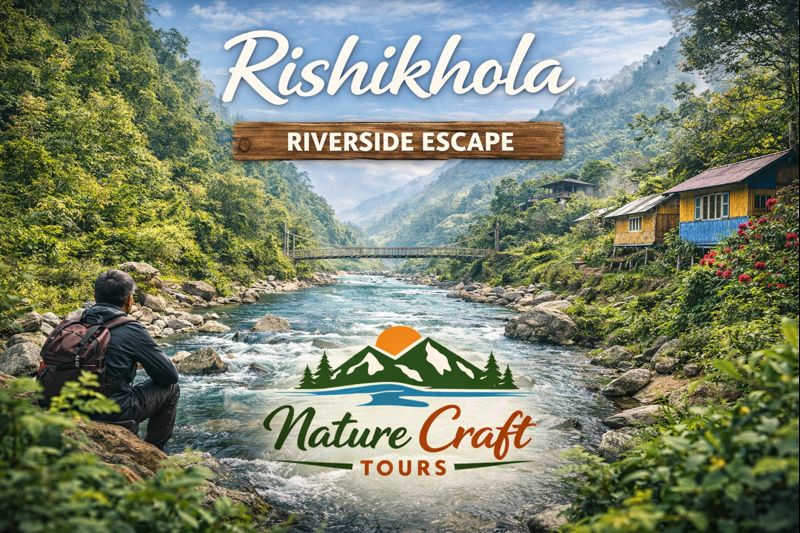
Rishikhola appeals most to travelers who value authenticity over attractions. Its charm lies in its unfiltered natural setting: wooden bridges suspended over clear mountain streams, forest paths replacing roads, and evenings governed by dusk rather than artificial light. For those seeking restorative travel experiences rooted in landscape and locality, Rishikhola represents one of the most immersive offbeat destinations in North Bengal.
Geographical Setting and Riverine Landscape
Rishikhola is situated at an altitude ranging between 1,800 and 2,200 feet above sea level, placing it within the lower Himalayan river valley zone. Unlike ridge-top settlements, this village unfolds along the riverbed itself, with accommodations, pathways, and farmlands arranged parallel to the flow of water. The surrounding terrain consists of steep forested slopes that funnel rainwater into the river system, contributing to its perennial nature.
The Rishi Khola originates from higher forested regions near the Bhutan border and acts as a vital tributary within the Teesta river basin. Environmental assessments classify this river system as ecologically sensitive, supporting aquatic life, riparian vegetation, and local irrigation practices. The sound of flowing water is a constant presence, shaping both the acoustic and emotional character of the village.
Forest Cover and Biodiversity
Dense subtropical forests surround Rishikhola, dominated by sal, bamboo, ferns, wild banana, and mixed evergreen species. These forests act as wildlife corridors connecting Bhutan’s lower ranges with Indian forest tracts. Bird species such as drongos, kingfishers, forktails, and barbets are frequently observed along the riverbanks, particularly during early mornings.
Historical and Cultural Context
Historically, Rishikhola developed as a seasonal forest settlement supporting grazing, timber collection, and river-based livelihoods. Over time, permanent habitation emerged as families began cultivating small patches of land and establishing trade connections with Kalimpong and nearby hill markets.
The local population is primarily Nepali-speaking, with cultural influences drawn from Bhutia and Lepcha traditions. Religious practices are simple and community-centered, often revolving around household shrines, forest spirits, and seasonal rituals linked to agricultural cycles. This understated cultural landscape allows visitors to observe traditions as lived experiences rather than staged performances.
Important Points to See in and Around Rishikhola
The Rishi Khola Riverbanks
The river itself is the focal point of Rishikhola. Stone steps descend into shallow pools where water remains remarkably clear during non-monsoon months. These riverbanks are ideal for quiet reflection, nature photography, and observing daily village activities such as washing, fishing, and irrigation management.
Hanging Footbridges
Suspension-style footbridges connect different parts of the settlement across the river. These structures are both functional and symbolic, representing the village’s adaptive relationship with terrain. Walking across these bridges offers panoramic views of the river corridor and surrounding forest walls.
Forest and Riverside Walks
Short trails follow the course of the river and ascend gently into forested slopes. These walks reveal micro-ecosystems—moss-covered rocks, shaded pools, and seasonal wildflowers—making them ideal for slow exploration and environmental observation.
Village Life and Human–Nature Interaction
Life in Rishikhola is shaped by simplicity and self-reliance. Households depend on agriculture, livestock, and small-scale tourism. Terraced farming supports vegetables, maize, and seasonal crops, while river water is used judiciously for irrigation and household needs.
Electricity supply is limited and often supplemented by solar lighting, reinforcing a lifestyle attuned to daylight hours. Evenings are quiet, marked by conversations, river sounds, and starlit skies. For visitors accustomed to urban noise, this environment offers a profound recalibration of sensory awareness.
Major Distances to Rishikhola
- Kalimpong to Rishikhola: approximately 32–35 km
- Pedong to Rishikhola: approximately 20–22 km
- Siliguri to Rishikhola: approximately 85–90 km
- New Jalpaiguri Railway Station to Rishikhola: approximately 90 km
- Bagdogra Airport to Rishikhola: approximately 95 km
Travel times depend on road conditions and seasonal weather, especially during monsoon months.
How to Reach Rishikhola
By Air
Bagdogra Airport is the nearest airport with regular connections to major Indian cities. From Bagdogra, travelers proceed by road via Siliguri and Kalimpong before descending toward the Rishikhola valley.
By Rail
New Jalpaiguri Railway Station serves as the primary railhead. The onward journey by road offers a gradual transition from plains to forested hills.
By Road
Motorable roads reach up to designated parking points near Rishikhola. The final approach often involves short walks across bridges or along riverside paths, preserving the settlement’s low-impact character.
Such immersive travel routes appeal strongly to travelers who appreciate experiential journeys, similar in philosophy to nature-centric itineraries curated under Sundarban Travel, where landscape continuity defines the travel experience.
Staying Options in Rishikhola
Accommodation in Rishikhola consists mainly of eco-lodges, riverside cottages, and community-run homestays. These properties emphasize sustainability, minimal construction, and harmony with the river environment.
Rooms are typically built using wood, stone, and locally sourced materials, offering river-facing verandas and open communal spaces. Meals are home-style, prepared with regional ingredients, enhancing the sense of place and connection.
Best Time to Visit Rishikhola
Autumn (October to November)
Autumn offers clear skies, stable river levels, and comfortable temperatures. This is one of the best periods for riverside walks and photography.
Winter (December to February)
Winters are cool and tranquil. While nights can be cold, days remain pleasant. The river appears exceptionally clear during this season.
Spring (March to April)
Spring brings flowering trees, renewed forest activity, and moderate weather. This season is ideal for nature walks and extended stays.
Monsoon (June to September)
Monsoon transforms Rishikhola into a lush green valley, but heavy rainfall can cause swollen rivers and limited accessibility. Travel during this season requires caution and flexibility.
Why Rishikhola Matters for Responsible Travel
Rishikhola exemplifies a form of tourism rooted in restraint. Its limited infrastructure has preserved both ecological balance and cultural integrity. The village demonstrates how riverine settlements can accommodate visitors without compromising environmental health.
Much like thoughtfully curated delta and forest experiences promoted through Sundarban Tour initiatives, Rishikhola highlights the value of slow, respectful travel that prioritizes observation over consumption.
To visit Rishikhola is to step into a living river landscape—where water shapes memory, movement, and meaning. It is a destination that does not entertain but enriches, leaving travelers with stillness, perspective, and a renewed appreciation for places that choose to remain quietly themselves.