




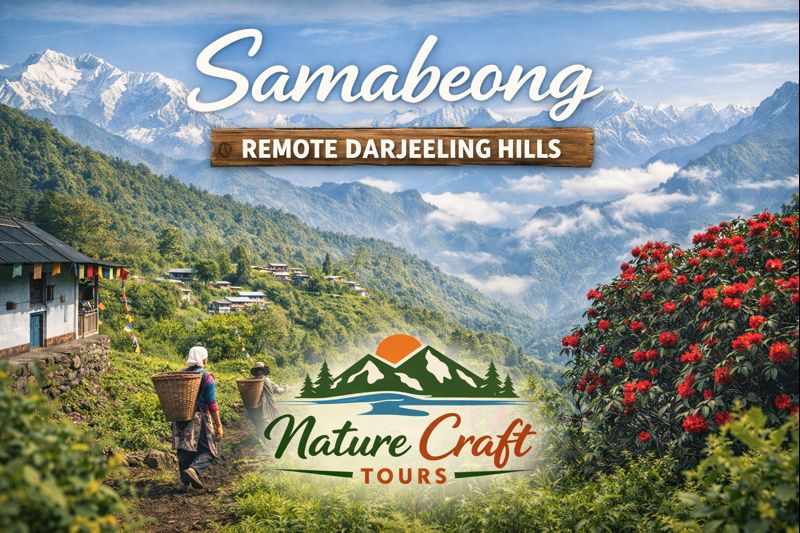
Samabeong is not merely a destination; it is a high-altitude cultural and ecological enclave. Its isolation has preserved traditional lifestyles, forest-based knowledge systems, and a sense of spatial humility that is increasingly rare in Himalayan travel circuits. For travelers seeking authenticity, solitude, and an unfiltered mountain environment, Samabeong represents one of the purest offbeat experiences in the Darjeeling region.
Geographical Setting and Landscape Identity
Samabeong is located at an elevation of approximately 6,500–7,000 feet above sea level, within the Darjeeling district of West Bengal. The village lies near the India–Nepal border, not far from the Singalila National Park buffer zone. Its position on a steep ridge makes it inaccessible to heavy vehicular traffic, reinforcing its remoteness and ecological integrity.
The landscape is defined by dramatic gradients—sharp slopes descending into dense forests, cloud-filled valleys below, and open skies above. On clear days, the snow-covered peaks of Kanchenjunga appear startlingly close, dominating the northern horizon. Environmental studies of the Singalila range highlight Samabeong’s zone as part of a fragile montane ecosystem, rich in endemic flora and migratory bird corridors.
Forest Ecology and Biodiversity
The surrounding forests consist primarily of oak, rhododendron, chestnut, and mixed temperate vegetation. During spring, rhododendron blooms transform the slopes into vivid red and pink corridors. The area is also known for bird diversity, including Himalayan bulbuls, flycatchers, and seasonal raptors. Butterflies and pollinators thrive here due to minimal pesticide use and intact forest cover.
Historical and Cultural Background
Samabeong’s history is closely tied to trans-Himalayan movement and forest-based livelihoods. Oral traditions suggest that the village emerged as a seasonal settlement for communities engaged in grazing, medicinal plant collection, and border trade. Over time, permanent habitation developed, shaped by subsistence farming and forest dependency.
The local population is predominantly Nepali-speaking, with cultural influences from Limbu and Rai traditions. Social structures emphasize cooperation, shared labor, and respect for natural boundaries. Religious practices blend Hindu rituals with animistic beliefs, particularly reverence for forests, mountain spirits, and water sources.
Important Points to See in and Around Samabeong
Kanchenjunga Viewpoints
Samabeong is renowned for its unobstructed Kanchenjunga views, especially at sunrise. As the first light strikes the snow peaks, the mountains shift from pale blue to glowing gold. These moments are considered among the finest high-altitude visual experiences in the Darjeeling hills.
Village Trails and Ridge Walks
Narrow footpaths connect Samabeong to neighboring hamlets and forest clearings. These trails follow ancient routes used by villagers and herders. Walking these paths provides insight into how settlements adapt to extreme topography and limited resources.
Forest Edge Zones
The edges of Singalila forest near Samabeong offer quiet spaces for nature observation. Moss-covered trees, fallen logs, and filtered light create an atmosphere suited for slow exploration and ecological study. These zones are particularly rich in birdlife during early mornings.
Life in Samabeong: Community and Daily Rhythms
Daily life in Samabeong revolves around agriculture, livestock care, and household self-sufficiency. Terraced fields support maize, potatoes, millet, and seasonal vegetables. Livestock such as cattle and goats are integral to both subsistence and cultural practices.
Electricity and communication infrastructure are limited, reinforcing a lifestyle that prioritizes daylight cycles and seasonal planning. Visitors often remark on the deep quiet of evenings, broken only by wind, distant bells, or forest sounds—an experience increasingly valued in mindful travel.
Major Distances from Samabeong
- Darjeeling to Samabeong (via Manebhanjan): approximately 28–32 km
- Manebhanjan to Samabeong: approximately 8–10 km (last stretch involves walking)
- Siliguri to Samabeong: approximately 90 km
- New Jalpaiguri Railway Station to Samabeong: approximately 95 km
- Bagdogra Airport to Samabeong: approximately 98 km
Travel times can vary significantly depending on weather, road conditions, and seasonal landslides. Adequate planning is essential.
How to Reach Samabeong
By Air
Bagdogra Airport is the nearest airport, well connected to major Indian cities. From Bagdogra, travelers proceed by road to Darjeeling or Manebhanjan before continuing toward Samabeong.
By Rail
New Jalpaiguri Railway Station serves as the primary railhead. From NJP, road transport leads to Darjeeling district, followed by a combination of vehicle travel and short trekking sections.
By Road and On Foot
Road access is available up to Manebhanjan or nearby points, after which travelers must walk to Samabeong. This final approach is part of the experience, offering gradual immersion into the high-altitude environment.
Such journeys appeal strongly to travelers who appreciate experiential routes, similar in philosophy to immersive nature circuits promoted under Sundarban Tour planning, where movement through landscape is as meaningful as the destination itself.
Staying Options in Samabeong
Accommodation in Samabeong is limited to small, community-run homestays and eco-lodges. These properties are designed for minimal environmental impact, using local materials and traditional architectural forms. Rooms are simple, clean, and oriented toward views rather than luxury.
Meals are typically home-cooked, prepared from locally grown produce. Staying in Samabeong allows visitors to participate in daily routines, fostering cultural exchange while supporting local livelihoods.
Best Time to Visit Samabeong
Spring (March to May)
Spring is one of the best seasons to visit Samabeong. Rhododendrons bloom across the hillsides, temperatures remain moderate, and visibility is excellent for mountain views.
Autumn (October to November)
Post-monsoon autumn offers clear skies and crisp air. Kanchenjunga views are at their sharpest, making this period ideal for photography and extended stays.
Winter (December to February)
Winters are cold, with occasional snowfall. While travel becomes challenging, the landscape acquires a stark, dramatic beauty. This season suits experienced travelers prepared for low temperatures.
Monsoon (June to September)
Monsoon travel is generally discouraged due to heavy rainfall, slippery trails, and limited accessibility. However, the forests are at their most lush during this period.
Why Samabeong Matters for Offbeat and Responsible Travel
Samabeong represents a model of low-impact mountain living. Its limited accessibility has protected it from overdevelopment, allowing ecological processes and cultural traditions to remain largely intact. For travelers seeking depth rather than entertainment, Samabeong offers a rare opportunity to engage with the Himalayas on their own terms.
Just as carefully curated river-delta experiences under Sundarban Travel emphasize coexistence between humans and nature, Samabeong demonstrates how mountain tourism can remain respectful, small-scale, and sustainable.
To visit Samabeong is to step into a landscape where the mountains are not a backdrop but a living presence—shaping thought, movement, and time itself. It is a place that rewards patience, attentiveness, and humility, leaving travelers not with souvenirs, but with perspective.