
Srikhola
– Where the Mountain Stream Writes Poetry on Stone
Tucked deep within the folds of the Eastern Himalayas, Srikhola is not merely a village—it is an unhurried conversation between water, forest, and time. Located on the historic trekking corridor between Manebhanjan and Sandakphu–Phalut, Srikhola rests quietly along the banks of the crystal-clear Srikhola River, a tributary that murmurs endlessly as if guarding ancient mountain secrets. Unlike crowded hill towns shaped by hurried tourism, Srikhola remains contemplative, earthy, and profoundly human in scale.
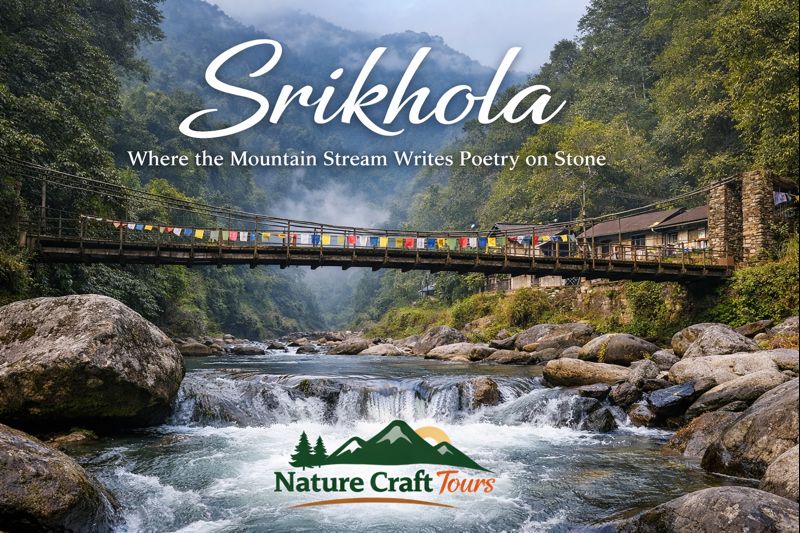
For travelers seeking authenticity over ornamentation, Srikhola offers an experience rooted in simplicity—wooden footbridges, prayer flags trembling in the wind, moss-covered stones, and the comforting sound of flowing water echoing through the valley. It is a destination that does not announce itself loudly, yet leaves an indelible mark on those who pause long enough to listen.
Geographical Setting and Natural Character of Srikhola
Srikhola is situated in the Darjeeling district of West Bengal, near the Indo–Nepal border, at an altitude of approximately 6,900 feet above sea level. The village lies below Rimbick and above Gorkhey, forming a crucial resting point for trekkers on the Sandakphu trail. Encircled by dense oak, magnolia, and rhododendron forests, the settlement enjoys a temperate mountain climate and remarkable ecological diversity.
The Srikhola River, from which the village derives its name, flows with remarkable clarity, its icy waters sourced from higher Himalayan streams. The soundscape of the village is shaped by this river—gentle during summer, forceful and resonant during monsoon, and meditative in winter. This rhythmic flow defines daily life, agriculture, and spiritual practices of the local community.
Why Srikhola Is Considered an Offbeat Himalayan Gem
What distinguishes Srikhola from more commercial hill destinations is its unaltered rhythm of life. There are no shopping streets, neon signboards, or hurried itineraries. Instead, the village offers something increasingly rare—stillness without isolation. Travelers wake to birdsong rather than traffic, and evenings dissolve into quiet conversations under starlit skies.
Srikhola also serves as a cultural threshold where Nepali mountain traditions blend seamlessly with Himalayan ecology. Stone houses with wooden balconies, organic farming practices, and communal hospitality reflect a way of life that remains deeply connected to the land. This authenticity makes Srikhola particularly appealing to slow travelers, trekkers, nature writers, and those seeking mindful retreats.
Important Places and Experiences Around Srikhola
The Srikhola River and Suspension Bridge
The heart of the village is undoubtedly the river itself. A charming suspension bridge connects different sections of Srikhola, offering mesmerizing views of cascading water below. Early mornings here are especially evocative, with mist rising gently from the river surface as sunlight filters through the trees.
Forest Trails and Birdlife
Short walks around Srikhola lead into dense Himalayan forests that are home to a wide range of bird species, including sunbirds, flycatchers, and Himalayan barbets. These trails are ideal for gentle exploration rather than strenuous trekking, allowing visitors to immerse themselves in forest silence.
Gateway to Gorkhey and Sandakphu
Srikhola is strategically located for those exploring higher Himalayan destinations. Many trekkers rest here before proceeding towards Gorkhey, Phalut, or Sandakphu. Even for non-trekkers, the surrounding landscapes offer dramatic mountain vistas and pristine village scenery.
Travelers interested in other tranquil Himalayan hamlets may also explore nearby destinations such as
Tinchuley village, which shares a similar ethos of eco-conscious tourism and mountain serenity.
Major Distances from Srikhola
Understanding distances helps travelers plan a comfortable and realistic itinerary:
- Srikhola to Manebhanjan: approximately 23 km
- Srikhola to Rimbick: approximately 6 km
- Srikhola to Darjeeling: approximately 55 km
- Srikhola to Siliguri: approximately 95 km
- Srikhola to NJP Railway Station: approximately 100 km
- Srikhola to Bagdogra Airport: approximately 102 km
Road conditions vary depending on season, but the journey is consistently scenic, passing through forested stretches, terraced fields, and quiet hill settlements.
How to Reach Srikhola
By Rail
The nearest major railhead is New Jalpaiguri (NJP). From NJP, travelers must continue by road via Manebhanjan and Rimbick. The journey offers panoramic views as the plains gradually give way to rolling hills and dense forests.
By Air
Bagdogra Airport is the nearest airport, well-connected to major Indian cities. From Bagdogra, Srikhola can be reached by road in approximately 4.5 to 5 hours, depending on weather and traffic conditions.
By Road
Road access is typically routed through Siliguri–Manebhanjan–Rimbick–Srikhola. The final stretch from Rimbick descends sharply into the valley, revealing the village nestled beside the river.
Staying Options in Srikhola
Accommodation in Srikhola is intentionally modest, focusing on warmth, cleanliness, and local hospitality rather than luxury. Travelers will primarily find:
- Traditional village homestays with river-facing rooms
- Eco-friendly lodges designed with local materials
- Trekkers’ guesthouses offering simple but nourishing meals
Most properties emphasize organic food, locally sourced vegetables, and home-style cooking. Electricity availability may be limited during extreme weather, reinforcing the village’s commitment to low-impact living.
Best Time to Visit Srikhola
Spring (March to May)
Spring is among the finest seasons to visit Srikhola. Forests come alive with blooming rhododendrons, the river flows gently, and weather conditions remain comfortable for walking and exploration.
Summer (June)
Early summer offers lush greenery and cooler temperatures compared to the plains. This period is ideal for travelers escaping heat, though occasional showers may occur.
Monsoon (July to September)
Monsoon transforms Srikhola into a verdant dreamscape. While the scenery is breathtaking, landslides and slippery roads may pose challenges. Travel during this season requires flexibility.
Autumn (October to November)
Clear skies, crisp air, and distant Himalayan views make autumn exceptionally rewarding. This is also a favored time for trekkers heading towards Sandakphu.
Winter (December to February)
Winters are cold but deeply atmospheric. While snowfall is rare in Srikhola itself, higher reaches may receive snow, adding to the region’s allure for seasoned travelers.
Cultural and Responsible Travel Insights
Srikhola thrives on community-based tourism. Visitors are encouraged to respect local customs, minimize plastic use, and engage meaningfully with residents. Photography should always be undertaken with sensitivity, particularly around homes and religious spaces.
Those planning broader eco-focused journeys may find inspiration in sustainable travel narratives associated with regions like the Sundarban Tour, where nature and community coexist through responsible tourism models.
Srikhola in the Larger Context of Eastern Himalayan Travel
Srikhola represents a philosophy of travel that values depth over distance. In an era dominated by checklists and hurried itineraries, this village reminds travelers that sometimes the most meaningful journeys occur where roads narrow and silence deepens.
For travelers crafting multi-destination itineraries, pairing Srikhola with other mindful destinations—such as
Tinchuley—creates a harmonious exploration of Darjeeling’s lesser-known landscapes.
Likewise, those drawn to immersive nature-based tourism can find conceptual parallels in destinations like the
Sundarban Travel circuits, where patience and observation form the core of the experience.
A Poem for Srikhola
The river hums where footsteps fade,
And wooden bridges gently sway,
Mist unravels the mountain’s face,
As silence learns the art of stay.
Stone and prayer share the same breath,
Time forgets the weight of years,
Leaves write letters to the wind,
Night arrives on silver tiers.
In Srikhola, the heart grows still,
And learns the mountain’s quiet will.
Srikhola, a Place to Pause
Srikhola does not promise spectacle; it offers sincerity. It invites travelers not to conquer landscapes, but to coexist with them—even if briefly. In its flowing river, humble homes, and forested silence, Srikhola stands as a reminder that some destinations are not meant to be consumed, but quietly understood.
For those willing to slow down, listen deeply, and travel with intention, Srikhola becomes more than a stop on a map—it becomes a memory etched gently into the soul.