





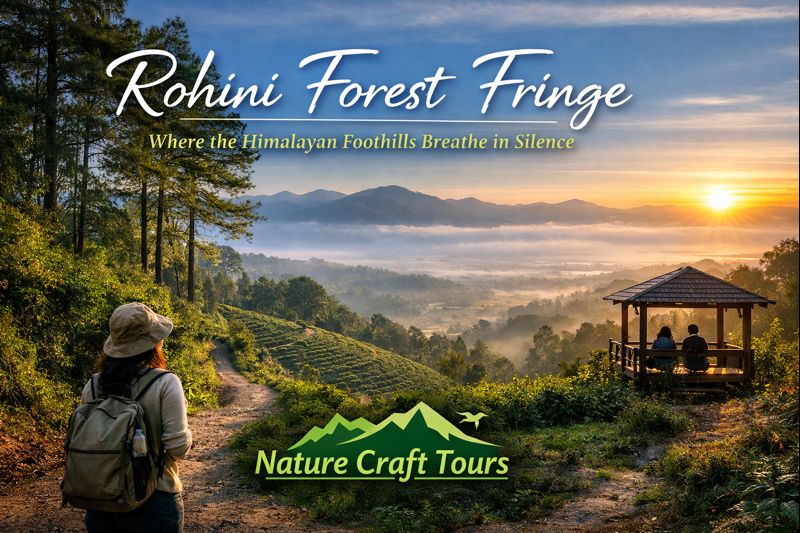
Rohini Forest Fringe
– Where the Himalayan Foothills Breathe in Silence
Tucked quietly along the lesser-known curves of the Darjeeling foothills, the Rohini forest fringe emerges as a gentle threshold between dense Himalayan woodland and human settlement. Far removed from the bustle of mainstream hill stations, this region remains a landscape of restraint—where forests whisper instead of announce, where roads wind carefully as if respecting the terrain, and where time seems to slow into something contemplative and deliberate.
Rohini is not a destination that overwhelms with spectacle; instead, it reveals itself slowly. The forest fringe here—stretching across wooded slopes, tea patches, seasonal streams, and secluded hamlets—forms an ecological and cultural buffer zone between the plains of North Bengal and the higher reaches of Darjeeling district. For travellers seeking authenticity, quietude, and ecological intimacy, Rohini offers an experience rooted in observation rather than consumption.
Understanding the Rohini Forest Fringe Landscape
The Rohini forest fringe lies along the lower Himalayan belt, primarily accessed via the historic Hill Cart Road corridor between Siliguri and Kurseong. This transitional zone is characterised by mixed broadleaf forests, sal and pine groves, scattered tea gardens, and undulating ridges that provide filtered views of the plains below.
Ecologically, forest fringes play a critical role. They act as buffer ecosystems, absorbing human pressure while supporting wildlife movement between deeper forest zones. In Rohini, this balance is still largely intact. Birdsong dominates the mornings, cicadas claim the afternoons, and evenings descend with a palpable hush broken only by wind through leaves or distant river murmurs.
Forest Composition and Natural Character
The vegetation here is a layered tapestry—sal trees dominate lower elevations, interspersed with bamboo clusters, wild ferns, moss-laden trunks, and seasonal wildflowers. Higher ridges gradually introduce pine and oak varieties. The forest floor remains rich with leaf litter, supporting insects, amphibians, and ground-nesting birds.
This environment also sustains a remarkable diversity of avifauna, making Rohini a quiet haven for birdwatchers and nature photographers who prefer unstructured exploration over crowded trails.
Important Points to See Around Rohini Forest Fringe
Forest Trails and Canopy Walks
Unmarked forest trails branching from village paths lead into shaded corridors of green. These routes are best explored slowly, preferably in the early morning, when light filters through the canopy in soft layers. The experience is less about reaching a destination and more about immersion in sound, texture, and scent.
Seasonal Streams and Natural Springs
Several natural springs and rain-fed streams emerge from the forest slopes, particularly active during and after the monsoon. These water sources sustain both wildlife and nearby settlements, and their presence adds a continuous, calming acoustic layer to the landscape.
Tea Garden Edges
Small tea patches appear intermittently along the forest edge, where cultivated land meets wilderness. These zones reveal a striking contrast—orderly tea bushes set against untamed forest growth—illustrating the region’s delicate balance between livelihood and ecology.
Sunrise and Dusk Vantage Points
Certain ridgelines near Rohini offer expansive views over the Terai plains. At dawn, the plains glow beneath a veil of mist; at dusk, the forest deepens into shadow while distant settlements flicker into light.
Cultural Texture of the Forest Fringe Villages
The villages around Rohini forest fringe remain modest in scale and rhythm. Life here follows seasonal cycles—agriculture, forest produce collection, and small-scale tea work form the backbone of local livelihoods. Architecture is simple, built for climate and terrain rather than display.
Visitors often find that meaningful interactions emerge naturally—shared conversations over tea, quiet observation of daily routines, or participation in seasonal village life. This understated cultural presence enriches the travel experience without performing it.
Major Distances from Rohini Forest Fringe
- Siliguri: approximately 25–30 km
- Bagdogra Airport: approximately 30–35 km
- Kurseong: approximately 12–15 km
- Darjeeling town: approximately 45–50 km
These distances position Rohini as an accessible yet secluded retreat, making it ideal for travellers wishing to step away from crowded tourist centres while remaining well-connected.
How to Reach Rohini Forest Fringe
By Air
The nearest airport is Bagdogra, which connects the region with major Indian cities. From the airport, road travel through forested foothills leads gently upward toward Rohini.
By Train
New Jalpaiguri Railway Station serves as the primary rail gateway. From here, travellers can proceed by road along the Hill Cart Road, enjoying a gradual transition from plains to forested slopes.
By Road
Road access is one of Rohini’s quiet strengths. The journey itself becomes part of the experience, with forest views, tea gardens, and occasional wildlife sightings along the way.
Staying Options Near Rohini Forest Fringe
Accommodation around Rohini is deliberately low-impact. Options typically include forest-edge homestays, eco-lodges, and small nature retreats designed to blend with the surroundings. These properties prioritise simplicity, clean living spaces, local cuisine, and experiential engagement over luxury.
Many stays encourage slow travel—guided nature walks, birdwatching sessions, and evening conversations around local narratives rather than packaged entertainment.
Best Time to Visit Rohini Forest Fringe
Autumn (October to November)
Clear skies, comfortable temperatures, and crisp forest air make this period ideal for exploration and photography.
Winter (December to February)
Cool mornings and mist-laden forests define winter. While nights can be cold, the tranquillity during this season is unmatched.
Spring (March to April)
Spring brings renewed greenery, flowering trees, and heightened bird activity—an excellent time for nature enthusiasts.
Monsoon (June to September)
Though travel requires caution, the forest becomes intensely vibrant. This season suits experienced travellers who appreciate raw landscapes and solitude.
Slow Travel Connections and Nearby Explorations
Travellers exploring Rohini often combine their journey with other offbeat Himalayan hamlets. The contemplative rhythm of the forest fringe aligns seamlessly with destinations such as
Tinchuley, where village life and mountain silence intersect, or extended forest-based circuits across the Darjeeling foothills.
For those interested in contrasting ecosystems, curated journeys like a
Sundarban Tour or a thoughtfully planned
Sundarban Travel experience offer insight into India’s mangrove wilderness, creating a meaningful dialogue between mountains and delta landscapes.
The Rohini Forest Fringe
In Rohini, the forest does not speak aloud,
It breathes between footsteps and falling leaves.
Light arrives filtered, never demanding attention,
And silence settles like an old, familiar shawl.
Here, paths remember those who walk gently,
Streams carry stories without naming them.
Birdsong replaces clocks and calendars,
Moss measures time more faithfully than stone.
The forest fringe waits without expectation,
And teaches the art of arriving without hurry.
Why Rohini Forest Fringe Matters to the Thoughtful Traveller
Rohini forest fringe is not designed for hurried itineraries or checklist tourism. Its value lies in its restraint—in what it withholds as much as what it offers. It invites travellers to slow their pace, refine their senses, and re-engage with landscapes that still function on their own terms.
For those who believe that travel is as much about listening as it is about seeing, Rohini remains a rare and quietly enduring refuge within the Darjeeling foothills.