





Simana Viewpoint Belt on the Indo–Nepal Border Road
– Where Two Nations Share the Same Horizon
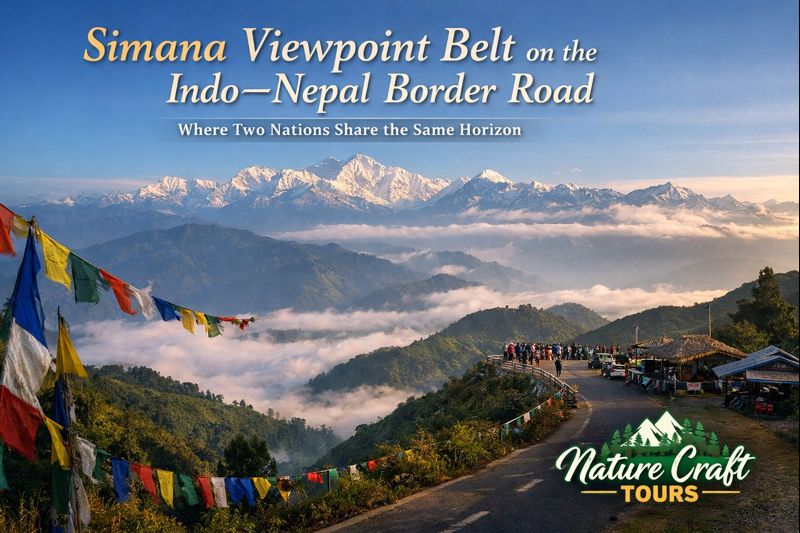
The Simana Viewpoint belt on the Indo–Nepal border road is one of the most understated yet profoundly evocative landscapes of the Darjeeling–Singalila region. The term “Simana” itself means boundary, yet this is a place where boundaries lose their rigidity and transform into a shared cultural and geographical continuum. Stretching along a historic mountain road that gently curves between India and Nepal, this belt is not defined by a single lookout point. Instead, it unfolds as a series of viewpoints, forested bends, quiet hamlets, and high ridgelines where the Himalayas reveal themselves in layered silence.
This region appeals particularly to slow travelers, landscape photographers, and those seeking contemplative journeys. There are no loud attractions, no commercial complexes, and no hurried itineraries. What exists instead is an ever-changing canvas of clouds, distant snow peaks, prayer flags fluttering in the wind, and valleys that descend into blue-green depths. The Simana Viewpoint belt is a journey of observation rather than consumption, inviting travelers to pause, breathe, and understand the land.
Geographical Setting and Border Significance
The Simana Viewpoint belt lies along the old Indo–Nepal border road connecting the Darjeeling hills with Nepal’s eastern highlands. This road historically served as a trade and movement corridor long before modern political boundaries were formalized. Even today, the border here feels symbolic rather than restrictive, marked quietly by stone pillars, signboards, and occasional check posts.
On one side lie Indian hamlets nestled within forested slopes, while on the other stretch Nepalese villages with terraced fields and grazing land. The road itself acts as a ridge-line corridor, offering uninterrupted views across valleys on both sides. The altitude generally ranges between 6,500 and 7,500 feet, creating a cool, temperate climate throughout most of the year.
Landscape Character
The terrain is defined by rolling ridges, dense patches of oak, pine, and rhododendron forests, and occasional open meadows where the land flattens briefly before descending again. On clear days, distant Himalayan peaks emerge on the horizon, while on misty mornings the entire belt transforms into a dreamlike corridor of drifting clouds.
Key Viewpoints and Scenic Stops
The Simana belt comprises several unnamed and locally known viewpoints rather than a single landmark. Each bend in the road offers a slightly different perspective, shaped by elevation, forest cover, and orientation toward the valleys.
Primary Simana Viewpoint
The most recognized Simana Viewpoint is marked by a small clearing where travelers can stop safely. From here, expansive views open toward both India and Nepal, with deep valleys stretching below and ridges receding into the distance. Early mornings often bring golden light filtering through mist, while late afternoons offer dramatic cloud formations and changing hues.
Forest Bends and Ridge Walks
Beyond the main viewpoint, the road passes through dense forest stretches punctuated by natural clearings. These quiet spots are ideal for short walks, birdwatching, and photography. The absence of heavy traffic allows travelers to experience the sounds of wind, birds, and distant village life without interruption.
Cultural Landscape and Local Life
The Simana Viewpoint belt is inhabited by communities whose lives are shaped by the border yet not confined by it. Families on both sides share cultural practices, festivals, agricultural rhythms, and even dialects. Small roadside tea stalls occasionally appear, offering warm refreshments and informal conversation.
Prayer flags tied to trees and poles reflect the spiritual traditions of the region, blending Buddhist and indigenous beliefs. Stone markers and modest shrines dot the roadside, quietly reinforcing the sense that this is a lived landscape rather than a tourist construct.
How to Reach Simana Viewpoint Belt
Reaching the Simana Viewpoint belt requires a journey through the heart of the Darjeeling hills. The route itself is part of the experience, winding through tea gardens, forests, and mountain settlements.
From Siliguri and New Jalpaiguri
The nearest major transit hubs are Siliguri and New Jalpaiguri. From here, travelers proceed toward Darjeeling or Maneybhanjang, depending on the chosen route. The Simana belt is typically accessed via Maneybhanjang, which serves as a key junction for the Singalila region.
From Darjeeling
Darjeeling town lies approximately 30–35 kilometers from the Simana belt. The drive takes around two to three hours, depending on road conditions and stops. The road ascends gradually, offering views of tea estates before entering forested terrain.
Those planning a broader exploration of offbeat Darjeeling may also combine this journey with visits to nearby destinations such as Tinchuley, which complements the Simana experience with village-based mountain living.
Major Distances at a Glance
- Siliguri to Simana Viewpoint belt: approximately 90 kilometers
- Darjeeling to Simana Viewpoint belt: approximately 30–35 kilometers
- Maneybhanjang to Simana Viewpoint belt: approximately 8–10 kilometers
Staying Options Near Simana Viewpoint Belt
Accommodation around the Simana belt is limited and intentionally modest. The emphasis here is on immersion rather than luxury.
Village Homestays
Several villages near the border road offer traditional homestays. These properties provide simple yet comfortable rooms, home-cooked meals, and the opportunity to engage with local families. Staying in a homestay allows travelers to experience daily mountain life, seasonal farming activities, and regional cuisine.
Eco-Lodges and Small Guesthouses
A few eco-conscious lodges and guesthouses operate in nearby settlements. These properties are designed to blend with the environment, often using local materials and sustainable practices. They are suitable for travelers seeking slightly more privacy while remaining close to nature.
Best Time to Visit Simana Viewpoint Belt
The Simana Viewpoint belt is accessible throughout most of the year, though each season offers a distinct character.
Spring (March to May)
Spring brings blooming rhododendrons, clear skies, and comfortable temperatures. This is one of the best periods for panoramic views and photography.
Monsoon (June to September)
During the monsoon, the landscape turns lush and vibrant, though fog and occasional landslides may affect travel. This season appeals to those who enjoy misty atmospheres and dramatic cloud movement.
Autumn (October to November)
Autumn offers crisp air and the clearest mountain views. The post-monsoon clarity makes this an excellent time for long-distance vistas.
Winter (December to February)
Winters are cold but serene. While snowfall is rare, temperatures drop significantly, and mornings can be frost-laden. The quiet of winter enhances the contemplative quality of the region.
Responsible Travel and Border Etiquette
Travelers should remain respectful of border regulations and local customs. Photography near official border markers should be undertaken cautiously. Supporting local homestays, minimizing waste, and maintaining silence in forested areas contribute to the preservation of this fragile belt.
Reflection on Simana Viewpoint Belt
Where the road forgets its name at the edge of two lands,
Simana waits with folded clouds in its hands.
Here borders breathe, not divide the hill,
And silence speaks louder than human will.
Prayer flags borrow the language of wind,
Mountains remember all we leave behind.
Two nations gaze through the same blue air,
Sharing the sun without a border to care.
At Simana, the horizon softly agrees,
That the earth was never meant to be owned, only seen.
Planning a Broader Journey
The Simana Viewpoint belt fits seamlessly into extended itineraries across the Darjeeling hills and beyond. Travelers often pair this experience with nature-centric journeys or contrasting ecosystems such as the mangrove landscapes of the Sundarbans. For those interested in exploring such diversity, curated experiences like Sundarban Tour options offer a compelling counterpoint to the Himalayan highlands.
Similarly, travelers planning comprehensive regional travel may find inspiration through thoughtfully designed itineraries available via Sundarban Travel, creating a journey that spans mountains, forests, and riverine landscapes.
The Simana Viewpoint belt on the Indo–Nepal border road is not a destination defined by monuments or crowds. It is defined by perspective, silence, and the quiet harmony of shared geography. For travelers willing to slow down, observe, and reflect, Simana offers an experience that transcends borders and leaves a lasting imprint on the mind.