





Mungpoo: A Rare Pause of Mist, Memory, and Measured Silence in the Eastern Himalayas
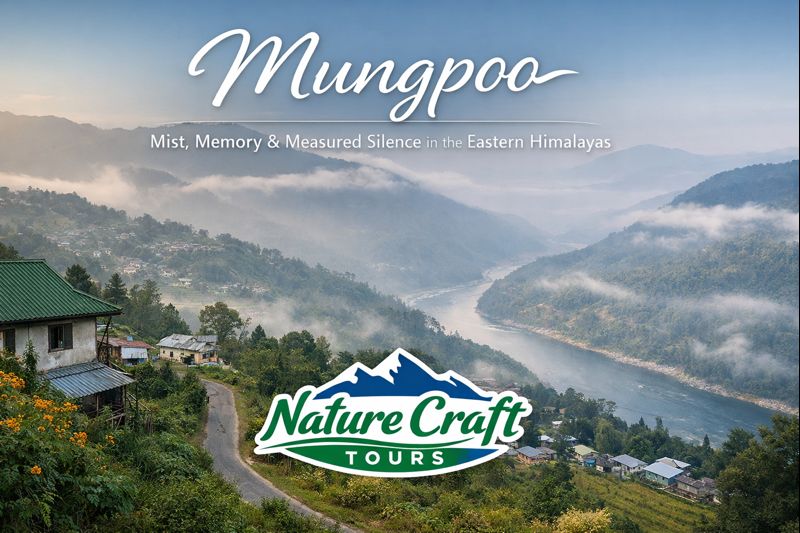
Mungpoo offers a rare pause in the Eastern Himalayas, defined by mist, memory, and measured silence.
In a region where hill destinations are increasingly shaped by visibility, speed, and volume, Mungpoo remains deliberately understated. It does not announce itself through dramatic skylines or crowded promenades.
Instead, it reveals its character slowly—through drifting clouds, muted colours, and a silence that feels cultivated by time.
This village is not a destination for hurried sightseeing. It is a place of observation and inward travel, where the landscape does not compete for attention but invites reflection.
For travellers drawn to nuance rather than novelty, Mungpoo stands as a rare Himalayan settlement where restraint itself becomes the experience.
Destination Overview: Mungpoo in the Eastern Himalayan Context
Mungpoo is located approximately 35 kilometres southeast of Darjeeling town, at an elevation of around 3,500 feet above sea level. Positioned on a gentle ridge overlooking the Teesta River valley, the village occupies an ecological and cultural transition zone between the higher Eastern Himalayas and the lower foothills leading toward Kalimpong and the plains of North Bengal.
The terrain surrounding Mungpoo is shaped by undulating hills rather than steep alpine slopes. Cinchona plantations dominate much of the landscape, interspersed with cardamom patches, vegetable fields, and pockets of secondary forest. Roads wind slowly through this terrain, frequently vanishing into fog before reappearing beside old buildings or forest edges.
Unlike commercial hill stations developed primarily for tourism, Mungpoo continues to function as a working village. Agriculture, plantation labour, and local administration remain central to everyday life.
Tourism exists here quietly, without displacing the rhythms that have defined the settlement for generations.
Historical Layers and Cultural Memory
Cinchona Plantations and Colonial Medical History
Mungpoo holds an important place in the colonial medical history of India due to the introduction of cinchona cultivation during the nineteenth century. The bark of the cinchona tree, the source of quinine, was critical in treating malaria, a disease that posed a serious threat to colonial expansion.
Experimental plantations established in Mungpoo reshaped both the land and local society. Terraced slopes, labour settlements, and administrative infrastructure emerged around this industry, leaving a legacy that remains visible today. The plantations continue to function, not as museum pieces, but as living landscapes shaped by ongoing human interaction.
Literary Associations and Intellectual Retreat
Mungpoo is closely associated with Rabindranath Tagore, who spent time here during the later years of his life.
Drawn by the calm climate and isolation, he found the village conducive to reflection and creative work.
Several important literary compositions were completed during his stays in this quiet Himalayan setting.
The residence associated with Tagore is preserved as a cultural landmark, valued less for architectural grandeur
and more for its atmosphere. Set amid forested slopes and frequent mist, it reflects the contemplative qualities
that continue to define Mungpoo’s identity.
Ecological Setting: Mist, Forests, and Transitional Biodiversity
Ecologically, Mungpoo lies within a transitional zone where subtropical and temperate Himalayan ecosystems overlap. This positioning supports diverse plant life, including cinchona, alder, bamboo, ferns, and seasonal flowering species. High humidity and frequent cloud cover encourage the growth of mosses and lichens, giving the landscape its distinctive softness.
Birdlife is present throughout the year, though sightings are often subtle rather than dramatic. The environment rewards patience: calls emerging from fog, movement in dense foliage, and fleeting silhouettes against pale skies. This is a landscape experienced gradually, through repetition and stillness.
Complete Tour Plan for Exploring Mungpoo
Best Time and Season to Travel
The most favourable period to visit Mungpoo is between October and early April. Post-monsoon months bring clear air and stable weather, allowing unobstructed views across the Teesta valley. Winter temperatures remain cool but moderate, making the season suitable for extended walks and outdoor observation.
The monsoon season transforms Mungpoo into a landscape of dense greenery and near-constant mist. While travel during this period requires flexibility due to road conditions, it also reveals the village in its most atmospheric form, appealing to experienced travellers comfortable with uncertainty.
Ideal Travel Duration
A stay of two to three nights is ideal for experiencing Mungpoo at an unhurried pace. This duration allows visitors to engage with the landscape, explore plantation paths, and observe daily village life without the pressure of structured sightseeing.
Route and Accessibility
Mungpoo is accessible by road from Siliguri, New Jalpaiguri, and Darjeeling. The most commonly used route passes through Teesta Bazaar before ascending gradually into the hills. Private transport is recommended for greater flexibility, particularly for travellers wishing to explore surrounding areas.
Key Attractions and Experiential Highlights
Cinchona Plantation Walks
Walking through the cinchona plantations remains one of the most immersive ways to experience Mungpoo.
These paths, shaped by daily labour rather than tourism design, offer insight into the village’s economic and ecological foundations.
Teesta Valley Viewpoints
Unmarked clearings around Mungpoo provide expansive views of the Teesta River as it winds through the lower Himalayas. These viewpoints are discovered organically, often with local guidance, reinforcing the exploratory nature of the destination.
Practical Insights for Thoughtful Travellers
Accommodation options in Mungpoo are limited and modest, reflecting the village’s low-impact tourism character.
Travellers should prepare for cool evenings, intermittent connectivity, and minimal commercial infrastructure.
These conditions, rather than inconveniences, form part of the village’s enduring appeal.
For travellers interested in contrasting Himalayan and deltaic ecosystems, journeys toward the mangrove landscapes of https://sundarbantravel.com/sundarban-tour/ offer a compelling continuation of Eastern India exploration.
Structured regional itineraries may include resources such as Sundarban Tour Packages, while destination-specific planning can be explored through detailed guides on Mungpoo and Mungpoo Tour Package.
The Value of Stillness in a Moving World
Mungpoo does not promise excitement or transformation through spectacle. Instead, it offers something increasingly rare—the opportunity to pause within a living landscape shaped by time, labour, and memory.
Its mist-laden hills and measured rhythms encourage travellers to slow down, observe, and reconsider what meaningful travel can be.
In resisting the pressures of mass tourism, Mungpoo preserves its essence. It remains a place where silence carries meaning, and where the Eastern Himalayas reveal themselves not through grandeur,
but through quiet continuity.