



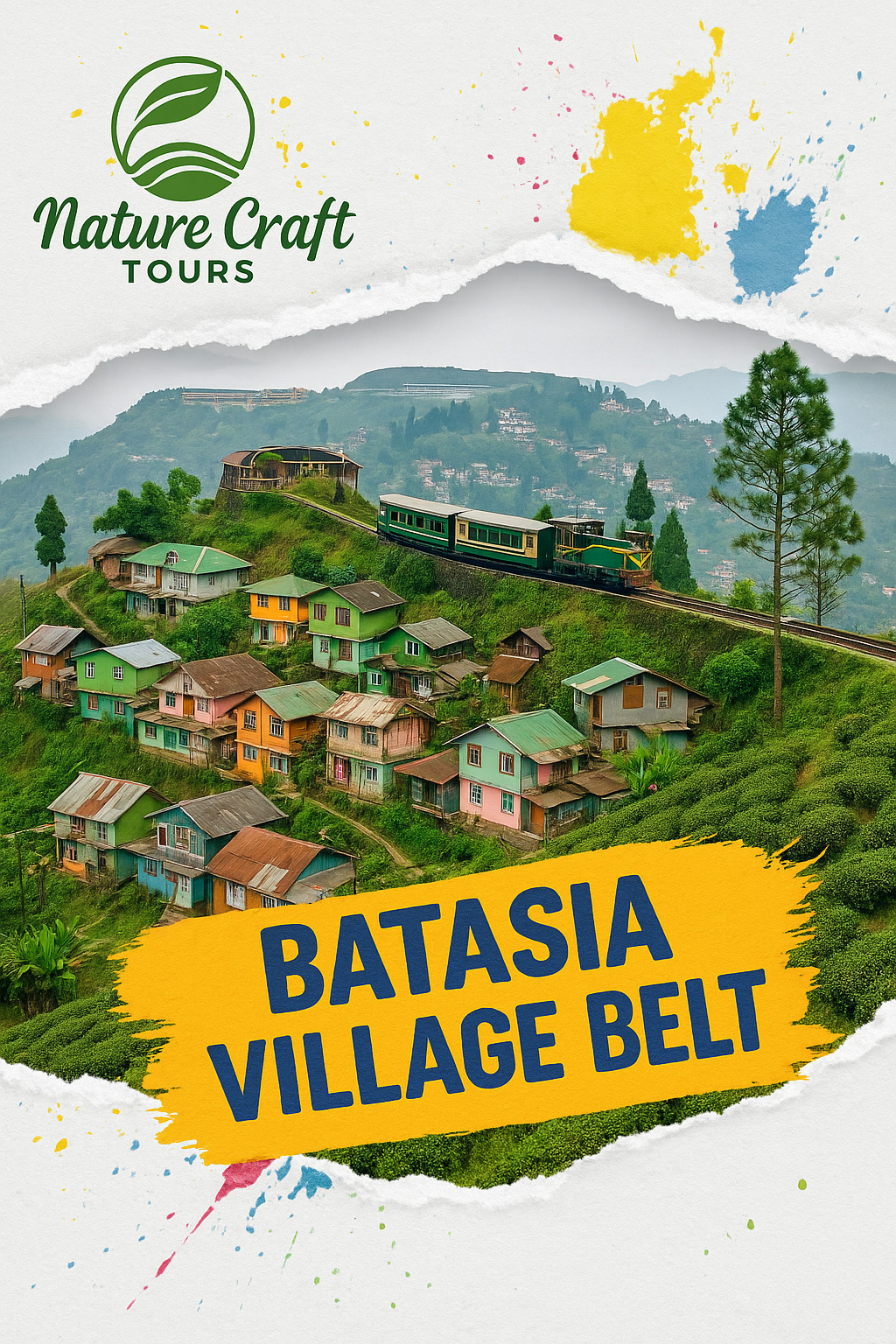
Where toy trains whistle above misty ridges, where terraced homes cling gently to the hillside, and where tea bushes roll down like emerald waves—there, beneath the famous Batasia Loop, the quiet Batasia village belt lives its everyday Himalayan story.
Batasia Village Belt
– The Living Hillside Below Darjeeling’s Iconic Batasia Loop
When travellers think of Batasia, they almost always picture the celebrated Batasia Loop of the Darjeeling Himalayan Railway—the graceful circular track where the narrow-gauge toy train curves around manicured gardens and war memorials against a majestic Kanchenjunga backdrop. Yet, just below this world-famous loop lies a lesser-known world: the Batasia village belt. Here, steep lanes wind between traditional houses, Buddhist prayer flags flutter in the wind, and everyday life unfolds quietly under the shadow of the tracks.
Stretching along the slope below the main Batasia Loop and spilling down towards the valley side, the Batasia village belt is a cluster of compact settlements, terraced fields, small tea patches, homestays, schools, local shops, and monasteries. It offers travellers a deeply authentic glimpse of Darjeeling’s hill life—far removed from the more commercial spaces of the town above, yet only a short drive away.
Administratively, this area falls under the Darjeeling district of West Bengal and is influenced by the same cultural and ecological environment that shapes the broader hill region. For broader district information and tourism initiatives, visitors can refer to the official state portal:
West Bengal Tourism – Official Government Portal
Understanding the Batasia Village Belt
The Batasia village belt is not a single, formally demarcated village, but rather a string of hillside neighbourhoods and localities directly below and around the Batasia Loop area on the Darjeeling–Ghoom road. Small stairways connect the road above to the homes below, and narrow concrete paths thread between clusters of houses, kitchen gardens, and community spaces. This belt typically includes:
- Residential clusters of Gorkha, Lepcha, and other Himalayan communities
- Small tea patches and terraced agricultural land
- Homestays and family-run guest houses overlooking deep valleys
- Monasteries and village temples
- Local primary schools and community halls
From many balconies in the village belt, residents and visitors can watch the toy train pass above, making slow, dramatic curves around the loop. When the sky is clear, the white mass of Mt. Kanchenjunga rises beyond Darjeeling town, creating a layered tableau of houses, ridges, and snow peaks.
Historical and Cultural Context
The identity of the Batasia village belt is inseparable from the history of the Darjeeling Himalayan Railway (DHR), a UNESCO World Heritage narrow-gauge railway line. The Batasia Loop itself was engineered in the early 20th century to reduce the gradient between Ghoom and Darjeeling, enabling the tiny steam locomotives to negotiate the steep hillside safely. Today, the loop is described in detail on:
Around this engineering marvel, a living community grew over time, with many families historically connected to tea gardens, railway work, tourism, and small trade. The population is largely Nepali-speaking, with cultural influences from Gorkha, Lepcha, Bhutia, and other Himalayan ethnic groups. Festivals such as Dasain, Tihar, Losar, and Buddha Jayanti are celebrated with music, prayer, and community feasts.
Important Points to See in the Batasia Village Belt
1. Hillside Viewpoints Beneath the Loop
While tourists flock to the official viewing platforms above, the slopes below the loop offer quieter, more intimate vantage points. From village rooftops and small open terraces, travellers can view:
- The toy train circling Batasia Loop above
- Darjeeling town cascading across the opposite ridge
- The deep Balasun and Rangit river valleys far below
- Kanchenjunga glowing at sunrise and sunset on clear days
The juxtaposition of everyday village life in the foreground and the iconic loop above creates a powerful visual narrative.
2. Traditional Village Lanes and Stairways
A walk through the Batasia village belt reveals a maze of steep lanes and stone staircases descending from the main road. These paths are lined with:
- Colorful houses with tin roofs and wooden balconies
- Small flower gardens bursting with marigolds, hydrangeas, and wild roses
- Kitchen gardens growing potatoes, beans, chilies, and leafy greens
- Corner shops selling tea, snacks, and household essentials
This is where the real charm of the area lies—not in monumental attractions, but in the gentle rhythm of daily life.
3. Monasteries and Prayer Flag Clusters
Small Buddhist monasteries and gompas are scattered in and around the belt, often perched on quiet corners overlooking valleys. Prayer flags flutter between homes and footpaths, inscribed with sacred mantras meant to carry blessings on the wind. These religious spaces reflect the spiritual fabric of the hills and provide calm pockets for reflection.
4. Tea Patches and Terraced Fields
While large tea estates lie elsewhere, modest tea patches and terraced fields appear on slopes around the Batasia village belt. These smallholdings supply families with green leaves for local consumption or small-scale sale. During spring and early summer, the terraces shimmer in bright green, contrasting with dark pine forests higher up.
5. Local Schools and Community Life
Primary schools, community grounds, and local clubs dot the belt. Observing a school assembly or children walking in groups along the paths provides insight into the social bonds that hold the community together. Evenings often see young people playing football or carrom while elders chat on verandas.
Major Distances from the Batasia Village Belt
The village belt enjoys a strategic location between Ghoom and Darjeeling, making it easy to access major hill destinations while staying in a quieter setting. Approximate distances are:
- Batasia Village Belt to Darjeeling Clock Tower: 4–5 km by road
- Batasia Village Belt to Ghoom: 3–4 km by road
- Batasia Village Belt to Tiger Hill Viewpoint: about 10–11 km
- NJP Railway Station to Batasia area: approx. 70–75 km (via Siliguri and Hill Cart Road)
- Bagdogra Airport to Batasia area: approx. 75–80 km
- Kurseong to Batasia area: approx. 45–50 km
Travel time from NJP or Bagdogra is usually 2.5 to 3.5 hours, depending on traffic, season, and weather conditions.
How to Reach the Batasia Village Belt
By Air
The nearest airport is Bagdogra Airport near Siliguri. From there, travellers can hire reserved vehicles or pre-arranged taxis to reach Darjeeling via the Hill Cart Road. The route typically passes through Kurseong and Ghoom before arriving at the Batasia Loop area. From the main Batasia point on the roadside, stairways and narrow lanes lead down into the village belt below.
By Rail
New Jalpaiguri (NJP) is the closest major railhead. It connects to major Indian cities such as Kolkata, Delhi, Mumbai, and Guwahati. Once at NJP, travellers proceed by road towards Darjeeling. Some visitors also experience a segment of the Darjeeling Himalayan Railway by taking the toy train between Darjeeling and Ghoom, passing over the Batasia Loop and glimpsing the village belt from above.
For travellers planning wider eastern India circuits, hill destinations like Batasia can be beautifully combined with delta and mangrove ecosystems further south. Many itineraries pair the Darjeeling hills with a Sundarban Travel experience to showcase two dramatically different landscapes within the same state.
By Road
The Batasia area lies directly on the main Darjeeling–Ghoom road. Shared jeeps, private taxis, and local buses ply regularly along this route. Visitors staying in the Batasia village belt typically:
- Alight at the Batasia Loop stop on the main road
- Descend via designated stairways and lanes into the residential belt below
Luggage is often carried down by porters or residents themselves, as some accommodations may be accessible only by foot.
Staying Options in the Batasia Village Belt
The Batasia village belt is gradually emerging as a homestay-based destination for travellers who wish to stay close to Darjeeling but away from dense tourist crowds. Accommodation options mainly include:
- Family-run homestays
- Small guest houses
- Simple hillside lodgings with valley views
Homestays
Homestays form the heart of the accommodation network in the belt. Typical features include:
- Clean, cosy rooms with basic amenities
- Home-cooked meals featuring local ingredients
- Balconies or terraces overlooking valleys and ridges
- Opportunities to interact with hosts and learn about hill culture
Many homestays are located on steep slopes, requiring a short walk up or down from the main road. This slight physical effort is rewarded with peaceful surroundings and expansive views.
Guest Houses and Small Lodges
A few guest houses along or just below the main road provide slightly more conventional lodging formats while still preserving the hillside atmosphere. These may offer:
- Multiple room categories
- Dining halls with panoramic windows
- Easy road access for guests who prefer minimal walking
Life, Culture, and Everyday Rhythm
Life in the Batasia village belt echoes the broader cultural rhythm of the Darjeeling hills. The morning often begins with the distant whistle of the toy train, followed by the sounds of roosters, prayer chants, and school bells. Men and women head to work in town, tea gardens, or local shops, while elders tend to kitchen gardens and grandchildren.
Common aspects of daily life include:
- Preparing traditional meals of rice, lentils, vegetables, and local meat dishes
- Attending community gatherings during festivals and weddings
- Visiting monasteries or churches for prayer
- Participating in village-level sports and cultural programs
Languages spoken primarily include Nepali, along with Hindi, Bengali, and increasingly English among younger generations. Folk music, dance, and oral storytelling traditions remain strong, especially during festive seasons.
Best Time to Visit the Batasia Village Belt
Spring (March to April)
Spring is one of the most delightful seasons. Rhododendrons, magnolias, and wildflowers bloom across the hills, and the weather remains pleasantly cool. Visibility is often good, allowing clear views of the Himalayan range.
Summer (May to June)
Summer offers mild temperatures and long daylight hours. This is an excellent period for families seeking a break from the heat of the plains. Early mornings and evenings are particularly refreshing, with soft breezes flowing through the valley.
Monsoon (July to September)
Monsoon drapes the village belt in deep green hues and swirling mists. While the atmosphere becomes incredibly romantic and atmospheric, roads may be slippery and views often clouded. This season appeals most to travellers who enjoy rain-washed landscapes and quiet indoor retreats with hot tea.
Autumn (October to November)
Autumn is widely considered the best season for mountain views. Skies are clear, air is crisp, and the Kanchenjunga range appears strikingly vivid. This is also the time of major festivals such as Dasain and Tihar, giving visitors a chance to witness celebrations and cultural rituals.
Winter (December to February)
Winter brings cold, sometimes near-freezing nights, but offers excellent visibility on many days. Occasional frost and a sharper chill in the air lend a dramatic feel to the landscape. Travellers must carry adequate warm clothing if visiting during this period.
Nearby Attractions and Suggested Excursions
- Batasia Loop Garden and War Memorial: Just above the village belt, the manicured loop offers a classic toy train experience and panoramic photo opportunities.
- Darjeeling Town: Only a short drive away, with its tea gardens, museums, heritage schools, monasteries, and bustling Chowrasta.
- Tiger Hill: The most famous sunrise point in the region, accessible via early morning drive from the Batasia side.
- Ghoom Monastery: One of the oldest monasteries in Darjeeling, home to an impressive statue of Maitreya Buddha.
- Lebong and Happy Valley Tea Gardens: For visitors interested in tea heritage and plantation walks.
Travel Tips for Visitors
- Pack comfortable walking shoes, as many homes and viewpoints are accessible only via steep paths and stairways.
- Carry warm layers even in summer; evenings can be cool due to altitude.
- Respect local privacy when photographing houses, children, or religious sites; always ask permission.
- Dispose of waste responsibly—this hillside ecosystem is fragile and requires careful stewardship.
- Plan enough time for slow exploration rather than rushing; the charm of the belt lies in its everyday pace.
Conclusion
The Batasia village belt may sit quietly beneath the world-famous Batasia Loop, but it holds a world of its own—of families, stories, traditions, and uninterrupted views of the mountains. Here, you do not merely watch the toy train curve through the sky; you hear its whistle echo across your balcony, see children waving from lanes below, and feel how closely the railway is woven into the lives of the people.
For travellers seeking a more intimate experience of Darjeeling—one that combines iconic Himalayan vistas with genuine village life—the Batasia village belt offers a perfect base. It is a place where heritage, everyday simplicity, and grand landscapes come together on a single slope. As the train climbs upward and the sun sets behind the ridges, you may find that the most memorable part of the journey was not just the loop itself, but the quiet world that lives beneath it.