


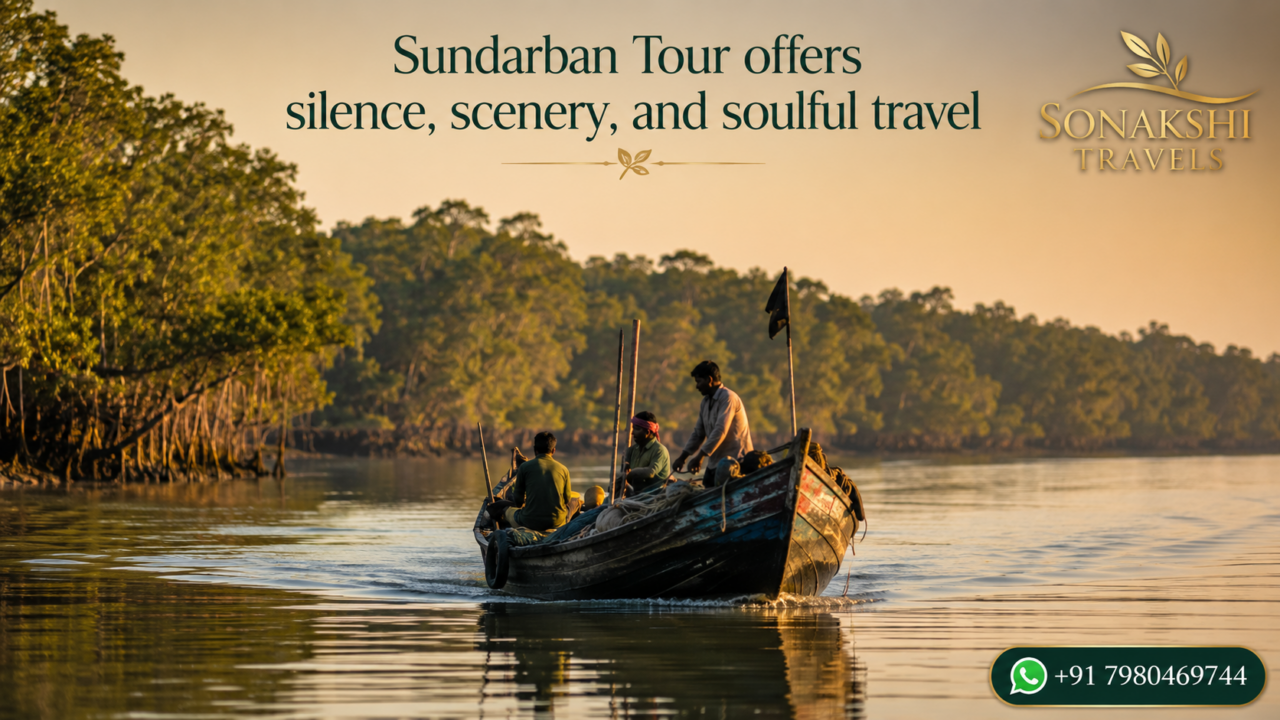


Sundarban Tour is perfect for educational eco-travel
Educational eco-travel becomes meaningful when a journey teaches more than names, places, and photographs. It should help a learner observe a living landscape, understand natural relationships, and feel respect for the quiet systems that support life. In this sense, a Sundarban tour offers a rare classroom without walls. The forest, river, mudflat, tide, village edge, bird movement, mangrove root, and silence together create a deep learning environment where nature explains itself slowly.
The Sundarban is not only a destination for visual experience. It is a sensitive ecological space where land and water constantly interact. For students, teachers, researchers, nature lovers, and thoughtful travellers, this region opens a practical understanding of ecology. It shows how a forest can breathe with the tide, how trees can survive in saline soil, how animals adapt to uncertain ground, and how human life remains connected with natural rhythm. This makes Sundarban tour highly suitable for educational eco-travel.

Why Educational Eco-Travel Needs a Living Landscape
Education becomes stronger when learners can connect theory with direct observation. Many people study forests, rivers, climate, food chains, biodiversity, and conservation from books. But a living landscape gives these ideas shape, sound, smell, and movement. The Sundarban allows visitors to see how natural systems do not work separately. The river does not stand apart from the forest. The mud does not stand apart from the roots. The birds do not stand apart from the tide. Every visible element is connected with another unseen process.
This is the main reason why Sundarban tour can become a strong educational journey. It helps travellers move beyond surface-level sightseeing. Instead of only asking what can be seen, the traveller begins to ask why something exists in that form. Why are mangrove roots exposed? Why does the riverbank look soft and layered? Why do birds gather near certain patches? Why does silence feel different inside the creek? These questions create the foundation of eco-learning.
Educational eco-travel also develops patience. In ordinary travel, people often expect quick attractions and instant excitement. In the Sundarban, the environment works differently. The forest teaches slowly. A learner must watch the colour of water, the pattern of roots, the behaviour of birds, the sound of wind through leaves, and the changing mood of open river channels. This slow observation is important because environmental knowledge is not always dramatic. Much of it is hidden in small details.
The Mangrove Forest as a Natural Classroom
The mangrove forest is one of the strongest reasons why the Sundarban is perfect for educational eco-travel. Mangroves are not ordinary trees growing beside water. They are highly adapted plants that survive in difficult conditions. Their roots, leaves, bark, and growth patterns show how nature creates solutions for survival. For students, this is a powerful lesson in adaptation. The forest becomes a real example of how life adjusts to salinity, soft mud, tidal movement, and low oxygen soil.
During a responsible Sundarban tour package, learners can observe that the ground is never simply dry land. It is a shifting surface shaped by water and sediment. The exposed roots of mangroves are not decorative features. They help the trees breathe and remain stable in unstable soil. This single observation can explain several ecological ideas: plant adaptation, oxygen exchange, soil condition, erosion control, and habitat formation.
The mangrove edge also teaches the importance of boundaries. It is not a sharp line between land and water. It is a living transition zone. This zone supports fish, crabs, insects, birds, reptiles, and many small organisms that are often missed by casual visitors. For educational eco-travel, such observation is important because it shows that the smallest habitats may support large ecological functions. A muddy creek bank may look simple, but it can hold the beginning of a food chain.
Learning from Roots, Mud, and Tidal Movement
The roots of the mangrove forest are among the most meaningful learning points in the Sundarban. They stand above the mud like natural breathing structures. Their presence tells a story of survival in a difficult environment. When students see them directly, the idea of adaptation becomes easy to understand. They can see that plants are not passive objects. They are living organisms with special strategies.
The mud also has educational value. It records the movement of water, the softness of sediment, and the pressure of living organisms. Footmarks, crab holes, root patterns, and water marks together create a natural text. A careful learner can read this text by observing shape, depth, and pattern. This kind of field-based learning builds attention. It also teaches humility because nature does not always explain itself loudly.
Tidal movement adds another layer of learning. It shows that the Sundarban is not fixed. The same edge can appear different at different times because water level, current, and exposed land keep changing. This helps learners understand that ecosystems are dynamic. A forest may look still from a distance, but inside it, movement is continuous. This is one of the most valuable lessons of eco-travel.
Silence, Rhythm, and the Psychology of Nature Learning
The Sundarban teaches through silence as much as through visible beauty. In an educational journey, silence is not emptiness. It is a condition that allows attention to deepen. When the sound of traffic, hurried conversation, and urban noise disappears, the mind starts noticing smaller details. The splash of water, the call of a bird, the movement of leaves, and the distant sound of a boat become meaningful parts of the experience.
This is why Sundarban tour package can support psychological learning along with ecological learning. Travellers begin to understand how natural rhythm affects human awareness. The slow movement of the boat, the wide water surface, and the repeating patterns of forest lines create a calm mental space. This helps learners observe more carefully and think more deeply. Such learning is different from classroom memorisation. It becomes personal and reflective.
Silence also teaches respect. In a sensitive ecosystem, loud behaviour feels out of place. The forest naturally encourages controlled movement, softer speech, and patient watching. This behavioural shift is an important part of eco-travel education. It shows that responsible travel is not only about rules. It is also about attitude. A traveller must learn to reduce disturbance and allow the landscape to remain itself.
Understanding Biodiversity Through Observation
Biodiversity is often explained as the variety of life. In the Sundarban, this idea becomes visible through layers. There are trees, shrubs, roots, fish, crabs, birds, insects, reptiles, mammals, and microorganisms. But educational eco-travel should not treat biodiversity as a list of species only. It should explain how different life forms depend on one another. The value of the Sundarban lies in this relationship.
A Sundarban tour package designed with an educational mindset can help visitors observe this relationship with care. A bird standing near the waterline may indicate food availability. A crab hole may show the health of the muddy surface. A dense patch of mangrove may protect soil from erosion. A quiet creek may support small aquatic life. Each small detail helps explain the larger ecological structure.
For students, this approach is especially useful. It teaches them not to look at wildlife only as rare or exciting sightings. Instead, it teaches them to observe ordinary life forms with equal respect. A small crab, a mangrove seedling, or a mudskipper can become an important subject of study. This changes the quality of travel. The journey becomes less about collecting memories and more about developing environmental intelligence.
Behavioural Learning from the Forest Environment
The behaviour of the Sundarban environment can be studied like a living system. Water rises and falls. Birds move according to food and safety. Leaves respond to light and wind. Roots hold the mud. Human movement remains limited by natural conditions. This teaches an important lesson: nature has its own order, and people are only temporary visitors inside it.
This understanding is central to educational eco-travel. When travellers accept that the forest is not arranged for human convenience, they begin to see nature more honestly. They understand that ecosystems do not exist as entertainment spaces. They exist as life-support systems. This shift in thinking is one of the strongest educational outcomes of a thoughtful Sundarban travel experience.
Behavioural learning also includes human behaviour. The way visitors speak, move, listen, and respond to the forest becomes part of the journey. Responsible conduct is not a separate instruction. It grows naturally when travellers understand the sensitivity of the place. This is why educational eco-travel in the Sundarban can create more mature travellers.
Human Life Beside a Sensitive Ecosystem
The Sundarban is also important because it shows the close connection between human life and natural systems. People living near such landscapes understand the forest differently from distant observers. Their lives are shaped by river movement, forest rules, livelihood patterns, and ecological limits. For educational travellers, this human-nature relationship is very important because conservation is not only about protecting trees and animals. It is also about understanding communities living near the ecosystem.
A responsible Sundarban travel agency can help present this relationship with dignity and accuracy. The focus should not be on romanticising hardship or turning local life into a display. The better approach is to understand how people adapt to the landscape, how they respect natural limits, and how their daily rhythm is connected with water and forest conditions. This creates a more balanced form of learning.
Educational eco-travel must avoid treating the Sundarban only as wilderness. It should recognise that human presence around the forest is part of a wider ecological and cultural reality. The learner sees that sustainability needs cooperation between environment, livelihood, awareness, and responsible tourism. This makes the travel experience more complete and more ethical.
Why the Sundarban Builds Environmental Responsibility
Environmental responsibility grows when people feel connected with what they learn. The Sundarban creates that connection because its landscape is powerful but not loud. It does not teach through grand monuments. It teaches through fragile edges, patient water, exposed roots, and living silence. These elements make travellers aware that ecosystems can be strong and delicate at the same time.
During a meaningful Sundarban private tour package, the educational value becomes even stronger when the journey allows focused observation. Smaller groups often find it easier to listen, pause, ask questions, and reflect. The purpose is not luxury for comfort alone. The deeper value is the possibility of quieter learning and more attentive engagement with the environment.
Responsibility also comes from understanding impact. Every sound, movement, waste habit, and careless action can affect a sensitive place. Educational eco-travel should make this clear without fear-based language. The goal is to create awareness. When travellers understand why silence matters, why cleanliness matters, why distance matters, and why patience matters, they become better participants in conservation-minded travel.
The Role of Interpretation in Eco-Travel
Observation becomes more useful when it is supported by interpretation. Interpretation means explaining what the traveller is seeing in a simple and meaningful way. In the Sundarban, this is very important because many ecological processes are not immediately obvious. A visitor may see roots, water, mud, and birds, but without explanation, the deeper meaning may remain hidden.
A knowledgeable Sundarban tour operator can help connect field observation with ecological understanding. The explanation should remain clear and grounded. For example, instead of using heavy scientific language, the guide can explain how mangrove roots help trees breathe, how mud supports small life forms, or how tidal rhythm influences the forest edge. Simple interpretation makes learning accessible to all age groups.
Good interpretation also prevents shallow travel. It helps visitors avoid seeing the Sundarban only as a background for photographs. When people understand what they are looking at, they begin to value it more. This is the heart of educational eco-travel. Knowledge turns a scene into a lesson. Attention turns a journey into learning.
Field Observation as a Research Habit
Educational eco-travel can also encourage research habits. These habits do not need to be complicated. They begin with simple field observation. A student can note changes in water colour, bird activity, root density, mud texture, or sound patterns. A teacher can ask learners to describe what they see before explaining it. This builds independent thinking.
The Sundarban is ideal for this because it rewards patient observation. The landscape does not reveal everything at once. A learner must compare, wait, and notice. This process is similar to research. It develops discipline, attention, and curiosity. Even a short moment of careful watching can create a question that leads to deeper study.
This is why Sundarban tour from Kolkata has value beyond travel convenience. For learners from an urban environment, the shift from city rhythm to mangrove rhythm can be educational in itself. It shows how different landscapes create different ways of seeing, hearing, and thinking.
Eco-Travel and Emotional Connection with Nature
Education is not only intellectual. It is also emotional. People protect what they learn to value. The Sundarban can create this emotional connection because its beauty is quiet, layered, and thoughtful. It does not depend only on dramatic moments. Its emotional strength comes from still water, distant forest lines, soft movement, and the feeling that life is continuing silently around the traveller.
A carefully planned Sundarban private tour can support this kind of emotional learning when the pace allows reflection. The traveller gets time to absorb the landscape rather than rush through it. This helps the mind form a respectful relationship with the place. Such emotional connection is important because environmental education without feeling often remains incomplete.
When learners feel the calm seriousness of the Sundarban, they begin to understand why conservation matters. They see that a forest is not only a collection of resources. It is a living world with its own rhythm and dignity. This emotional awareness can stay with them long after the journey ends.
Luxury, Comfort, and Educational Depth
Comfort and education can work together when the purpose remains responsible. In eco-travel, comfort should not distract from the environment. It should help travellers remain attentive, safe, and calm enough to learn. A Sundarban luxury tour package can be meaningful when it supports quiet observation, respectful movement, and better interpretation rather than unnecessary excess.
The idea of Sundarban luxury tour should be understood in an educational way. True value lies in refined experience, not noise or display. A comfortable setting can give travellers more mental space to observe the ecosystem. It can help families, senior travellers, researchers, and learning groups engage with the landscape in a more settled manner.
Similarly, a Sundarban luxury private tour can support topic-focused learning when it allows controlled discussion, slower interpretation, and a more personal connection with the forest atmosphere. The educational purpose should remain at the centre. Comfort should serve learning, not replace it.
Why This Journey Matters for Students and Families
For students, the Sundarban offers lessons that are difficult to understand through textbooks alone. They can learn about adaptation, habitat, biodiversity, conservation, food chains, erosion, salinity, and human-environment relationships through direct experience. These ideas become easier because the learner can see real examples. The forest becomes a practical study space.
For families, educational eco-travel creates shared learning. Parents and children can observe together, ask questions together, and discuss what they notice. This kind of travel builds awareness across generations. A child who watches mangrove roots carefully may remember the lesson longer than a paragraph from a book. A parent who experiences the silence of the forest may understand why responsible travel matters.
A best Sundarban tour package for educational eco-travel is not defined by how many activities are included. It is defined by how deeply the journey helps travellers understand the ecosystem. The best experience is one that keeps the mind alert, the behaviour respectful, and the connection with nature honest.
Maintaining Topic Purity in Educational Travel
The Sundarban can easily be discussed from many angles, but educational eco-travel requires focus. The main subject is not entertainment, speed, or consumption. The main subject is learning through ecological experience. Every part of the journey should support this purpose. The forest should be observed as a living system. The river should be understood as an active force. The silence should be respected as part of the learning atmosphere.
This is why a Sundarban tour package from Kolkata becomes meaningful when it is shaped by awareness, not only movement. The educational value lies in how the traveller is guided to see. A journey that encourages observation, interpretation, and respect can be far more valuable than one that only lists places.
The same principle applies to a Sundarban private tour packages experience. Privacy should not mean isolation from learning. It should allow better attention, clearer communication, and deeper connection with the landscape. Topic purity means the traveller stays focused on ecology, behaviour, silence, adaptation, and responsibility.
Connection Between Local Food Culture and Eco-Learning
Educational eco-travel can also include careful understanding of food culture when it remains connected to place and ecology. In the Sundarban region, food is not only a matter of taste. It reflects river life, local preference, seasonal memory, and cultural identity. However, this subject should be handled with balance. It should not shift the article away from eco-learning. Instead, it can show how human culture develops beside a river-based landscape.
Events such as Sundarban hilsa festival and Sundarban ilish utsav can be understood as cultural expressions connected with river memory and Bengali food heritage. When presented responsibly, such themes can help travellers understand how ecology and culture often meet through food traditions. The learning point is not simply eating a dish. The learning point is understanding how landscape influences culture.
For future-focused travel content, Sundarban hilsa festival 2026 and Sundarban ilish utsav 2026 can be positioned carefully within educational eco-travel when the focus remains on cultural ecology, responsible celebration, and respect for regional identity. This keeps the discussion connected with the main theme.
Responsible Travel as a Learning Outcome
The strongest result of educational eco-travel is responsible thinking. After experiencing the Sundarban carefully, a traveller should not only say that the place is beautiful. The traveller should understand why it is important, why it is sensitive, and why human behaviour matters. This shift from enjoyment to responsibility is the real success of eco-learning.
A thoughtful Sundarban private tour package can help create this outcome when it encourages slower attention and careful interpretation. A meaningful Sundarban luxury tour packages experience can also support responsible learning when comfort is aligned with ecological respect. In both cases, the quality of the journey depends on awareness.
Responsible travel also means understanding that the Sundarban is not silent because it is empty. It is silent because its life moves in subtle ways. The forest does not need to perform for visitors. The traveller must learn to observe without demanding constant excitement. This attitude is essential for any educational eco-travel experience.
Sundarban Tour is perfect for educational eco-travel because it brings together ecology, silence, behaviour, adaptation, culture, and responsibility in one living landscape. It helps travellers understand that nature is not a separate subject. It is a complete system where water, mud, roots, birds, animals, people, and rhythm remain connected. This makes the journey deeply valuable for students, families, researchers, and thoughtful travellers.
The real strength of a Sundarban tour package 2 night 3 days or any learning-focused Sundarban experience is not only in what travellers see. It is in how they learn to see. When observation becomes patient, silence becomes meaningful, and the forest is understood as a living classroom, travel becomes education. That is why the Sundarban stands as one of the most powerful places for responsible and research-minded eco-travel.