


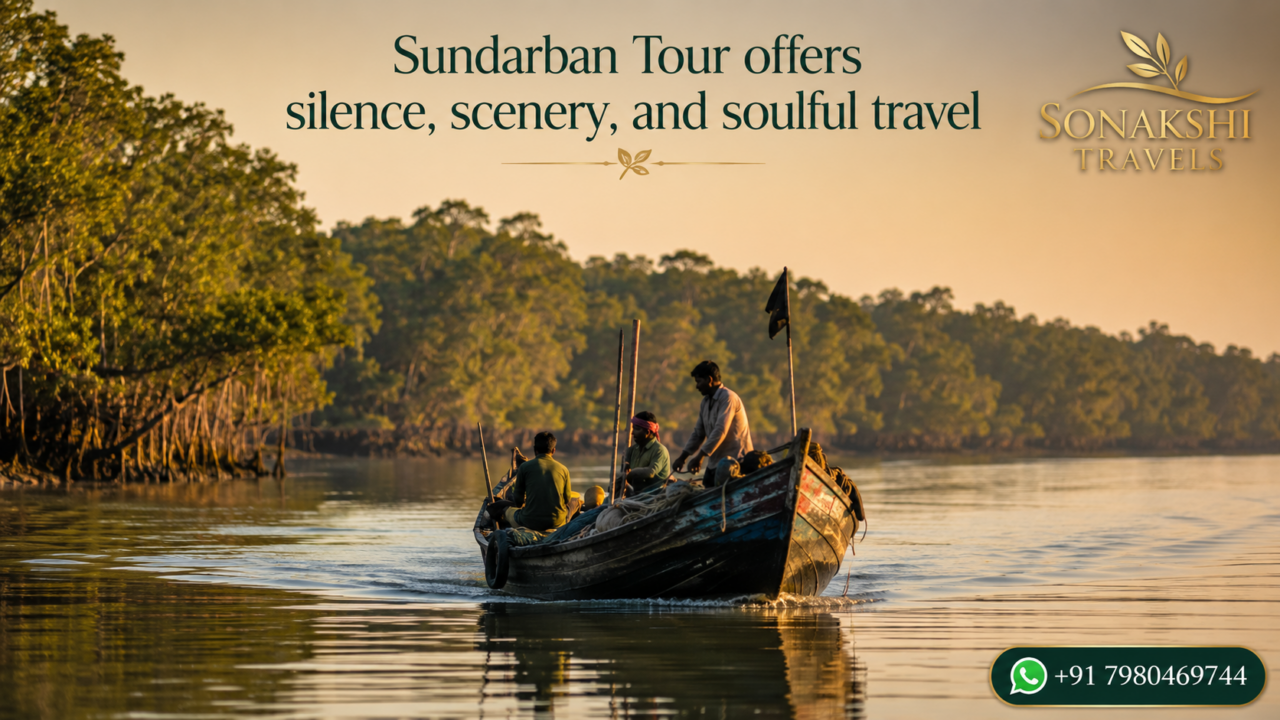


Sundarban Tour is a journey through water, mud, and mangroves
A Sundarban tour is not only a movement from one place to another. It is a slow journey through water, mud, and mangroves, where the landscape teaches the traveller to observe more carefully. The region does not reveal itself through loud scenery. It works through silence, tide, reflection, smell, shadow, and the soft movement of boats through narrow river channels. Every part of the journey feels connected to the natural rhythm of the delta.
The first strong impression comes from water. In the Sundarban, water is not only a background. It is the main road, the living surface, and the changing mirror of the forest. The rivers, creeks, and channels shape the way people move, think, and wait. A traveller soon understands that this land cannot be read like a normal forest. It must be understood through flow. The water is always carrying silt, sound, sunlight, memory, and movement.
Mud is the second language of the place. It appears along the riverbanks, under the mangrove roots, beside village edges, and near the tidal flats. This mud is not empty soil. It is a living, breathing surface where the forest negotiates with the tide every day. It records footprints, crab movement, root pressure, and the marks left by retreating water. In many ways, the mud shows the hidden labour of the delta more honestly than any distant view can show.
Mangroves form the third and most powerful layer of the journey. They do not stand like ordinary trees on firm land. They rise from wet ground, saline soil, and tidal pressure. Their roots spread, hold, breathe, and protect. For a traveller, mangroves create a different idea of beauty. Their beauty is not decorative. It is functional, patient, defensive, and deeply ecological. They show how life survives where land and water are never fully separate.

Water as the moving path of the journey
In the Sundarban, the journey begins to change the traveller’s mind because the path itself is liquid. The boat does not rush through the forest. It moves with care, following channels that may look similar from a distance but feel different when observed closely. The surface of the water changes with tide, depth, light, and wind. Sometimes it looks wide and open. Sometimes it becomes narrow, secretive, and almost silent.
This is why Sundarban tour experiences often feel more meditative than ordinary travel. The traveller sits and watches, but the watching is active. The eyes begin to notice the meeting line between water and mud, the bend of a creek, the leaning branches, and the small disturbances on the surface. The forest is not always visible in a dramatic way. It is often suggested through small movements.
Water also creates a special kind of distance. The traveller can see the forest, but cannot enter it freely. This distance is important. It keeps the forest respected. It reminds the visitor that the Sundarban is not a landscape made for easy human control. The boat becomes a respectful viewing space, and the water becomes a boundary between human curiosity and wild independence.
The sound of water is equally important. There may be no large noise, yet the place is never completely silent. There is the soft push of the boat, the low sound of the current, the occasional call of birds, and the faint movement of branches. This layered silence makes the journey feel serious and thoughtful. It encourages the traveller to slow down and accept the pace of the delta.
Mud as the memory of the tide
The mud of the Sundarban is one of the most meaningful parts of the journey. It may look simple at first, but it holds the story of the tide. When water rises, it covers the mud. When water falls, it reveals the surface again. This repeated covering and uncovering gives the landscape a living quality. Nothing feels fixed. Every exposed bank looks temporary, yet deeply important.
For the careful traveller, mud explains the behaviour of the forest. The roots of mangroves push through it. Small creatures use it. Birds search near it. The river cuts it, deposits it, and reshapes it. A Sundarban tour becomes richer when this mud is not ignored as background, but understood as a central part of the ecosystem.
Mud also gives the Sundarban its raw character. It removes artificial polish from the travel experience. The place does not try to look smooth or controlled. It is wet, textured, uneven, and changing. This natural roughness creates authenticity. It helps the traveller feel that the journey is taking place inside a working environment, not inside a staged tourist setting.
There is also a psychological meaning in this mud. It reminds the traveller of uncertainty. The ground itself is not always firm. The edge of land is always being shaped by water. This makes the Sundarban feel humble and powerful at the same time. It teaches that stability in nature can come from adaptation, not from hardness.
Mangroves as living architecture
The mangrove forest is the visual and ecological heart of the journey. Its structure is unlike the familiar image of a forest with clean trunks and dry paths. Here, the forest grows with roots exposed, branches bent, and trunks shaped by salt, tide, and wind. The mangroves look dense from outside, yet their real strength lies in their relationship with water and mud.
During a Sundarban tour package experience, the traveller often sees the forest from the river. This river-facing view is important because it shows the mangroves as a protective wall. The trees seem to hold the land together. Their roots grip the soft banks and reduce the direct force of moving water. This gives the visitor a clear sense that the forest is not passive. It is constantly working.
The root systems are especially meaningful. Some roots rise upward to breathe. Some spread sideways to support. Some appear like natural sculptures on the mud. These forms are not accidental. They are survival designs. In simple terms, mangroves live in difficult conditions, and their bodies show the solution. This is why the forest feels intelligent, even without speaking.
The mangroves also change the quality of light. Sunlight enters unevenly through leaves, branches, and river mist. The result is a soft but serious visual atmosphere. The forest rarely looks open. It looks layered. This layered look creates mystery, but not in an artificial way. The mystery comes from ecological density, limited visibility, and the natural complexity of the delta.
The rhythm of slow observation
The most valuable part of the journey is the change it brings to the traveller’s attention. In fast travel, people often look for quick highlights. In the Sundarban, quick looking is not enough. The environment asks for patience. A branch may move slightly. A bird may appear only for a moment. A mudbank may show marks that disappear with the next tide. The journey trains the eye to notice small signs.
This is where the experience becomes deeply editorial and reflective. A Sundarban tour package may be arranged as a travel service, but the real meaning of the journey comes from how the traveller learns to observe. The delta does not behave like a monument. It behaves like a living system. Its value is not only in what is seen, but also in what is understood through quiet attention.
The movement of the boat creates a natural rhythm. The traveller is carried forward, yet the mind becomes still. The river moves, the mud waits, and the mangroves stand with patient tension. This combination creates a rare emotional atmosphere. It is peaceful, but not empty. It is calm, but never lifeless. It is beautiful, but not fragile in a simple sense.
Such observation also changes the meaning of silence. Silence in the Sundarban is not the absence of life. It is the presence of hidden life. The forest may appear still, but it is full of processes. Roots breathe, mud settles, water shifts, fish move, birds scan, and leaves respond to air. The traveller slowly understands that silence can be a form of activity.
The meeting of human movement and wild restraint
A journey through the Sundarban is also a lesson in restraint. Human movement is possible, but it is limited by river routes, tidal behaviour, forest boundaries, and natural caution. This controlled movement gives the travel experience a special seriousness. The traveller does not dominate the landscape. The traveller passes through it with permission, distance, and respect.
This is why the role of a responsible Sundarban tour operator is not only to arrange movement, but to maintain the dignity of the experience. The forest should not be treated as a stage for noise or careless excitement. It should be approached as a sensitive delta system, where every sound and movement has meaning.
Human life near the Sundarban is also shaped by this environment. Even without turning the article into a village story, one can feel that the landscape has trained local behaviour. People understand tide, mud, boat movement, and river caution in a practical way. Their relationship with the delta is based on experience, not theory. This human presence adds depth to the journey, but it never removes the central power of the landscape.
A Sundarban tour from Kolkata can therefore become a movement from urban speed into tidal patience. The contrast is strong. City life often depends on fixed roads, fixed schedules, and constant sound. The Sundarban depends on water routes, ecological timing, and careful silence. This contrast makes the journey emotionally memorable.
Ecological intelligence of the landscape
The Sundarban landscape is often admired for its beauty, but its deeper value lies in ecological intelligence. Water, mud, and mangroves are not separate elements placed side by side. They operate together. The water brings and removes sediment. The mud receives and records change. The mangroves stabilize, breathe, shelter, and adapt. This partnership creates the living identity of the delta.
For readers searching through a serious Sundarban travel lens, this ecological relationship is central. The journey is meaningful because it shows how nature functions under pressure. Salt, tide, soft soil, erosion, and limited stability are not obstacles alone. They are conditions through which the mangrove system has developed its own survival language.
The forest also shows that strength in nature does not always look grand. The mangrove tree may look small compared with many inland trees, but its strength lies in adaptation. Its roots, leaves, bark, and growth pattern all respond to environmental demand. This gives the traveller a more mature idea of wilderness. Wilderness is not only height, size, or dramatic visibility. It is also endurance, adjustment, and balance.
A careful Sundarban travel agency narrative should therefore respect this ecological intelligence. The words used to describe the journey should not reduce the Sundarban to only thrill or spectacle. The true richness lies in the relationship between visible beauty and hidden function. The more carefully one observes, the more meaningful the journey becomes.
The sensory character of the delta
The Sundarban is strongly sensory. The smell of wet soil, river water, leaves, and silt creates an atmosphere that cannot be fully captured through photographs. The air often feels heavy with natural material. The river carries a different smell from the mudbank. The mangrove edge carries another. Together, these details make the journey feel close to the earth.
Sound also shapes memory. There are no unnecessary layers in the natural soundscape. The boat engine may fade into the background, and the smaller sounds of the delta become clearer. A splash near the bank, a wingbeat above the river, the distant call of a bird, or the movement of leaves can become important. The place trains the ear in the same way it trains the eye.
The visual texture is equally rich. Water reflects light but rarely appears clean and empty. Mud absorbs light and gives the banks a dense, earthy presence. Mangrove leaves create patterns of green, shadow, and movement. The traveller is surrounded by textures rather than single postcard views. This is why the journey feels layered and slow.
Even the body feels the difference. Sitting in a boat for a long river passage changes the rhythm of breathing and attention. The traveller becomes aware of balance, direction, and distance. The body understands that it is moving through a soft geography, where land and water constantly speak to each other.
Why the journey feels inward as well as outward
A Sundarban journey often becomes inward because the landscape does not demand constant conversation. It creates space for thought. The slow river, repeated mangrove lines, and exposed mudbanks produce a calm but serious mood. The traveller may begin by looking outside, but gradually starts reflecting inside.
This inward quality is not separate from the environment. It comes from the way the delta moves. The boat travels forward, but the scenery changes slowly. The tide works quietly. The forest remains partly hidden. This combination creates a reflective state of mind. It makes the traveller feel the value of patience, humility, and attention.
In this sense, a Sundarban private tour can offer a more intimate way to feel the silence of the place, when the focus remains on the landscape rather than noise. The main subject is still the journey through water, mud, and mangroves. Privacy simply allows the traveller to hear and observe the delta with fewer distractions.
Similarly, a carefully designed Sundarban private tour package should protect the slow emotional character of the journey. It should not convert the forest into a rushed checklist. The deeper value lies in giving enough mental space to understand the environment as a living system.
Luxury as quiet depth, not excess
In the Sundarban, luxury should not mean loudness. The landscape itself is too sensitive for excess. The more suitable meaning of luxury is quiet comfort, thoughtful pacing, clean observation, and respectful distance from the forest. This idea fits the character of the delta because the place rewards calmness more than display.
A Sundarban luxury tour becomes meaningful when it helps the traveller experience water, mud, and mangroves with greater ease and attention. The luxury is not in separating the visitor from nature. It is in allowing the visitor to remain present without discomfort becoming the main memory.
The same principle applies to a Sundarban luxury tour package. Its best role is to support the atmosphere of the journey, not to overpower it. The delta should remain the main subject. The river should remain the guide. The mud should remain visible. The mangroves should remain respected.
A Sundarban luxury private tour can therefore be understood as a quiet, focused form of travel, where the traveller has more room to feel the environment deeply. The word luxury becomes connected with silence, space, care, and ecological respect rather than unnecessary decoration.
Food, culture, and the river mood
The central theme of the journey remains water, mud, and mangroves, but cultural taste can sometimes deepen the feeling of place when it is connected to the river mood. Food traditions near the delta often carry the memory of water, fish, soil, and seasonal community life. They should be understood as part of the larger river identity, not as a separate distraction from the landscape.
For example, the idea of Sundarban hilsa festival becomes relevant when presented as a cultural expression connected to river life and Bengal’s emotional relationship with fish. It should not take attention away from the mangrove journey. Instead, it can quietly add another layer to the meaning of water in local memory.
The phrase Sundarban ilish utsav also carries a similar cultural feeling. It connects food, river, family emotion, and place identity. When handled with restraint, such cultural references can support the main theme by showing how water is not only a physical route, but also a source of memory and taste.
Even Sundarban hilsa festival 2026 or Sundarban ilish utsav 2026 should be understood in this article only through the emotional connection between river culture and the wider Sundarban atmosphere. The journey remains centered on the delta itself.
The moral lesson of water, mud, and mangroves
The Sundarban gives a quiet moral lesson. It shows that survival is not always loud. The strongest systems may be the ones that bend, breathe, hold, and adjust. Water moves around obstacles. Mud receives change. Mangroves survive by adapting to difficult conditions. Together, they create a landscape that is both vulnerable and powerful.
This lesson is important for the traveller. The journey is not only about seeing a famous region. It is about understanding how a place can live between uncertainty and balance. The Sundarban does not offer simple comfort to the mind. It offers a deeper awareness of nature’s patience.
The traveller who pays attention leaves with more than images. The memory remains as a sequence of movements: the boat turning through a channel, the mud shining after the tide, the roots rising like breathing structures, the forest standing in layered silence. These memories are not loud, but they are lasting.
That is why the title is meaningful. A Sundarban tour is truly a journey through water, mud, and mangroves. Water carries the traveller. Mud reveals the work of the tide. Mangroves explain survival. Together, they create an experience that is quiet, serious, ecological, and deeply human.
A journey through the Sundarban should be understood with patience. It is not a place that gives all its meaning at once. Its beauty is layered in water movement, muddy banks, mangrove roots, tidal silence, and the careful distance between human presence and wild life. The more slowly one observes, the more the delta becomes clear.
The most honest way to experience the Sundarban is to let the landscape remain the main storyteller. The river should not be treated only as a route. The mud should not be treated as empty ground. The mangroves should not be treated only as scenery. Each element has a role, a voice, and a living function.
In the end, the journey through water, mud, and mangroves becomes a journey into attention itself. It teaches the traveller to look softly, listen carefully, and respect what is partly hidden. This is the lasting power of the Sundarban. It does not need to shout to be unforgettable.