
Bara Pathing
– An Untouched Highland Hamlet Where Silence, Stone Paths, and Mountain Light Coexist
Hidden quietly beyond the familiar routes of Darjeeling tourism, Bara Pathing is a lesser-known Himalayan hamlet where time slows, voices soften, and the mountains reclaim their ancient authority over human presence. Resting in the eastern folds of the Darjeeling hills, Bara Pathing is not a destination shaped by commercial tourism, but a settlement shaped by geography, agrarian rhythm, and inherited memory. For travellers seeking offbeat Darjeeling experiences rooted in authenticity rather than spectacle, Bara Pathing offers a deeply contemplative journey.
Geographical Setting and Natural Character of Bara Pathing
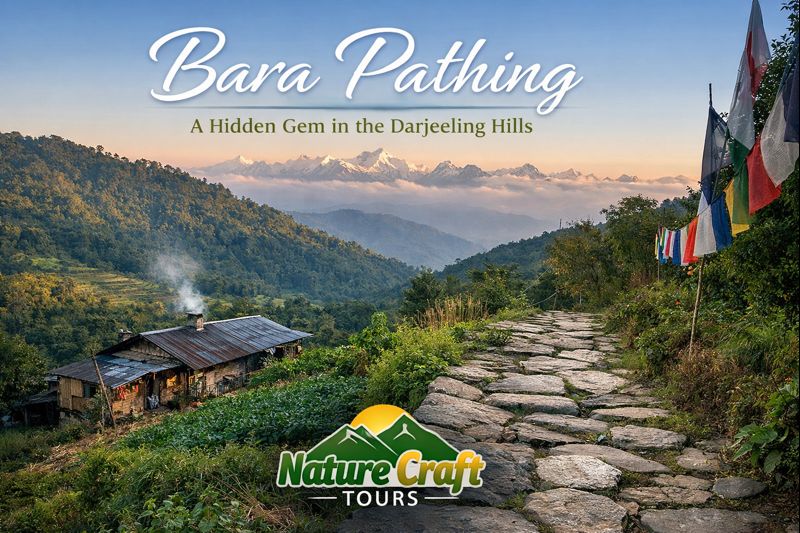
Bara Pathing is located in the mid-altitude zone of the Darjeeling Himalayas, surrounded by undulating forest ridges, terraced farmlands, and distant views of higher Himalayan peaks on exceptionally clear days. The name “Pathing” is believed to derive from local dialects referring to pathways or slopes, while “Bara” indicates its relative size or prominence compared to nearby smaller settlements. The village is connected through narrow mountain roads and stone-laid footpaths, reinforcing its identity as a place where walking remains central to daily life.
The natural environment here is defined by mixed Himalayan forests comprising pine, oak, chestnut, and seasonal flowering shrubs. Birdsong replaces engine noise, and mornings often begin with a soft veil of mist rolling upward from forested valleys. Agricultural plots of maize, millet, seasonal vegetables, and cardamom integrate seamlessly into the landscape, reflecting sustainable hill farming practices followed for generations.
Why Bara Pathing Remains an Offbeat Destination
Unlike prominent hill stations that developed under colonial influence, Bara Pathing remained largely outside structured tourism expansion. The absence of large hotels, crowded viewpoints, and commercial attractions has preserved its rural character. Visitors here are not entertained by itineraries but are instead invited to participate—through walking, observing, listening, and unlearning haste.
This makes Bara Pathing especially appealing to slow travellers, nature writers, photographers, birdwatchers, and those seeking digital detox retreats. The hamlet represents a living cultural landscape rather than a curated tourist product.
Important Places and Experiences in and Around Bara Pathing
Forest Walks and Village Trails
The most profound experience in Bara Pathing is walking itself. Narrow trails pass through forests, farms, and homesteads, offering close interaction with the terrain. These walks reveal medicinal plants, traditional water channels, prayer flags tied to old trees, and stone resting platforms used by villagers.
Sunrise and Light Play Over the Hills
Early mornings unveil a quiet spectacle as sunlight filters gradually across ridgelines. On clear days, distant Himalayan ranges glow faintly, while nearer slopes shift through tones of silver, gold, and deep green. These moments are best experienced from open village clearings rather than designated viewpoints.
Local Agricultural Life
Seasonal farming activities form the backbone of daily life in Bara Pathing. Visitors can observe traditional ploughing, seed sowing, harvesting, and drying processes depending on the time of year. Such interactions offer insight into hill agronomy and climate-dependent livelihoods.
Birdwatching and Quiet Observation
The surrounding forests host numerous Himalayan bird species, including barbets, flycatchers, laughing thrushes, and woodpeckers. The absence of traffic and crowds significantly enhances wildlife visibility and auditory experiences.
Major Distances from Bara Pathing
Understanding distances helps in planning a comfortable journey:
- Bara Pathing to Darjeeling: approximately 35–40 km
- Bara Pathing to Kurseong: approximately 25–30 km
- Bara Pathing to Siliguri: approximately 65–70 km
- Bara Pathing to NJP Railway Station: approximately 70 km
- Bara Pathing to Bagdogra Airport: approximately 75 km
Road conditions vary with seasons, and travel times may extend during monsoons due to fog or landslides.
How to Reach Bara Pathing
By Air
Bagdogra Airport is the nearest airport. From Bagdogra, travellers must continue by road through Siliguri and onward into the Darjeeling hills. The final stretch involves narrower mountain roads, offering scenic yet slower travel.
By Train
New Jalpaiguri (NJP) serves as the primary railhead. From NJP, road transport via shared or private vehicles is required. The ascent gradually transitions from plains to forested hills.
By Road
Bara Pathing is accessible by road from Darjeeling, Kurseong, and Siliguri. However, the final approach often requires careful navigation, and travellers are advised to travel during daylight hours for safety and better visibility.
Staying Options in Bara Pathing
Accommodation in Bara Pathing remains intentionally limited, preserving the village’s low-impact character. Visitors generally stay in:
- Family-run homestays offering basic yet clean rooms
- Eco-friendly village lodges built with local materials
- Farm-based stays integrated with agricultural households
These properties emphasize local cuisine, seasonal produce, and cultural immersion rather than luxury amenities. Electricity and mobile connectivity may be limited, which many travellers consider an advantage rather than an inconvenience.
Best Time to Visit Bara Pathing
Spring (March to May)
Spring brings blooming wildflowers, clear skies, and pleasant temperatures. This period is ideal for walking, photography, and cultural observation.
Summer (June to Early July)
Early summer offers lush greenery, though increasing humidity and occasional rain begin to appear.
Monsoon (July to September)
The monsoon transforms the landscape into vivid green expanses, but travel may be disrupted by landslides and road conditions. This season is best avoided unless travellers are experienced with hill travel.
Autumn (October to November)
Autumn is considered the finest season, marked by crisp air, stable weather, and expansive views of the Himalayas.
Winter (December to February)
Winters are cold, quiet, and introspective. While snowfall is rare, temperatures can drop significantly, and mornings are often mist-laden.
Cultural Sensitivity and Responsible Travel
Bara Pathing is not a performance village. Visitors are expected to respect local customs, dress modestly, seek permission before photography, and minimize waste. Responsible travel here means participation without intrusion.
Travellers interested in broader eco-cultural circuits may explore other offbeat villages such as
Tinchuley, which shares similar philosophies of sustainable hill tourism and community-led hospitality.
Bara Pathing in the Context of Slow Travel in Eastern Himalaya
As travellers increasingly seek meaningful journeys over hurried sightseeing, destinations like Bara Pathing become essential narratives in Himalayan tourism. The village does not compete with famous hill towns; instead, it complements them by offering contrast—where silence replaces schedules and observation replaces consumption.
Those combining forested hill retreats with wetland ecosystems may also explore curated travel experiences such as
Sundarban Tour or Sundarban Travel, which present a distinct yet equally profound relationship between humans and nature.
A Poem for Bara Pathing
Stone paths remember every barefoot morning,
Mist folds the village into quiet prayer,
Forests speak in leaf and winged syllables,
Hills breathe slower here, teaching patience,
Smoke from kitchens writes temporary skies,
Silence listens more than it speaks,
Time loosens its grip among these ridges,
Footsteps become thoughts, unhurried and soft,
Night arrives without announcement or noise,
And Bara Pathing remains—unchanged, watching gently.
Why Bara Pathing Deserves Thoughtful Discovery
Bara Pathing is not a destination to conquer or consume. It is a place to arrive quietly, to stay attentively, and to leave respectfully. In an age of accelerated tourism, it offers something increasingly rare—space to feel landscapes rather than merely view them.
For travellers seeking offbeat Darjeeling villages rooted in ecology, community, and introspection, Bara Pathing stands as a gentle reminder that the Himalayas still hold places where silence is not absence, but presence.