


Tiger Hill Darjeeling
Tiger Hill Darjeeling
– Where the First Light of the Himalayas Touches the Earth
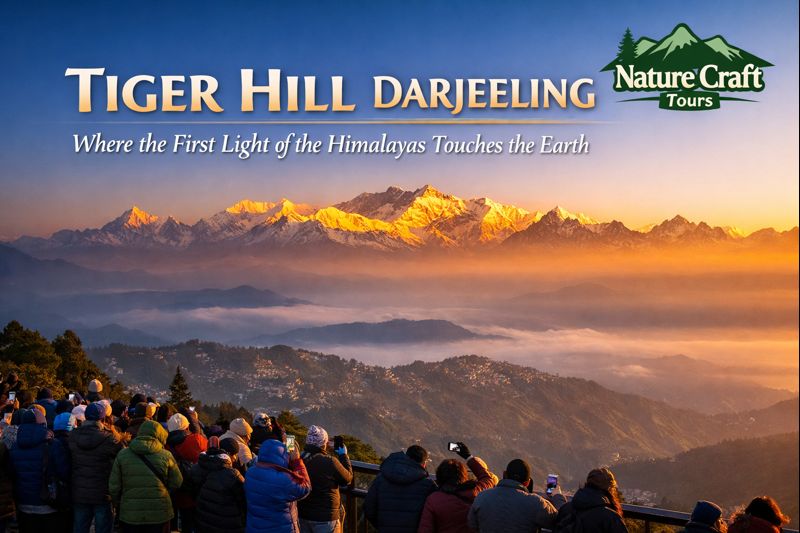
Perched above the historic hill town of Darjeeling, Tiger Hill is not merely a viewpoint; it is a sunrise theatre carved into the Eastern Himalayas. At approximately 2,590 metres (8,500 feet) above sea level, it is celebrated for a rare kind of morning spectacle: the first sunlight striking the snow peaks of the high Himalaya, turning them from cold silver into molten gold. When the sky is clear and the air is steady, the horizon reveals a layered procession of ridges and valleys, culminating in the luminous presence of Kanchenjunga—a mountain revered not only for its height, but also for its commanding, spiritual aura in the Himalayan imagination.
For the traveller who wishes to explore Darjeeling beyond postcards, Tiger Hill offers something deeper: a lesson in patience and perspective. It rewards those who wake before dawn, travel through shadowed forests, and wait in quiet expectation. The sunrise here is not instantaneous; it unfolds like a carefully written story—first a faint grey, then a thin line of pale light, followed by colour that spreads across the mountains as if the heavens are painting the landscape in slow motion.
Why Tiger Hill Is Considered Darjeeling’s Most Iconic Viewpoint
Tiger Hill is widely recognised because it provides a front-row view of Himalayan sunrise and an extraordinary perspective over Darjeeling’s hillscape. On exceptionally clear days, travellers often speak of seeing not only Kanchenjunga but also a distant silhouette of Mount Everest far to the west—appearing like a faint, icy pyramid. While such visibility depends entirely on weather conditions, the possibility itself adds to Tiger Hill’s legendary reputation.
The viewpoint is arranged with a structured viewing area, including platforms that help visitors position themselves for the best line of sight. The early morning crowd—photographers, couples, families, and solo explorers—creates a shared sense of anticipation. Yet even among many, the moment feels personal. The mountains are so vast, and the dawn so quiet, that each person experiences it as if it were made exclusively for them.
Important Things to See at Tiger Hill
1) Kanchenjunga Sunrise View
The primary attraction is the sunrise reflecting on Kanchenjunga’s snowfields. Before the sun appears, the peaks often look like distant shadows. Then, gradually, light touches the summit and spreads downward in a warm cascade. This transition—from dim outlines to radiant snow—is the moment most travellers come for.
2) Himalayan Ridge Layers and Darjeeling’s Rolling Hills
From Tiger Hill, the hills do not appear as a single landscape but as multiple layers of ridges, each fading lighter into the distance. This creates a natural depth effect—like a painting made by the atmosphere itself. In the lower stretches, you may notice scattered settlements, tea slopes, and winding roads that connect Darjeeling’s villages.
3) The Dawn Atmosphere in the Forest Belt
The journey to Tiger Hill in the pre-dawn darkness passes through quiet forested sections. The air is crisp, often scented with pine and damp earth. The silence, interrupted only by occasional vehicle movement and distant birds, forms an essential part of the Tiger Hill experience. It is not only a destination; it is a mood that begins the moment you leave your hotel.
4) Photography and Time-Lapse Opportunities
Tiger Hill is highly suited for sunrise photography, portrait silhouettes, and time-lapse sequences. A stable viewpoint, changing light conditions, and dramatic mountain contours create a natural studio. For travellers aiming for better images, carrying gloves to prevent hand stiffness in cold wind and keeping camera batteries warm is strongly advised.
Major Distances to Tiger Hill (Practical Travel Planning)
For planning a smooth visit, distance awareness is crucial. Tiger Hill is located roughly 11–13 km from central Darjeeling (depending on your starting point). Travel time is typically 30–50 minutes early morning, but it can increase due to road traffic and peak-season crowd control.
- Darjeeling Mall / Chowrasta to Tiger Hill: approx. 11–13 km
- Ghoom to Tiger Hill: approx. 4–6 km
- NJP Railway Station to Darjeeling: approx. 70–75 km (road journey; time varies)
- Bagdogra Airport to Darjeeling: approx. 65–70 km (road journey; time varies)
If you are building your broader Darjeeling itinerary, it is helpful to explore the main town first and then plan Tiger Hill as an early morning highlight. For a broader overview of Darjeeling’s attractions and travel flow, you may also explore a general town guide such as Darjeeling district information, which can support route-level planning.
How to Reach Tiger Hill (Detailed, Explorer-Friendly Guidance)
Option 1: Shared Sunrise Vehicle (Most Common Choice)
Shared vehicles depart very early—often between 3:00 AM and 4:00 AM depending on sunrise time and season. This is cost-effective and convenient for travellers who do not require private flexibility. Typically, the route includes a brief stop at Ghoom (often for tea) before continuing uphill.
Option 2: Private Car for Sunrise (Comfort and Control)
A private vehicle offers better timing control, fewer delays, and easier management for families, senior travellers, and photographers carrying equipment. It also allows you to add short en-route pauses for night views over Darjeeling or forest photography in early blue-light conditions.
Option 3: Combine Tiger Hill with Ghoom and Batasia Loop
Many travellers combine Tiger Hill sunrise with the heritage-rich Ghoom Monastery and the scenic Batasia Loop. This makes the early morning outing feel like a complete mini-circuit rather than a single point visit. If you wish to understand Darjeeling’s heritage railway identity, you may find background reading helpful from UNESCO’s World Heritage resources related to mountain railways.
Option 4: Hiking (For the Physically Fit Explorer)
For travellers who prefer walking and can manage steep gradients in cold conditions, hiking to Tiger Hill is possible in theory, though it requires strong fitness and a well-planned start time. It is best attempted with local guidance and proper gear, especially in foggy or winter conditions. Roads are narrow and vehicles move early, so safety and visibility must be prioritised.
Best Time to Visit Tiger Hill (Season-by-Season Clarity)
Tiger Hill is a sunrise-centric destination, so the “best time” depends on both seasonal visibility and personal comfort. The clearest skies typically occur in cooler months, but crowds also increase during peak tourist periods.
October to November (Post-Monsoon Clarity)
This is among the most rewarding periods for mountain views. Post-monsoon air can be crisp, and the Himalayan visibility is often excellent. The mornings are cold but manageable with proper layering.
December to February (Winter Drama)
Winter offers strong chances of sharp mountain outlines, but it also brings intense cold, occasional frost, and heavier wind-chill at the viewpoint. For travellers who enjoy winter landscapes and do not mind waking into freezing air, this season can feel profoundly cinematic.
March to May (Spring and Pleasant Comfort)
Spring balances comfort and visibility. Rhododendrons and new vegetation appear across the region, and temperatures become more pleasant than winter. Visibility can still be good, though it varies with local weather.
June to September (Monsoon Considerations)
During monsoon months, clouds and rain frequently reduce visibility. The sunrise may be partially or fully obscured, and road conditions can be affected by rainfall. This season is not ideal for first-time Tiger Hill visitors focused on Himalayan views, but it can appeal to travellers who enjoy misty moods and quieter tourism.
Best Time of Day and Sunrise Strategy (What Experienced Travellers Do)
Tiger Hill is best experienced by arriving early enough to secure a good viewing position. A practical strategy is to reach the viewpoint 30–45 minutes before sunrise. This allows you to witness the full transition of light rather than only the final moment. It also reduces stress related to crowds and movement.
- Arrive early: to avoid blocked views and last-minute crowd congestion.
- Carry warm layers: wind at the top can be sharply cold.
- Keep expectations realistic: visibility depends on weather; the mountain does not appear on command.
Entry and Crowd Management (A Realistic On-Ground Picture)
Tiger Hill can become crowded during peak tourist seasons, particularly around long weekends and holiday months. The sunrise viewpoint operates under local management systems that may include regulated entry or crowd controls. An explorer-style approach is to treat crowd movement as part of the journey and focus on observation rather than frustration. If you are travelling with elderly members, plan extra time to walk safely and avoid rushing on cold mornings.
Staying Options Near Tiger Hill (Properties Without Contact Numbers)
Tiger Hill itself does not function as a stay location in the conventional sense; however, Darjeeling offers a wide range of accommodation categories suitable for different travel styles. Choosing the right area can improve your sunrise experience by reducing early-morning travel fatigue.
1) Staying Around Chowrasta / Mall Road (Central Comfort)
This is ideal for travellers who want evening walks, cafés, heritage ambience, and easy access to town attractions. You will need to depart earlier for Tiger Hill due to distance, but you gain the benefit of being in Darjeeling’s most walkable zone.
2) Staying Near Ghoom (Closer to Tiger Hill)
Ghoom is closer to Tiger Hill and can reduce early-morning travel time. It suits travellers who prefer quieter surroundings and quicker access to sunrise routes. The area is often cooler at night due to elevation.
3) Tea-Garden Side Stays (For Nature-Focused Travellers)
Some travellers prefer staying near tea slopes and forest edges, where mornings begin with birdsong and mist. These stays can feel deeply restorative, especially for couples and slow travellers. Travel time to Tiger Hill varies depending on the specific location, so route planning is important.
4) Premium Heritage-Style Properties (For High-Comfort Itineraries)
Darjeeling also offers premium properties that emphasise heritage architecture, mountain-facing rooms, and curated hospitality. These are well-suited for travellers who want Tiger Hill as one highlight among several comfort-driven experiences.
What to Carry for Tiger Hill (Explorer’s Packing Notes)
- Warm jacket, gloves, cap: early morning wind can be severe even in spring.
- Thermal layer: particularly important from October to February.
- Water bottle: hydration matters at higher altitude.
- Camera / phone with extra battery: cold drains batteries faster.
- Small snack: helpful if you must wait long before sunrise.
Responsible Travel Notes (Protecting the Experience)
Tiger Hill is a shared natural stage. Preserving its quality requires small disciplines: avoiding plastic litter, keeping noise controlled, and respecting local staff and fellow travellers. If you are travelling as a tour operator or content creator, it is wise to encourage guests to follow “leave no trace” etiquette—because the true beauty of Tiger Hill depends not only on mountain visibility but also on the dignity of the environment and the experience.
A Short Explorer’s Reflection: Why Tiger Hill Stays in Memory
Many destinations impress the eyes; Tiger Hill settles into the mind. The real magic lies in the minutes before sunrise—when the crowd becomes quiet, when breath turns visible in the cold, and when the horizon begins to glow as if the earth is slowly waking. Even on days when clouds hide the peaks, the experience can still feel meaningful, because the journey teaches attention: the ability to watch, wait, and accept the Himalayas on their own terms.
If you are designing a Darjeeling itinerary for clients, Tiger Hill remains a signature experience—best offered with honest expectations, early logistics planning, and a gentle reminder that nature is never a guaranteed show. It is a living landscape, and every sunrise is a different story.