
10 Days, 10 Destinations
10 Days, 10 Destinations:
An Explorer’s Offbeat Darjeeling Circuit (NJP to NJP)

There are journeys that are measured in kilometres—and there are journeys measured in atmosphere. Offbeat Darjeeling belongs to the second kind. Here, mornings arrive like a slow-opening flower, and the hills do not “perform” for visitors; they simply exist—quietly, honestly—until you learn to observe. This 10-day route is designed as a complete NJP-to-NJP package circuit covering 10 widely loved offbeat hamlets and nature-zones of the Darjeeling district, combining tea-country calm, forest silence, ridge-top viewpoints, and river-valley life.
Tour Snapshot (For Package Planning)
- Total Duration: 10 Days / 9 Nights
- Route Type: Point-to-point circuit (NJP → Hills → Ridge → Valley → Lake → Kurseong → NJP)
- Ideal Traveller Type: Couples, families, senior-friendly slow travel, birders, photographers, writers, wellness travellers
- Transport Style: Private car recommended (hillside roads + time discipline)
- Trip Character: Tea gardens, pine forests, eco-villages, village walks, sunrise points, riverside valley breaks
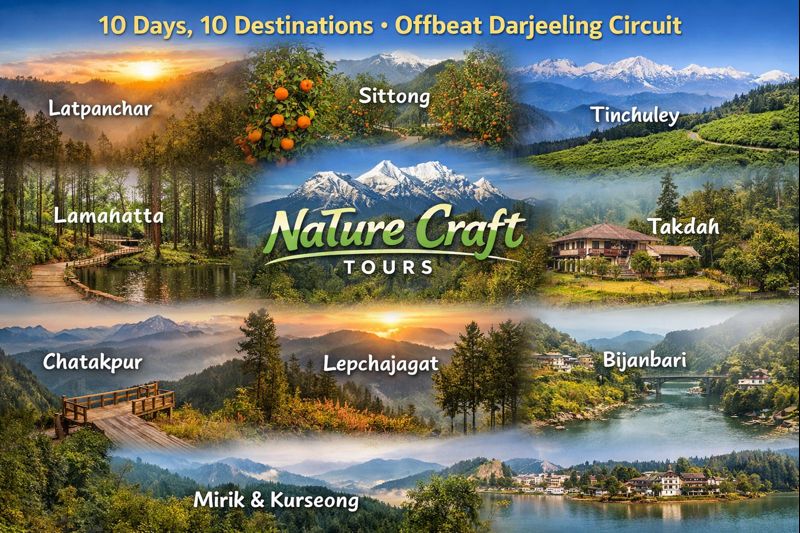
The 10 Offbeat Destinations Covered
- Latpanchar
- Sittong (Sitong) – the orange village
- Tinchuley
- Lamahatta
- Takdah
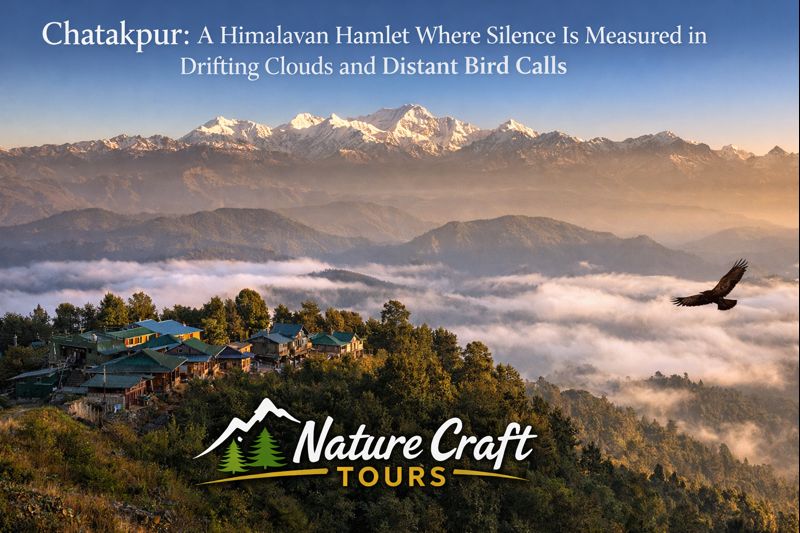
- Chatakpur (Senchal forest eco-village)
- Lepchajagat
- Bijanbari (riverside valley)
- Mirik – Soureni belt
- Kurseong (Dow Hill & heritage hill-town mood)
Best Time to Visit (Season Intelligence)
Spring (March–May): Clear skies, comfortable days, strong mountain visibility; best for viewpoints, tea gardens, and forest walks.
Autumn (October–November): Often the sharpest Kanchenjunga views; crisp air; excellent for photography and long drives.
Winter (December–February): Very quiet, romantic, and cold; warm layers essential; sunrise is late but dramatic.
Monsoon (June–September): Lush, cinematic greenery but landslide risk and road interruptions can occur—keep buffer time and avoid “tight” schedules.
How to Reach the Circuit Start (NJP Arrival Logic)
Entry Point: New Jalpaiguri (NJP) Railway Station (also accessible via Bagdogra Airport). From NJP, the route climbs gradually to the Kurseong-side forests first (Latpanchar–Sittong), which is a practical acclimatization strategy: you enter the hills gently before rising to higher ridges like Chatakpur and Lepchajagat.
Day-by-Day Explorer Package Tour Plan (NJP to NJP)
Day 1: NJP → Latpanchar (Forest Ridge & Birding Calm)
Travel Timing: 09:00–13:00 (approx. 4 hours with scenic pauses).
Explorer Note: Latpanchar is where the hills begin to feel like a living organism—leaf-sound, insect-song, and sudden silence in equal measure.
- Special Attractions: Forest-edge village mood, birdwatching culture, sunrise/sunset ridgeline ambience.
- Things to Do: Short forest walks, soft birding sessions, village photography, evening tea with ridge wind.
- Stay Options (Properties): Simple village homestays, forest-view cottages (basic, clean, experience-based).
Day 2: Latpanchar → Sittong (Orange Orchards & Lepcha Hamlet Life)
Travel Timing: 09:30–12:30 (short drive; slow roads).
Special Attractions: Orange orchards (seasonal), calm village lanes, river-valley views.
- Must-See: Orchard walks, hillside viewpoints, quiet stream corners.
- Stay Options (Properties): Orange-garden homestays, family-run hillside cottages.
Day 3: Sittong → Tinchuley (Tea Slopes, Mountain Balcony, Slow Culture)
Travel Timing: 09:00–13:00 (approx. 4 hours).
Special Attractions: Tea gardens, village viewpoints, gentle eco-tourism feel.
- Must-See: Tea-slope walks, sunrise viewpoints, local produce tasting, forest edges.
- Stay Options (Properties): Boutique homestays, tea-view cottages, eco-stay style village properties.
- Internal Link (Natural Read): For a deeper destination profile and local storytelling, you may include this guide mid-article:
Tinchuley offbeat guide.
Day 4: Tinchuley → Lamahatta (Pine Forest, Sacred Pond, Eco Park)
Travel Timing: 10:00–12:00 (short but scenic).
Special Attractions: Pine and dhupi forest ambience, manicured eco-park landscape, peaceful walking trails.
- Must-See: Lamahatta Eco Park, forest walks, viewpoint moments when skies are clear.
- Stay Options (Properties): Homestays, small hillside lodges near the eco-park zone.
Day 5: Lamahatta → Takdah (British-Era Cantonment Mood & Tea Estates)
Travel Timing: 10:00–11:30 (short drive).
Special Attractions: Old bungalows (heritage ambience), tea estate roads, orchid-rich gardens (seasonal), misty pine corridors.
- Must-See: Estate drives, colonial-era cantonment atmosphere, slow photography on empty lanes.
- Stay Options (Properties): Heritage bungalow stays (subject to availability), garden homestays, tea-estate-adjacent lodges.
Day 6: Takdah → Chatakpur (Senchal Forest Eco-Village)
Travel Timing: 09:30–12:30 (short distance, slower forest roads).
Special Attractions: High forest village inside the Senchal wildlife zone, powerful silence, ridge-top viewpoints.
- Must-See: Early sunrise viewpoint, forest walks with permission norms, night sky if weather is clear.
- Stay Options (Properties): Forest-managed cottages (limited), eco-homestays (advance booking advised).
Day 7: Chatakpur → Lepchajagat (Pine–Oak Forest, Sunrise & Deep Quiet)
Travel Timing: 10:00–12:30 (via Darjeeling-side approach).
Special Attractions: Dense pine-oak-rhododendron forest feel, iconic offbeat sunrise culture, minimal crowd density.
- Must-See: Sunrise from forest viewpoints, silent woodland walks, crisp air photography.
- Stay Options (Properties): Forest-view homestays, compact hill lodges, small family-run retreats.
Day 8: Lepchajagat → Bijanbari (Down to the River Valley)
Travel Timing: 09:00–12:00 (downhill, scenic).
Special Attractions: Riverside valley living, green slopes, village calm, and the feeling of “the hills opening out” after days of pine forests.
- Must-See: Riverbank time, village bridges, valley photography, slow local meals.
- Stay Options (Properties): Riverside homestays, family-run valley cottages (simple, nature-forward).
Day 9: Bijanbari → Mirik (via Soureni Belt) (Lake Day & Tea Country)
Travel Timing: 09:00–13:00 (approx.).
Special Attractions: Mirik Lake leisure, tea gardens, Soureni belt’s soft countryside charm.
- Must-See: Mirik Lake promenade, garden views, tea-stretch drives, local shopping (light and mindful).
- Stay Options (Properties): Lake-side hotels, family cottages, tea-garden stays (category-based).
- External Link (Natural Read): If you are building cross-destination credibility for your travel brand, a contextual link fits naturally here—for example:
Sundarban Tour Package.
Day 10: Mirik → Kurseong → NJP (Heritage Hills & Return)
Travel Timing: 08:30–16:30 (Mirik → Kurseong sightseeing → NJP).
Special Attractions: Kurseong’s old-school hill-town energy—quiet streets, forest corners, and the feeling of history in the air.
- Must-See: Dow Hill zone (forest ambience), viewpoints, tea moments, short heritage walks.
- Return to NJP: Plan NJP drop with buffer time for hill traffic and weather shifts.
- External Link (Natural Read): To diversify your internal ecosystem with relevant travel intent, you may place another contextual do-follow link here:
Sundarban Travel.
Major Distances & Driving Reality (Practical, Field-Ready)
Offbeat Darjeeling is not about “fast travel.” Distances can look short on a map but become longer due to mountain curves, narrow forest roads, and weather pauses. For professional package handling, always communicate driving time ranges, not just kilometres. A safe working logic is:
- Short hill hops: 15–25 km may still take 1–2 hours.
- Forest or eco-zone approaches: add buffer due to checks and road conditions.
- Monsoon and post-monsoon: keep an extra margin for landslide-prone stretches.
Important Points to See (Curated Highlights Across All 10 Stops)
- Tea Garden Landscapes: Tinchuley, Takdah, Mirik–Soureni belt—best enjoyed by walking quietly rather than “rushing for photos.”
- Pine & Forest Silence: Lamahatta, Chatakpur, Lepchajagat—ideal for mindful nature walks, bird calls, and early sunrises.
- Village Culture & Local Rhythm: Latpanchar and Sittong offer the most grounded “hamlet-life” experience.
- River Valley Mood: Bijanbari brings a softer, lower-altitude landscape that feels like a long exhale.
- Lake Leisure: Mirik balances the circuit with gentle comfort, cafés, promenades, and family-friendly pacing.
How to Reach Each Destination (Simple Access Notes for Clients)
Common Gateway: NJP (rail) / Bagdogra (air). The most efficient package method is a dedicated private vehicle for the full circuit, because offbeat hamlets rarely match perfect shared-transport timing.
- Latpanchar & Sittong: approached via Kurseong-side forest routes; ideal early in the circuit.
- Tinchuley–Lamahatta–Takdah: connected offbeat triangle near the Darjeeling ridge and tea zones.
- Chatakpur & Lepchajagat: forest eco-villages near the Darjeeling–Sonada belt; limited stays—advance booking essential.
- Bijanbari: valley descent from Darjeeling-side roads; best for travellers who want riverside calm.
- Mirik–Soureni: tea-country drive; comfortable for families and seniors.
- Kurseong: natural return corridor towards NJP, making the exit day logistically clean.
Staying Options (Property Styles, Without Contact Numbers)
This circuit is strongest when you keep stays authentic and location-appropriate. You may present stay choices in three clear categories for travellers:
- Category A: Premium Boutique / Heritage Mood – select tea-view cottages, heritage bungalow-style stays (best in Takdah belt; limited inventory).
- Category B: Comfortable Mid-range Nature Stays – clean cottages and homestays with reliable meals (ideal across Tinchuley, Lamahatta, Mirik, Kurseong).
- Category C: Pure Village Homestays – simple rooms, warm hospitality, local food, slow evenings (Latpanchar, Sittong, Bijanbari).
Professional Tip: For eco-villages like Chatakpur and sometimes Lepchajagat, keep guest expectations honest: electricity backup, hot-water method, and Wi-Fi reliability can vary by season and property type.
The Experience Layer (Why This Circuit Feels Different)
In classic Darjeeling tourism, travellers chase landmarks. In offbeat Darjeeling, travellers chase conditions: mist on a pine ridge, the fragrance of wet tea leaves, a valley turning gold at 4:45 pm, an orchard path where oranges glow like small suns. This circuit deliberately alternates landscapes—forest to orchard, tea slope to eco-village, ridge-top to river valley—so your clients feel the district’s full emotional geography rather than a single repetitive view.
And if you are building internal topical authority for your own website, you can place another natural internal do-follow link in a context like this—where the reader is already immersed in the Tinchuley segment of the journey:
Tinchuley travel details and route insights.
“Offbeat Darjeeling in Ten Dawn Steps”
1) From NJP the plains release me, and the first bend becomes prayer.
2) Latpanchar teaches birdsong—how silence can still be loud.
3) In Sittong, oranges glow like lanterns hung on hillside breath.
4) Tinchuley opens its tea-leaf pages, and the mountains read me back.
5) Lamahatta’s pine shadows fall softly, like blessings on a walking path.
6) Takdah remembers empire in mist, yet offers only peace to the present.
7) Chatakpur sits inside forest truth, where nights are stitched with stars.
8) Lepchajagat holds sunrise gently, as if it is fragile glass.
9) Bijanbari lets the river speak—deep, steady, and unhurried.
10) And Kurseong sends me home—changed, quieter, and grateful for the hills.
Closing Note (For Your Package Branding)
This “10 days / 10 destinations” circuit is not merely a route—it is a carefully paced narrative your travel company can sell as a premium slow-travel experience: fewer crowds, deeper landscapes, meaningful village interactions, and a strong sense of discovery. If you position it as “explorer-style offbeat Darjeeling,” you are not competing with mass Darjeeling sightseeing—you are offering an alternative definition of luxury: space, stillness, and authenticity.