




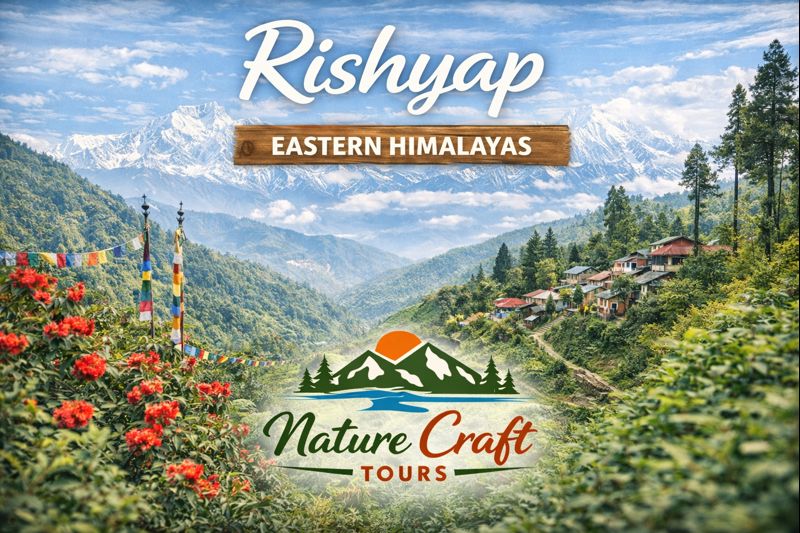
Rishyap belongs to a rare category of Himalayan settlements where time appears to slow naturally. It is neither a resort town nor a trekking base; instead, it functions as a lived-in village where tourism exists gently, without overwhelming local rhythms. For travelers seeking mindful travel, nature immersion, and authentic hill culture, Rishyap stands as one of North Bengal’s most rewarding offbeat destinations.
Geographical Location and Landscape Identity
Rishyap is situated at an elevation of approximately 8,500–9,000 feet above sea level, making it one of the higher habitable villages in the Kalimpong subdivision. It lies on a ridge extending from the Neora Valley forest belt, strategically positioned between Lava and Pedong. This elevated setting grants Rishyap expansive views across the Eastern Himalayan ranges and deep forested valleys below.
The terrain around Rishyap is defined by undulating ridgelines, steep forested slopes, and open grass patches used traditionally for grazing. Geological studies of this belt highlight its ecological sensitivity, as the ridge acts as a watershed zone influencing local streams that feed into the Teesta river system. The absence of large-scale construction has helped preserve slope stability and forest continuity.
Forest Ecology and Natural Surroundings
Rishyap is enveloped by dense coniferous forests dominated by pine, fir, oak, and seasonal rhododendron species. During spring, the forest floor comes alive with wildflowers and moss growth, while autumn offers clear air and golden light filtering through tall trees. Birdlife is abundant, with sightings of Himalayan thrushes, flycatchers, and woodpeckers common in the early mornings.
Historical and Cultural Background
Historically, Rishyap developed as a forest-edge settlement supporting grazing communities and small-scale agriculture. Its relative isolation meant that it remained largely untouched by colonial-era commercialization, unlike nearby tea-growing regions. Oral histories suggest that the village also functioned as a resting point for forest workers and traders moving between Kalimpong, Lava, and interior forest routes.
The local population is predominantly Nepali-speaking, with cultural influences from Lepcha and Bhutia traditions. Social life revolves around seasonal agriculture, forest stewardship, and religious observances tied closely to natural cycles. Cultural expression in Rishyap is subtle—embedded in daily practices rather than formal performances.
Important Points to See in and Around Rishyap
Kanchenjunga Viewpoints
One of Rishyap’s most celebrated features is its unobstructed view of the Kanchenjunga range. On clear mornings, the mountains appear luminous, with changing hues from dawn to midday. These views are best appreciated without haste, allowing light, cloud movement, and silence to shape the experience.
Forest Walks and Nature Trails
Numerous informal trails radiate from the village into surrounding forests. These paths are ideal for slow walks, birdwatching, and quiet exploration. The forest environment here encourages attentive observation—of sound, texture, and seasonal change—rather than destination-driven movement.
Village Life Observation
Simple village walks offer insight into mountain living at high altitude. Stone-and-wood houses, prayer flags, grazing areas, and communal spaces reflect a lifestyle adapted carefully to terrain and climate. Such observations provide meaningful cultural understanding without intrusion.
Life in Rishyap: Community and Daily Rhythm
Daily life in Rishyap is guided by daylight, weather, and seasonal needs. Agriculture remains subsistence-oriented, with households cultivating potatoes, maize, and vegetables suited to high-altitude conditions. Livestock grazing plays a supplementary role in household economies.
Modern infrastructure is intentionally limited. Electricity supply can be intermittent, and mobile connectivity varies, reinforcing a lifestyle less dependent on constant digital engagement. Evenings are marked by quiet conversations, forest sounds, and expansive night skies—an experience increasingly rare in contemporary travel.
Major Distances from Rishyap
- Lava to Rishyap: approximately 4–5 km
- Kalimpong to Rishyap: approximately 32–35 km
- Pedong to Rishyap: approximately 22–25 km
- Siliguri to Rishyap: approximately 100 km
- New Jalpaiguri Railway Station to Rishyap: approximately 105 km
- Bagdogra Airport to Rishyap: approximately 108 km
While distances may appear short, travel time is influenced by steep roads, forest stretches, and weather conditions, particularly during monsoon.
How to Reach Rishyap
By Air
Bagdogra Airport is the nearest airport with regular connections to major Indian cities. From Bagdogra, travelers proceed by road via Siliguri and Kalimpong, followed by an ascent through Lava toward Rishyap.
By Rail
New Jalpaiguri Railway Station is the closest major railhead. It offers extensive connectivity across India. From NJP, a scenic road journey leads through foothills, forests, and ridge roads before reaching Rishyap.
By Road
Motorable roads reach close to Rishyap village, though the final approach may involve short walks depending on accommodation location. The road journey itself is part of the experience, gradually transitioning from plains to dense forest and open ridgelines.
Travelers who value immersive journeys often find resonance in destinations like Rishyap, much like thoughtfully designed nature circuits under Sundarban Tour planning, where the path through landscape holds as much meaning as the destination.
Staying Options in Rishyap
Accommodation in Rishyap is primarily community-driven, consisting of homestays, eco-lodges, and small mountain retreats. These properties emphasize warmth, simplicity, and scenic integration rather than luxury amenities.
Most stays offer views of forests or distant mountains, with common spaces designed for quiet reflection. Meals are typically home-cooked using locally sourced ingredients, enhancing the sense of place and cultural connection.
Best Time to Visit Rishyap
Spring (March to May)
Spring is one of the finest times to visit Rishyap. Rhododendrons bloom across the forested slopes, temperatures remain comfortable, and mountain views are frequent.
Autumn (October to November)
Autumn offers clear skies, crisp air, and excellent visibility. This season is ideal for photography, extended stays, and contemplative travel.
Winter (December to February)
Winters are cold, with occasional frost. While conditions can be challenging, the atmosphere is serene and rewarding for travelers prepared for low temperatures.
Monsoon (June to September)
Monsoon months bring lush greenery but also frequent rainfall and mist. Travel during this season requires flexibility, as visibility and road conditions can change rapidly.
Why Rishyap Holds Special Value for Responsible Travelers
Rishyap represents a philosophy of restraint—where development has not overwhelmed landscape or community. Its limited scale of tourism allows ecological processes and cultural patterns to continue with minimal disruption.
Much like carefully curated riverine and forest experiences promoted through Sundarban Travel initiatives, Rishyap demonstrates that travel can be enriching without being extractive, immersive without being intrusive.
To visit Rishyap is to accept an invitation into stillness. It is a place that does not seek attention, yet rewards attentiveness profoundly—leaving travelers with clarity, perspective, and a deeper appreciation for the quiet power of the mountains.