





Gayabari Village –
Where the Hills Pause to Breathe in Silence
Hidden quietly along the old Hill Cart Road of Darjeeling, Gayabari village is one of those rare Himalayan settlements that does not announce itself loudly. It reveals itself slowly—through mist-laden pine forests, whispering mountain winds, and a sense of time that seems to have forgotten the rush of the plains. Situated between Kurseong and Mahanadi, Gayabari is not a conventional tourist destination; it is a lived-in landscape, shaped by tea gardens, colonial rail tracks, and generations of hill communities who have learned to coexist with nature rather than conquer it.
For travellers seeking an authentic offbeat experience in Darjeeling hills, Gayabari offers something increasingly rare: stillness. Here, the forests remain older than memory, the mornings arrive gently, and evenings dissolve into silence broken only by cicadas and distant train whistles. This article presents a comprehensive, research-based exploration of Gayabari village—its geography, history, experiences, access routes, seasonal character, and accommodation options—crafted for discerning travellers and cultural explorers.
Geographical Setting of Gayabari Village
Gayabari is located at an altitude ranging between approximately 3,000 to 3,500 feet above sea level, along the historic Hill Cart Road (National Highway 110). Administratively, it falls within the Darjeeling district of West Bengal and lies in close proximity to Mahanadi and Kurseong. The village is enveloped by dense mixed forests comprising pine, oak, bamboo, and subtropical shrubs, creating a natural corridor between the lower plains and mid-hill elevations.
The name “Gayabari” is believed to have evolved from local linguistic traditions, reflecting pastoral associations and forest landscapes. Unlike prominent hill towns, Gayabari has grown organically, without aggressive urban expansion, preserving its ecological balance and cultural rhythm.
Climate and Natural Character
Gayabari enjoys a temperate mountain climate throughout the year. Summers remain mild, monsoons arrive with dramatic cloud movements and heavy rainfall, while winters bring crisp air and quiet mornings. The surrounding forests act as natural climate regulators, maintaining cool temperatures and clean air even during peak summer months.
The village is also ecologically significant due to its location along bird migration routes and forest corridors connecting the lower Terai region with the higher Himalayan belt.
Historical Context and Colonial Footprints
The strategic importance of Gayabari increased during the British colonial period, when the Hill Cart Road was developed as a critical arterial route between Siliguri plains and Darjeeling. The nearby Darjeeling Himalayan Railway, now a UNESCO World Heritage Site, passes through the broader region, leaving behind a legacy of colonial engineering and cultural exchange.
Although Gayabari never evolved into a colonial station, it served as a forest settlement and transit halt, supplying timber, labor, and agricultural produce. Remnants of old stone pathways, railway bridges, and forest rest structures can still be observed by attentive visitors.
What Makes Gayabari Village Special
Forest Immersion and Silence
The defining quality of Gayabari is its profound silence. Unlike commercial hill stations, the absence of crowds allows travellers to experience uninterrupted forest immersion. Morning walks reveal moss-covered trunks, filtered sunlight, and birdsong echoing through the valleys.
Authentic Village Life
Gayabari remains a working village. Residents are engaged in small-scale agriculture, forest-based livelihoods, and tea garden activities. Visitors can observe traditional wooden homes, terraced cultivation, and a rhythm of life that remains aligned with daylight rather than clocks.
Proximity to Other Offbeat Destinations
Gayabari serves as a quiet base for exploring lesser-known hill settlements. Travellers interested in nearby offbeat experiences often extend their journey towards villages like Tinchuley, known for its panoramic Himalayan views and organic farming culture, or venture deeper into forested belts along the old trade routes.
Important Places to See Around Gayabari
Hill Cart Road Forest Stretch
The stretch of Hill Cart Road passing through Gayabari is one of the most scenic yet underrated drives in the Darjeeling hills. Dense forests, sudden valley openings, and shifting cloud formations make this route ideal for slow travel and photography.
Railway Bridges and Curves
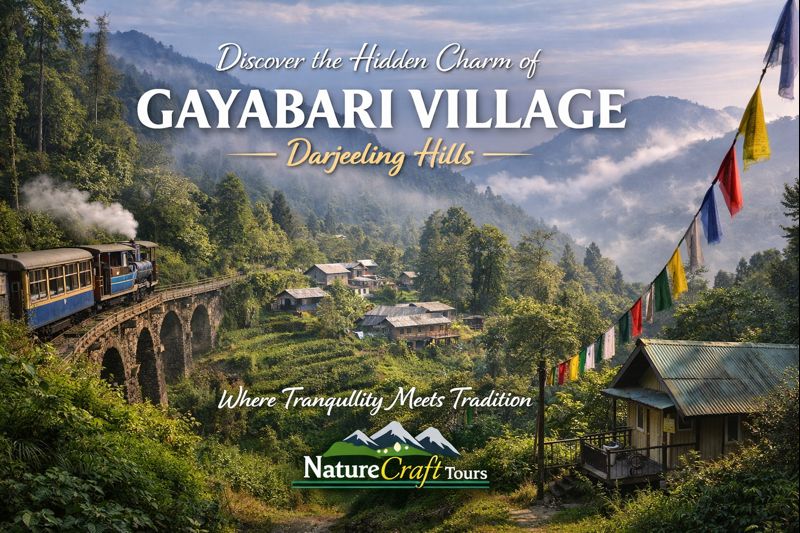
The Darjeeling Himalayan Railway passes not far from Gayabari, and certain vantage points offer glimpses of toy trains navigating sharp curves and bridges. These moments provide a nostalgic connection to Himalayan railway heritage.
Village Trails and Viewpoints
Local footpaths lead to quiet clearings overlooking forested slopes and distant hill ridges. On clear days, travellers may observe layered mountain silhouettes fading into the horizon.
Major Distances from Gayabari Village
- Gayabari to Siliguri: approximately 45 km
- Gayabari to Kurseong: approximately 18 km
- Gayabari to Darjeeling town: approximately 35 km
- Gayabari to New Jalpaiguri Railway Station: approximately 50 km
- Gayabari to Bagdogra Airport: approximately 48 km
These distances make Gayabari accessible yet sufficiently removed from high-traffic tourist circuits.
How to Reach Gayabari Village
By Air
The nearest airport is Bagdogra, which is well connected to major Indian cities. From Bagdogra, travellers can hire private vehicles and proceed via Siliguri and Hill Cart Road towards Gayabari.
By Rail
New Jalpaiguri (NJP) is the nearest major railway station. From NJP, road transport remains the most practical option. Alternatively, travellers may experience the Darjeeling Himalayan Railway up to nearby stations and continue by road.
By Road
Road access is straightforward via Siliguri–Kurseong route. The Hill Cart Road provides a scenic ascent through forests, gradually revealing Gayabari’s tranquil surroundings.
Staying Options in Gayabari Village
Accommodation in Gayabari is limited and intentionally low-key. The village offers small, family-run homestays and eco-lodges that emphasize simplicity, cleanliness, and local hospitality. These properties are typically constructed using wood and stone, blending harmoniously with the landscape.
Facilities are basic but comfortable, focusing on warm meals, quiet surroundings, and personalized care rather than luxury. Travellers seeking more amenities may consider staying in nearby areas such as Kurseong or extending their journey towards destinations like Tinchuley, which offers a wider range of boutique homestays.
Best Time to Visit Gayabari Village
Spring (March to May)
Spring brings clear skies, blooming wildflowers, and pleasant temperatures. This season is ideal for walking trails and nature observation.
Monsoon (June to September)
Monsoon transforms Gayabari into a lush green sanctuary. While landslides may occasionally affect travel, the forest during this season is at its most vibrant and atmospheric.
Autumn (October to November)
Autumn offers crisp air and excellent visibility. This is considered one of the best times for photography and relaxed exploration.
Winter (December to February)
Winters are cool and quiet, with misty mornings and star-filled nights. Travellers seeking solitude and introspection often prefer this season.
Responsible Travel and Cultural Sensitivity
Gayabari’s fragile ecosystem and close-knit community require respectful travel practices. Visitors are encouraged to minimize waste, respect local customs, and engage with residents thoughtfully. Slow travel, longer stays, and conscious consumption contribute positively to the village economy and environment.
Travellers interested in broader eco-tourism experiences across eastern India may also explore curated journeys such as a Sundarban Tour or thoughtfully designed hill-forest combinations offered across Bengal’s diverse landscapes.
A Poem from the Hills of Gayabari
Gayabari wakes where the forest still remembers,
Footsteps softened by moss and years.
Here, time folds itself into silence,
And clouds pause to listen.
Trains whisper history through valleys,
While pines hold secrets of rain.
Evenings arrive without announcement,
Carrying the scent of wood and earth.
In Gayabari, the hills do not hurry,
They simply breathe—and invite you to do the same.
Why Gayabari Belongs on the Offbeat Travel Map
Gayabari village is not a destination for hurried sightseeing or checklist travel. It is a place for those who value atmosphere over attractions, silence over spectacle, and authenticity over polish. In an era where popular hill stations struggle under tourism pressure, Gayabari stands quietly as a reminder of what the Himalayas once felt like—and, in places like this, still do.
For travellers who appreciate understated beauty and meaningful journeys, Gayabari is not merely a stop along the road. It is a pause—a gentle, enduring pause in the long conversation between mountains and people.
Those planning extended nature-based itineraries may consider pairing Gayabari with destinations across Bengal’s ecological spectrum, from mist-covered hill villages to riverine wilderness experiences such as a thoughtfully planned Sundarban Travel circuit, creating a journey that balances forest, hills, and water in one narrative.