




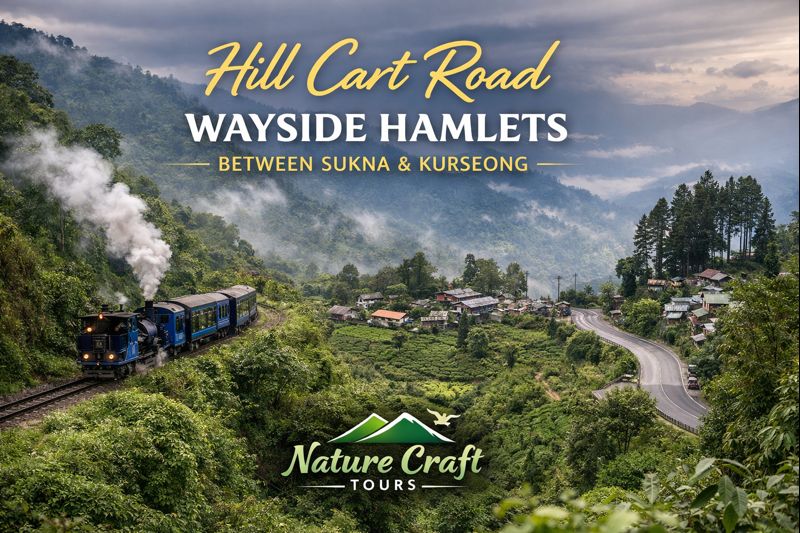
Hill Cart Road Wayside Hamlets between Sukna and Kurseong
– Where the Mountains Speak in Pauses, Not in Noise
The historic Hill Cart Road, stretching gently between Sukna and Kurseong, is far more than a mere mountain highway connecting the plains of North Bengal with the upper ridges of Darjeeling. It is a slow-moving corridor of life, memory, forests, and forgotten hamlets—places that exist quietly between destinations, yet possess a soul far deeper than many well-advertised hill towns. These wayside hamlets, scattered along the winding ascent from Sukna (the gateway of the Dooars and Terai) to Kurseong (the Land of White Orchids), represent an older rhythm of Himalayan living—measured, restrained, and deeply attuned to nature.
Unlike mainstream tourist centers, the villages along Hill Cart Road do not announce themselves loudly. They reveal their character gradually—through the smell of damp earth after rain, the whistle of the Darjeeling Himalayan Railway echoing across valleys, prayer flags fluttering on slopes, and tea gardens unfurling like green manuscripts written by time itself. This article explores these lesser-known wayside settlements, their landscapes, cultural textures, travel logistics, and seasonal beauty, offering a comprehensive, research-based guide for travelers seeking depth rather than crowds.
Understanding the Hill Cart Road Corridor
Hill Cart Road, officially known as National Highway 110, was engineered during the British colonial period as an alternative route to the Hill Loop Road. It runs parallel to the Darjeeling Himalayan Railway for several stretches and is historically significant for trade, administration, and tea transportation. The section between Sukna and Kurseong covers approximately 32 kilometers, yet the altitude rises dramatically—from about 500 feet above sea level at Sukna to nearly 4,800 feet at Kurseong.
This elevation gradient gives rise to a fascinating ecological transition zone: from sal forests and riverine plains near Sukna, to mixed broadleaf forests, tea estates, pine groves, and mist-laden ridges as one approaches Kurseong. Nestled within this gradient are small hamlets—often unnamed on maps—inhabited by Nepali, Lepcha, Tamang, Rai, and Bengali communities who depend on tea gardens, forest produce, and small-scale agriculture.
Why the Wayside Hamlets Matter
These hamlets serve as living repositories of Himalayan micro-culture. Unlike larger towns shaped by tourism infrastructure, these settlements retain organic architecture, traditional livelihoods, and unfiltered interaction with the land. For travelers interested in slow travel, cultural observation, photography, birdwatching, or reflective retreats, these villages offer a rare, uncommercialized experience.
Important Wayside Hamlets and Localities to Observe
Sukna and Lower Forest Fringe Settlements
Sukna marks the threshold between plains and hills. While often seen merely as a transit point, the forest-fringe habitations around Sukna are ecologically significant. Sal trees dominate the landscape, interspersed with streams that descend from higher altitudes. Early mornings here are rich with birdsong, making it an excellent zone for avian observation.
Rongtong Tea Estate Vicinity
As the road ascends, Rongtong emerges as one of the most visually striking zones along Hill Cart Road. The surrounding hamlets are closely tied to the tea estate economy. Small clusters of houses sit on slopes overlooking deep valleys, with uninterrupted views of forested ridges. The Darjeeling Himalayan Railway crosses this area, adding a timeless charm.
Tindharia and Peripheral Settlements
Tindharia is historically important due to the railway workshop established during the British era. Beyond the town itself lie quieter peripheral hamlets where life revolves around schools, small monasteries, and kitchen gardens. These areas provide insight into working-class hill life, largely untouched by mainstream tourism.
Upper Hill Cart Road Hamlets Near Kurseong
Approaching Kurseong, the settlements become cooler, more temperate, and enveloped in mist. Pine forests replace sal trees, and the air grows noticeably crisper. These hamlets often serve as agricultural buffers, supplying vegetables and dairy to Kurseong town.
Natural and Cultural Points of Interest
Travelers moving slowly along this corridor will encounter numerous understated yet meaningful sights:
- Dense forest sections rich in orchids, ferns, and moss
- Unmarked viewpoints overlooking the Teesta basin and Terai plains
- Small roadside monasteries and prayer wheels
- Tea garden labor lines reflecting colonial-era settlement patterns
- Steam and diesel locomotives of the Darjeeling Himalayan Railway appearing unexpectedly around bends
For those already exploring offbeat hill destinations like
Tinchuley, these hamlets provide an excellent comparative understanding of how altitude, access, and history shape village life differently across the Darjeeling hills.
Major Distances and Travel Orientation
Understanding distances helps plan a relaxed journey:
- Siliguri to Sukna: approximately 10 km
- Sukna to Rongtong: approximately 15 km
- Rongtong to Tindharia: approximately 8 km
- Tindharia to Kurseong: approximately 9 km
- Siliguri to Kurseong via Hill Cart Road: approximately 45 km
The road is motorable throughout the year, though landslides may cause brief disruptions during heavy monsoon periods.
How to Reach the Hill Cart Road Wayside Hamlets
By Rail
New Jalpaiguri (NJP) is the nearest major railway station, well-connected to Kolkata, Delhi, and other Indian cities. From NJP, Sukna can be reached by road in under an hour. The Darjeeling Himalayan Railway also runs between New Jalpaiguri, Kurseong, and Darjeeling, offering scenic access to several points along Hill Cart Road.
By Road
Siliguri serves as the primary road hub. Private vehicles and hired cars can access all major points along Hill Cart Road. The drive is especially rewarding for travelers interested in landscapes and photography.
By Air
Bagdogra Airport is the nearest airport, located approximately 20 km from Sukna. From the airport, road transfers are readily available.
Many travelers combine a Himalayan hill journey with other nature-centric experiences such as a
Sundarban Tour, creating a diverse itinerary that spans forests, rivers, and mountains within West Bengal.
Staying Options along the Route
Accommodation along Hill Cart Road is modest and experience-oriented. Options include:
- Tea estate bungalows adapted for heritage stays
- Small homestays run by local families
- Forest-edge lodges near Sukna
- Budget hotels and heritage properties around Kurseong
These stays emphasize local cuisine, personal interaction, and quiet surroundings rather than luxury amenities. Visitors interested in deeper cultural immersion often prefer these properties over conventional hotels.
Travelers planning extended journeys sometimes align their hill exploration with deltaic landscapes through curated experiences such as a
Sundarban Tour Package, allowing a holistic understanding of Bengal’s ecological diversity.
Best Time to Visit
The corridor is accessible year-round, but seasonal variations significantly influence experience:
- March to May: Clear skies, blooming flora, ideal for walking and photography
- June to September: Monsoon brings lush greenery and mist, though travel requires caution
- October to November: Post-monsoon clarity with festive village life
- December to February: Cold, quiet, and atmospheric, especially near Kurseong
A Road Between Hills
The road bends softly, not to hurry the heart,
Forests pause where the plains depart.
Tin roofs glimmer in filtered sun,
Days here end before they’ve begun.
Tea leaves whisper what time forgot,
A train hums past, then speaks no more.
Smoke rises slow from kitchen fires,
Mountains listen, never inquire.
Between Sukna’s heat and Kurseong’s cold,
Life lives gently, quiet and old.
The Beauty of In-Between Places
The Hill Cart Road wayside hamlets between Sukna and Kurseong remind us that journeys are not merely about destinations. These villages, forests, and slopes teach the art of noticing—of finding meaning in silence, continuity in routine, and beauty in restraint. For travelers seeking authenticity, reflection, and connection with Himalayan life beyond guidebooks, this corridor offers an experience that lingers long after the road climbs higher and the world grows louder.