


Observatory Hill & Mahakal Temple
Observatory Hill & Mahakal Temple
– Where Darjeeling’s Spiritual Core Meets Himalayan Horizons
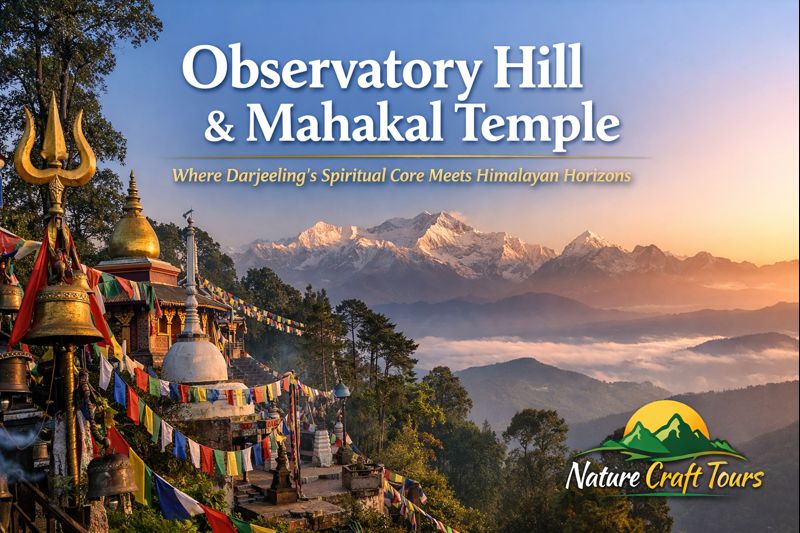
Perched quietly above the lively heart of Darjeeling, Observatory Hill stands as one of the town’s most contemplative and historically layered landmarks. Unlike viewpoints created solely for scenery, this hill evolved organically as a place of reverence, observation, and convergence of belief systems. At its summit rests the sacred Mahakal Temple, a living symbol of religious harmony where Shaivite Hindu traditions and Buddhist practices have coexisted for centuries.
For the discerning explorer, Observatory Hill is not merely a stop on an itinerary—it is a destination that reveals Darjeeling’s philosophical depth. From ancient colonial observatories to prayer-flag-lined forest paths, every element of this hill speaks of time, faith, and geography working in quiet unison.
Understanding the Significance of Observatory Hill
Observatory Hill occupies a central ridge just above Chowrasta, the social nucleus of Darjeeling. Long before it became associated with tourism, the hill functioned as a natural vantage point for astronomical and geographical observation during the early British period. Its unobstructed sightlines toward the eastern Himalayas made it ideal for studying mountain ranges, weather patterns, and celestial movement.
Over time, this strategic elevation transformed into a spiritual site. Local Lepcha communities regarded the hill as sacred, believing it to be protected by mountain deities. The later establishment of Mahakal Temple did not erase these beliefs; rather, it absorbed them, creating a layered spiritual identity that remains unique within the Eastern Himalayas.
A Rare Confluence of Faiths
What distinguishes Observatory Hill from most Himalayan viewpoints is its seamless blending of Hindu and Buddhist worship. Devotees offer prayers to Lord Shiva at Mahakal Temple while Buddhist monks chant mantras and spin prayer wheels within the same sacred perimeter. The coexistence is not ceremonial—it is lived, practiced daily, and deeply respected by all who visit.
Mahakal Temple: Darjeeling’s Sacred Crown
Mahakal Temple, dedicated to Lord Shiva in his fierce Mahakal form, occupies the highest point of Observatory Hill. The temple’s modest architectural scale contrasts sharply with its spiritual importance. Stone pathways lead pilgrims upward through pine and cryptomeria forests, gradually distancing visitors from the town’s bustle and guiding them toward introspection.
Inside the temple complex, bells, incense smoke, and prayer flags create a sensory atmosphere that feels timeless. On auspicious days, especially Mondays and during Shivaratri, the site draws devotees from across the Darjeeling hills and neighboring regions of Sikkim and Nepal.
Spiritual Practices and Ritual Observations
Rituals at Mahakal Temple are notably inclusive. Hindu priests perform traditional abhishekam and aarti, while Buddhist practitioners conduct silent circumambulation and mantra recitation. This coexistence reflects Darjeeling’s broader cultural fabric and makes the temple one of the most symbolically important spiritual sites in North Bengal.
Scenic Rewards: Himalayan Views from Observatory Hill
Beyond its spiritual essence, Observatory Hill offers commanding views of the eastern Himalayan range. On clear mornings, the snow-clad peaks of Kanchenjunga appear almost within reach, rising above layers of rolling hills and drifting clouds. The viewpoint is particularly valued by seasoned travelers who prefer subtle, natural framing over crowded platforms.
Unlike Tiger Hill, Observatory Hill allows visitors to experience the mountains without long pre-dawn travel. Sunrise and late afternoon both present excellent light conditions, with the latter offering softer hues and fewer crowds.
Photography and Visual Observation
Photographers are drawn to Observatory Hill for its interplay of natural and cultural elements. Prayer flags fluttering against snow peaks, temple bells silhouetted at dawn, and forest trails illuminated by filtered sunlight provide compelling compositions rarely found elsewhere in Darjeeling.
Important Points to See Around Observatory Hill
- The Mahakal Temple complex and its surrounding prayer flags
- Forest walking trails encircling the hilltop
- Panoramic Kanchenjunga viewpoints during clear weather
- Ancient stone platforms believed to be remnants of early observation points
- Quiet meditation corners used by monks and local devotees
Major Distances to Observatory Hill
Observatory Hill enjoys a highly accessible location within Darjeeling town, making it suitable for travelers of all age groups.
- Chowrasta (Mall Road): approximately 400 meters on foot
- Darjeeling Railway Station: around 1.2 kilometers
- Ghoom Monastery: approximately 6 kilometers
- NJP Railway Station: about 75 kilometers
- Bagdogra Airport: approximately 70 kilometers
How to Reach Observatory Hill & Mahakal Temple
Reaching Observatory Hill is straightforward and does not require motorized transport for the final approach. From Chowrasta, a clearly marked pedestrian pathway leads uphill through shaded forest stretches. The walk typically takes 10 to 15 minutes at a comfortable pace.
Travelers arriving in Darjeeling usually begin their journey from New Jalpaiguri or Bagdogra via hill roads passing through Kurseong or Mirik. Shared and private vehicles operate regularly along these routes, making Darjeeling well connected throughout the year.
For those planning a comprehensive Darjeeling itinerary, Observatory Hill pairs naturally with nearby attractions such as the Peace Pagoda and the heritage zones around Batasia Loop, allowing visitors to explore spiritual, cultural, and historical dimensions within a single day.
Staying Options Near Observatory Hill
Accommodation options around Observatory Hill range from heritage-era hotels to contemporary boutique stays. Properties near Chowrasta and Mall Road are particularly convenient, offering walking access to the hill while maintaining proximity to dining and shopping areas.
Travelers seeking quieter surroundings may opt for stays slightly away from the central ridge, where forested slopes and tea garden views provide a more secluded atmosphere. These properties typically emphasize mountain views, colonial architecture, or eco-sensitive design.
For curated stays and responsible travel planning in Darjeeling and surrounding regions, travelers often explore specialized hill-tour operators such as Sundarban Travel, which also designs extended Eastern Himalayan circuits blending nature, culture, and heritage.
Best Time to Visit Observatory Hill & Mahakal Temple
The ideal time to visit Observatory Hill extends from March to May and from October to early December. During these months, weather conditions remain stable, skies are clearer, and mountain visibility is at its best. Spring introduces blooming rhododendrons along the forest paths, while autumn offers crisp air and golden light.
Monsoon months bring lush greenery but frequent cloud cover, which may obscure mountain views. However, for travelers interested in spirituality and solitude, this season lends a quiet, introspective character to the hill. Winter visits are rewarding on clear days but require preparation for cold temperatures.
Why Observatory Hill Belongs on Every Darjeeling Itinerary
Observatory Hill and Mahakal Temple represent Darjeeling in its most authentic form—unhurried, inclusive, and deeply rooted in both nature and belief. Unlike attractions designed around spectacle, this hill invites contemplation. It allows travelers to observe not only the Himalayas but also the rhythms of devotion, coexistence, and history that define the region.
For explorers who value meaning over momentum, Observatory Hill offers an experience that lingers long after the journey ends. It is a place where Darjeeling speaks softly, yet profoundly, to those willing to pause and listen.