



Rongpo Khola Valley Settlements:
A Detailed Travel and Cultural Guide to an Emerging Himalayan Corridor
The Rongpo Khola Valley settlements represent one of the most understated yet strategically significant habitation zones in the eastern Himalayas. Situated along the banks of the Rongpo River—locally known as Rongpo Khola—this valley forms a natural transition between the plains of North Bengal and the rising terrain of Sikkim. Unlike heavily marketed hill destinations, the Rongpo Khola Valley remains rooted in everyday Himalayan life, where settlements evolved organically around rivers, trade routes, and agrarian cycles. This region is not merely a stopover point but a living landscape shaped by geography, history, and cross-border cultural exchanges.
The settlements scattered along the Rongpo Khola corridor hold immense relevance for travelers seeking authentic Himalayan environments, researchers studying river-valley habitation patterns, and cultural explorers interested in how ecology dictates lifestyle. This article offers a comprehensive, research-based overview of the Rongpo Khola Valley settlements, including geography, access routes, distances, points of interest, seasonal considerations, and accommodation patterns—presented in a formal and descriptive manner.
Geographical Setting and Environmental Significance
The Rongpo Khola originates in the higher Himalayan catchments and flows southward, eventually merging with the Teesta River. The valley carved by this river is narrow, steep-sided, and geologically young, marked by rocky riverbeds, alluvial terraces, and forested slopes. Settlements here are typically located on elevated spurs or river terraces to avoid seasonal flooding, reflecting generations of ecological adaptation.
This valley serves as a climatic and ecological buffer zone. Lower elevations experience warm, subtropical conditions, while higher reaches display temperate Himalayan characteristics. Such variation supports diverse vegetation, from riverine grasses and sal forests to mixed broadleaf trees and subtropical shrubs. The environmental fragility of the Rongpo Khola Valley makes sustainable habitation practices particularly important, and many settlements still rely on traditional water management and slope-stabilization methods.
The Role of Rongpo as a Gateway Settlement
Rongpo town stands as the most prominent settlement in the valley. Functioning as the primary entry point into Sikkim from West Bengal, Rongpo has evolved from a riverside trading post into a structured urban settlement. Despite modernization, the town retains its river-centric identity, with markets, transport hubs, and residential clusters aligned along the Khola’s course.
Beyond Rongpo town, smaller settlements such as Majitar, Lower Samdong fringes, and sparsely populated hamlets dot the valley, each exhibiting variations in architecture, land use, and socio-economic patterns.
Cultural Landscape of the Valley Settlements
The cultural identity of the Rongpo Khola Valley settlements is shaped by a confluence of Lepcha, Bhutia, Nepali, and plains-origin communities. This multicultural composition is evident in local architecture, religious practices, and agricultural methods. Houses are typically built with sloped roofs, stone bases, and wooden upper structures—designed to withstand heavy rainfall and seismic activity.
Religious sites in and around the settlements include small monasteries, riverbank shrines, and prayer-flag-lined footpaths. Festivals are often aligned with agricultural calendars and river cycles, reinforcing the spiritual importance of the Khola in daily life.
Traditional Livelihoods Along the Rongpo Khola
Most valley settlements depend on a mix of agriculture, small-scale trade, and transport-related employment. Terrace farming of maize, paddy, and seasonal vegetables is common, while river-adjacent areas support fishing and sand collection. Over the years, increased connectivity has introduced service-sector opportunities without fully displacing traditional livelihoods.
Important Points to See Around Rongpo Khola Valley
While the Rongpo Khola Valley is not defined by monumental attractions, its appeal lies in experiential travel and landscape appreciation. Key points of interest include river confluences, elevated viewpoints, and culturally significant zones.
Rongpo Riverbanks and Suspension Bridges
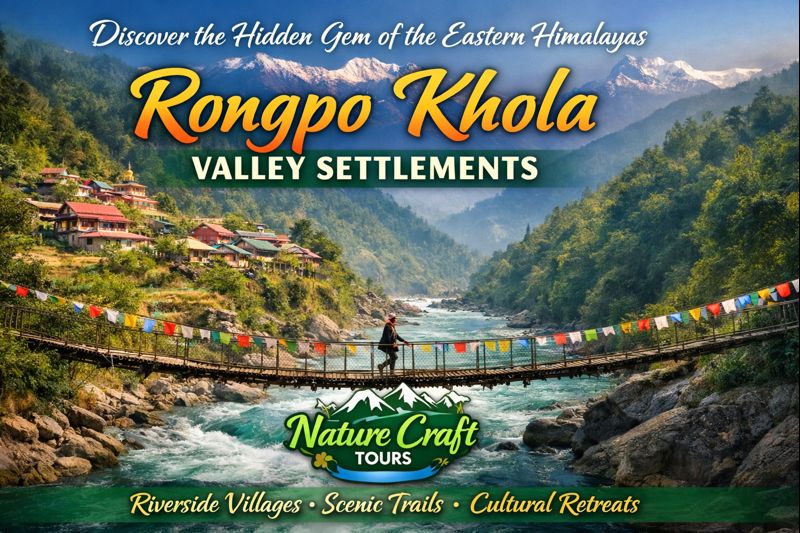
The riverbanks around Rongpo offer panoramic views of fast-flowing Himalayan waters framed by steep forested slopes. Suspension bridges connecting settlements across the Khola provide both functional transit routes and striking visual perspectives, particularly during early morning or late afternoon.
Majitar Plateau and Educational Corridor
The Majitar area, located upstream, represents a transitional settlement zone where the valley widens slightly. It is known for its organized infrastructure and proximity to educational institutions, blending modern planning with natural surroundings.
Foothill Forest Trails and Riverside Walks
Several informal trails originate from valley settlements, leading into foothill forests and elevated ridges. These routes are traditionally used by locals for agriculture and forest access, offering travelers immersive nature walks without commercial development.
Major Distances and Route Connectivity
Understanding distances is crucial when planning travel through the Rongpo Khola Valley, as terrain significantly influences travel time.
- Rongpo to Siliguri: approximately 70–75 km by road
- Rongpo to Gangtok: approximately 35–40 km uphill route
- Rongpo to Kalimpong: approximately 60 km via Teesta corridor
- Rongpo to NJP Railway Station: approximately 72 km
- Rongpo to Bagdogra Airport: approximately 78 km
These distances make Rongpo Khola Valley settlements strategically located for travelers moving between Sikkim and the plains, while still offering opportunities for slow, settlement-based exploration.
How to Reach Rongpo Khola Valley Settlements
Access to the Rongpo Khola Valley is primarily road-based, reflecting the region’s river-valley geography.
By Rail
The nearest major railway station is New Jalpaiguri (NJP), which connects the region to metropolitan centers across India. From NJP, road transport leads through the Teesta corridor to Rongpo, offering scenic views of river systems and foothill forests.
By Air
Bagdogra Airport serves as the closest air gateway. The onward journey follows well-maintained highways up to the valley entrance, gradually transitioning from plains to hilly terrain.
By Road
Rongpo is connected via National Highway corridors linking Siliguri, Kalimpong, and Gangtok. Shared and private vehicles operate regularly, making the valley settlements accessible throughout most of the year, weather permitting.
Travelers combining eastern India eco-circuits often explore destinations such as forest reserves and river landscapes in parallel. Responsible travel operators who design nature-sensitive itineraries—similar in approach to curated Sundarban Travel experiences—understand the importance of river ecosystems in shaping sustainable tourism.
Staying Options in Rongpo Khola Valley Settlements
Accommodation in the Rongpo Khola Valley reflects the region’s evolving tourism profile. Instead of large resorts, travelers will find small hotels, guesthouses, and homestay-style properties that integrate with local settlements.
Town-Based Hotels in Rongpo
Rongpo town offers modest hotels suitable for short stopovers. These properties cater primarily to transit travelers and business visitors, providing basic amenities and convenient access to transport hubs.
Homestays in Peripheral Settlements
Smaller settlements around Rongpo and Majitar offer homestay-style accommodations that emphasize cultural immersion. These stays are ideal for travelers interested in extended exploration, river walks, and community interaction.
Eco-Oriented Lodges
A limited number of eco-conscious properties are emerging along the valley, focusing on minimal environmental impact, local employment, and traditional architecture. Such initiatives mirror sustainable tourism models seen in sensitive ecosystems, including river-delta destinations promoted through platforms like Sundarban Tour Package planning frameworks.
Best Time to Visit Rongpo Khola Valley Settlements
Seasonal timing plays a crucial role in experiencing the valley settlements comfortably and safely.
October to April: Optimal Exploration Season
Post-monsoon and winter months provide clear skies, stable road conditions, and comfortable temperatures. River levels are moderate, making riverside walks and settlement exploration easier.
May to June: Early Summer Window
Early summer brings warmer days but remains suitable for travel. Vegetation is lush, and agricultural activity offers insights into valley livelihoods.
July to September: Monsoon Caution Period
Heavy rainfall during monsoon months increases the risk of landslides and road disruptions. Travel during this period requires careful planning and flexibility.
Why Rongpo Khola Valley Settlements Matter for Offbeat Travel
The Rongpo Khola Valley settlements embody a form of Himalayan living that prioritizes coexistence with natural forces. Unlike high-altitude tourist hubs, these settlements reveal how rivers shape mobility, economy, and cultural continuity. For travelers aligned with slow tourism, academic research, or experiential journeys, the valley offers insights unavailable in more commercial destinations.
As interest in offbeat Himalayan circuits grows, responsible exploration of the Rongpo Khola Valley can contribute to sustainable livelihoods without disrupting ecological balance. The settlements here do not demand attention through spectacle; instead, they reward patience, observation, and respect for the river that sustains them.
Rongpo Khola Valley settlements stand at the crossroads of geography, culture, and connectivity. Their importance extends beyond transit utility, offering a nuanced understanding of river-valley habitation in the eastern Himalayas. With mindful planning, appropriate seasonal timing, and respect for local ecosystems, travelers can experience a region where daily life flows in rhythm with the Khola—quietly, persistently, and meaningfully.