





6th Mile Village (Peshok Road): A Detailed Travel Chronicle of a Quiet Himalayan Settlement
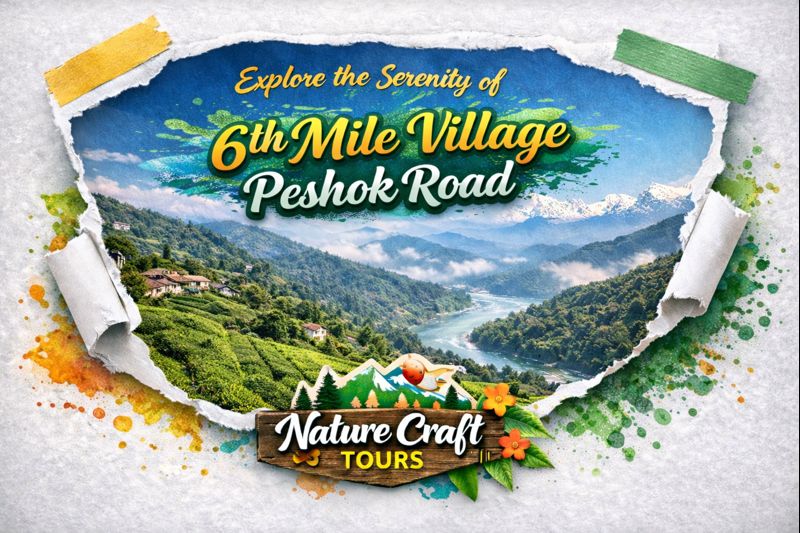
6th Mile Village, located along the scenic Peshok Road between Kalimpong and Darjeeling, represents one of the most understated yet intellectually engaging rural settlements of the Eastern Himalayas. Unlike prominent hill stations or commercial viewpoints, 6th Mile Village exists quietly within a living landscape shaped by tea gardens, forests, river valleys, and traditional hill communities. Its identity is defined not by landmarks, but by continuity—of land use, climate, and everyday life.
Positioned strategically along the Peshok Tea Belt, 6th Mile Village serves as a natural pause point where travelers encounter Darjeeling’s tea geography in its most authentic form. This comprehensive guide explores the village through geography, cultural context, important attractions, connectivity, distances, accommodation styles, and seasonal travel suitability, offering a research-based and descriptive narrative for mindful travelers.
Geographical Setting and Environmental Context
6th Mile Village derives its name from its distance marker along Peshok Road, a historic hill route connecting Kalimpong with Darjeeling. The village sits at an approximate elevation of 3,200 to 3,800 feet above sea level, overlooking the expansive Teesta Valley. Its location places it within a transitional ecological zone—between subtropical riverine forests and temperate Himalayan slopes.
The terrain around the village is gently undulating, dominated by tea estates, forest corridors, and small agricultural plots. This topography allows uninterrupted views of valleys and distant hills, while also supporting sustainable cultivation practices that have evolved over generations.
Climate and Microclimate Characteristics
The climate of 6th Mile Village remains moderate throughout the year. Summers are pleasantly cool, monsoons are humid and lush, and winters are crisp without severe snowfall. Early mornings often witness drifting mist that slowly lifts to reveal layered hills and tea gardens, creating a dynamic visual environment shaped by microclimatic shifts.
This balanced climate supports both tea cultivation and year-round habitation, reinforcing the village’s long-standing agricultural relevance.
Historical Background and Cultural Identity
The development of 6th Mile Village is closely linked to the expansion of tea estates during the colonial era. As tea plantations expanded along Peshok Road, worker settlements gradually formed at strategic intervals. Over time, these settlements evolved into stable villages supported by estate employment, subsistence farming, and inter-village trade.
Culturally, the village reflects a blend of Nepali, Lepcha, and Bengali influences. Community life revolves around agricultural cycles, local festivals, and shared labor traditions. Unlike tourist-oriented villages, cultural expressions here remain functional and community-focused rather than performative.
Daily Life in a Tea Landscape
Life in 6th Mile Village follows the rhythms of tea cultivation. Mornings often begin with estate work, while afternoons are reserved for household activities and small-scale farming. The absence of commercial tourism infrastructure has preserved a quiet pace of life, allowing travelers to observe daily routines without intrusion.
Important Places and Experiences Around 6th Mile Village
Tea Garden Walks Along Peshok Road
One of the most meaningful experiences near 6th Mile Village is walking through adjoining tea gardens. Estate roads and footpaths provide access to gently sloping plantations, where visitors can observe plucking patterns, pruning cycles, and the spatial organization of tea bushes. These walks are educational rather than curated, offering insight into the labor-intensive nature of tea production.
Teesta Valley Viewpoints
Several natural clearings near the village offer panoramic views of the Teesta River far below. The river appears as a winding ribbon through dense forests, especially dramatic during post-monsoon months when water levels rise. Sunrise and late afternoon are ideal times for observing shifting light across the valley.
Forest Corridors and Birdlife
Forest patches surrounding the village support diverse bird species and native vegetation. These corridors act as ecological buffers between tea estates, maintaining biodiversity and soil stability. Quiet walks along forest edges often reward visitors with bird sightings and immersive natural soundscapes.
Major Distances from 6th Mile Village
Despite its tranquil setting, 6th Mile Village remains well-connected to major towns in North Bengal.
- Kalimpong to 6th Mile Village: approximately 14 kilometers
- Darjeeling to 6th Mile Village: approximately 28 kilometers
- Siliguri to 6th Mile Village: approximately 65 kilometers
- New Jalpaiguri Railway Station to 6th Mile Village: approximately 70 kilometers
- Bagdogra Airport to 6th Mile Village: approximately 72 kilometers
Mountain roads and weather conditions influence travel time more than distance, making advance planning essential.
How to Reach 6th Mile Village (Peshok Road)
By Air
Bagdogra Airport is the nearest airport connecting the region with major Indian cities. From the airport, travelers proceed by road via Kalimpong or Teesta Bazaar before ascending toward Peshok Road.
By Rail
New Jalpaiguri Railway Station serves as the closest railhead. Road transport from NJP offers a gradual transition from plains to hills, with visible changes in vegetation and climate.
By Road
6th Mile Village is directly accessible via Peshok Road, which connects Kalimpong and Darjeeling. The road is scenic but narrow in places, requiring careful navigation, particularly during monsoon months.
Staying Options and Accommodation Styles
Accommodation near 6th Mile Village remains limited and community-based, aligning with the area’s low-impact travel philosophy.
Village Homestays
Homestays operated by local families are the primary lodging option. These accommodations offer clean, comfortable rooms and home-cooked meals, providing travelers with insight into local culture and daily routines.
Tea Estate Adjacent Lodges
A few small lodges and eco-stays operate near tea estates along Peshok Road. These properties emphasize location, views, and experiential value rather than luxury amenities. Hotel contact numbers are intentionally excluded to maintain ethical content presentation.
Best Time to Visit 6th Mile Village
Spring (March to April)
Spring brings mild temperatures, blooming vegetation, and clear skies. Tea gardens enter active growth phases, making this season ideal for landscape observation and photography.
Summer (May to June)
Summer remains comfortable and attracts travelers seeking respite from plains’ heat. Visibility remains good, and outdoor exploration is pleasant.
Monsoon (July to September)
Monsoon transforms the region into dense greenery. While rain may limit mobility, this season highlights the ecological vitality of the tea belt.
Autumn and Winter (October to February)
Autumn offers the clearest long-distance views, while winter introduces crisp mornings and quiet surroundings. Early winter is particularly suitable for tranquil stays.
Responsible Travel and Environmental Sensitivity
6th Mile Village exists within a working agricultural landscape. Visitors are encouraged to respect tea gardens, avoid disturbing workers, minimize waste, and engage with the community thoughtfully.
Travelers interested in understanding contrasting Indian ecosystems often complement Himalayan journeys with lowland explorations such as a Sundarban Tour, offering insight into mangrove biodiversity.
6th Mile Village in Broader Travel Circuits
The village fits naturally into slow-travel itineraries connecting Darjeeling, Kalimpong, and offbeat tea regions. Its calm environment provides a restorative counterbalance to crowded hill towns.
Well-designed journeys often integrate tea landscapes with riverine and forest ecosystems, including curated experiences under a Sundarban Travel Package, enriching regional understanding.
The Subtle Significance of 6th Mile Village
6th Mile Village does not present itself as a destination of spectacle. Instead, it offers depth—rooted in geography, labor, and lived tradition. Its value lies in observation rather than consumption, in stillness rather than display.
For travelers seeking authenticity and contextual understanding of the Darjeeling hills, 6th Mile Village stands as a quietly meaningful place—one where landscape and life remain in enduring balance.