





Sevok Forest Fringes Facing the Teesta Bridge
– Where River, Rail, and Rainforest Meet in Quiet Harmony
At the southern threshold of the Darjeeling Himalayas, where the plains of North Bengal gently rise toward forested hills, lies an evocative landscape often passed but rarely paused upon. The Sevok forest fringes facing the Teesta Bridge form a dramatic natural amphitheatre where dense sal forests, the jade-green Teesta River, colonial-era rail lines, and mist-laced hill slopes converge. This region, positioned between Siliguri and the first folds of the Eastern Himalaya, remains an understated destination—ideal for travelers seeking contemplative nature, slow exploration, and sensory richness away from overt tourist circuits.
Sevok is not merely a transit point on the way to Darjeeling, Kalimpong, or Sikkim. It is a living ecological corridor, a cultural borderland, and a visual poem shaped by water, rock, and forest. The forest fringes overlooking the Teesta Bridge offer panoramic views, biodiversity hotspots, and an atmosphere that changes with every hour of light. This article presents a detailed, research-informed exploration of this landscape—its geography, experiences, access routes, seasonal rhythms, and responsible stay options—woven with poetic sensibility and respect for its quiet dignity.
Geographical Setting and Landscape Character
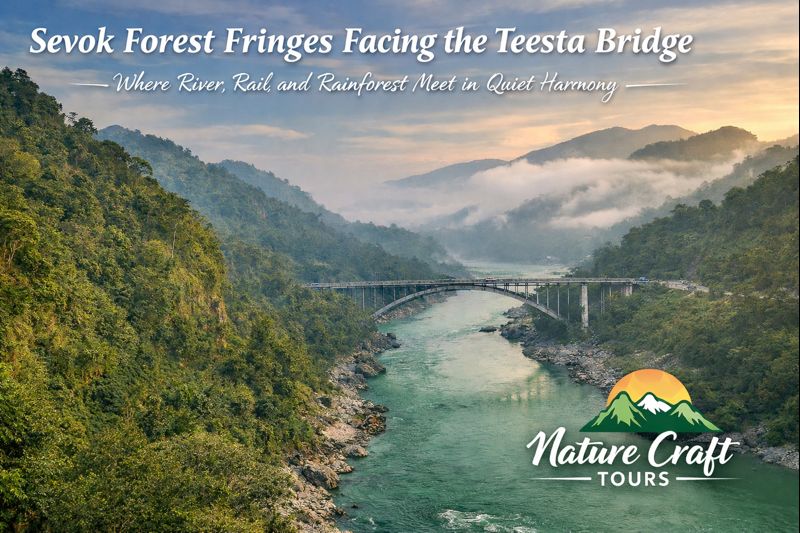
Sevok is located in the Jalpaiguri district of West Bengal, marking the strategic gateway between the Terai plains and the hill districts of Darjeeling and Kalimpong. The Teesta River, one of the most important Himalayan rivers of eastern India, flows forcefully through a narrow gorge here before spreading into the plains. The iconic Teesta Bridge—carrying both road traffic (NH-10) and the historic Darjeeling Himalayan Railway alignment nearby—cuts across this gorge, creating one of the most dramatic river crossings in North Bengal.
The forest fringes around Sevok are part of the larger Mahananda Wildlife Sanctuary–Teesta Valley ecological continuum. These forests are primarily composed of sal (Shorea robusta), mixed deciduous species, bamboo clusters, and riverine vegetation. The terrain is rugged, marked by steep slopes, rocky outcrops, seasonal streams, and thick undergrowth. Morning mist often rises from the Teesta, drifting into the forest canopy and lending the landscape a dreamlike stillness.
Ecological Importance of the Sevok Forest Belt
From an ecological perspective, the Sevok forest fringes serve as a vital buffer zone and wildlife corridor. The region supports a range of fauna including barking deer, wild boar, civets, macaques, and a notable diversity of birdlife such as hornbills, kingfishers, drongos, and migratory species during winter months. Although large mammals like elephants move primarily deeper within protected areas, occasional signs of their presence underscore the wilderness value of the region.
The Teesta River itself shapes microhabitats along its banks, sustaining fish populations, riparian bird species, and seasonal vegetation. The interplay of river ecology and forest edge makes Sevok particularly significant for nature observation, photography, and ecological study.
The Teesta Bridge Viewpoint – A Visual and Emotional Landmark
One of the defining attractions of Sevok is the vantage point from the forested slopes overlooking the Teesta Bridge. From these natural viewpoints, visitors can witness the full breadth of the Teesta as it rushes through the gorge—its color shifting from turquoise to deep green depending on season and sunlight. Trains snake across nearby tracks, vehicles move steadily across the bridge, and yet the forest remains profoundly calm.
Sunrise and late afternoon are particularly evocative times. Early light softens the river’s surface, while evenings often bring dramatic skies reflected in the water below. For photographers and quiet observers, this convergence of motion and stillness offers rare compositional depth.
Railway Heritage and Natural Drama
The railway alignment near Sevok—linked historically to the Darjeeling Himalayan Railway’s plains-to-hills transition—adds cultural texture to the landscape. Watching a train emerge from forest shadows and cross open stretches near the river evokes a sense of timeless travel, connecting colonial engineering heritage with untamed nature.
Important Places and Experiences Around Sevok Forest Fringes
While Sevok does not present conventional tourist “spots,” its value lies in experiential exploration. Some of the most meaningful engagements include:
Forest Walks and Edge Trails
Short forest-edge walks—always undertaken with local awareness and respect for wildlife—allow visitors to experience the forest’s textures: rustling leaves, bird calls, filtered light, and the scent of damp earth. These are not manicured trails but organic pathways shaped by local movement and nature itself.
River Observation and Quiet Reflection
From safe vantage points, observing the Teesta’s flow provides insight into Himalayan river systems. During monsoon, the river becomes fierce and expansive; in winter, calmer and clearer, revealing stone beds and subtle currents.
Birdwatching and Nature Photography
The forest fringes offer excellent conditions for birdwatching, particularly during early mornings. Light conditions, forest density, and river proximity combine to create rewarding opportunities for both amateur and serious nature photographers.
Cultural and Regional Context
Sevok lies at a cultural crossroads. Communities in surrounding areas reflect a blend of Nepali, Bengali, Lepcha, and tribal influences shaped by trade routes, railways, and river-based livelihoods. While Sevok itself remains sparsely settled, nearby villages and settlements retain a quiet rural rhythm deeply connected to forest and river cycles.
For travelers interested in extending their journey into nearby offbeat hill villages, destinations such as
Tinchuley provide an excellent contrast—offering elevated viewpoints, community-based tourism, and agrarian landscapes rooted in sustainability. Such connections allow Sevok to function as both a destination and a gateway.
Major Distances from Sevok
- Siliguri: approximately 25 km
- Bagdogra Airport: approximately 35 km
- Kalimpong: approximately 55 km
- Darjeeling town: approximately 70 km
- Sevoke Railway Station: within walking or short driving distance depending on forest location
These distances make Sevok an ideal short-stay destination or a contemplative stopover while traveling between the plains and the hills.
How to Reach Sevok Forest Fringes
By Air
Bagdogra Airport is the nearest airport. From Bagdogra, Sevok can be reached by road via Siliguri in approximately 1 to 1.5 hours, depending on traffic and weather conditions.
By Rail
Sevoke Railway Station lies on the New Jalpaiguri–Alipurduar line and is well connected to major stations in North Bengal. New Jalpaiguri (NJP) serves as the primary rail hub, from where Sevok is easily accessible by road.
By Road
Sevok is located directly along National Highway 10, which connects Siliguri with Kalimpong and Sikkim. The drive itself is scenic, following the Teesta River for long stretches.
Staying Options Near Sevok
Accommodation around Sevok is intentionally limited, which preserves its forest character. Staying options primarily include:
- Small nature lodges and eco-stays near the forest edge
- Riverside homestays in nearby settlements
- Forest-adjacent guesthouses along the NH-10 corridor
These properties emphasize simplicity, natural surroundings, and local hospitality rather than luxury. For travelers seeking more developed yet still serene environments, extending the stay toward
offbeat Darjeeling villages offers additional accommodation choices rooted in community tourism.
Best Time to Visit Sevok Forest Fringes
The ideal time to visit Sevok is between October and April. During these months, weather conditions remain stable, skies are clearer, and forest access is safer. Winter months (December to February) offer crisp mornings and excellent visibility, particularly for river and forest views.
The monsoon season (June to September) transforms the landscape into lush vibrancy, but heavy rainfall, landslide risks, and swollen river conditions require caution and are better suited to experienced travelers with flexible plans.
Responsible Travel and Environmental Awareness
Sevok’s beauty lies in its restraint. Visitors are encouraged to practice low-impact travel—avoiding noise pollution, littering, and off-trail intrusion. The forest fringes are sensitive ecological zones, and respectful engagement ensures their preservation for future generations.
For travelers combining forest destinations with deltaic ecosystems, responsible tourism principles practiced in regions like the Sundarbans offer valuable lessons. Curated experiences such as a Sundarban Tour or Sundarban Travel itinerary demonstrate how nature-focused tourism can coexist with conservation when approached thoughtfully.
Sevok Forest and the Teesta
Where the Teesta bends beneath a bridge of iron and time,
The forest leans closer, listening to the river’s rhyme.
Mist rises softly from emerald flow and stone,
Carrying the breath of hills the plains have never known.
Rails hum briefly, then vanish into green,
Leaving silence stitched with birdsong in between.
Here, the forest does not speak—it waits,
For those who slow their steps at unseen gates.
In Sevok’s hush, the journey learns to stay,
And the river teaches the heart how to flow, not stray.
Sevok as a Threshold of Stillness
The Sevok forest fringes facing the Teesta Bridge represent more than a scenic location; they embody a threshold—between plains and hills, motion and stillness, known routes and unexplored pauses. For travelers attuned to subtle beauty, ecological depth, and reflective travel, Sevok offers a rare invitation: to stand quietly at the edge of forest and river, and to listen.
In an age of hurried itineraries, Sevok reminds us that some destinations are not meant to be consumed, but contemplated—slowly, respectfully, and with enduring reverence.